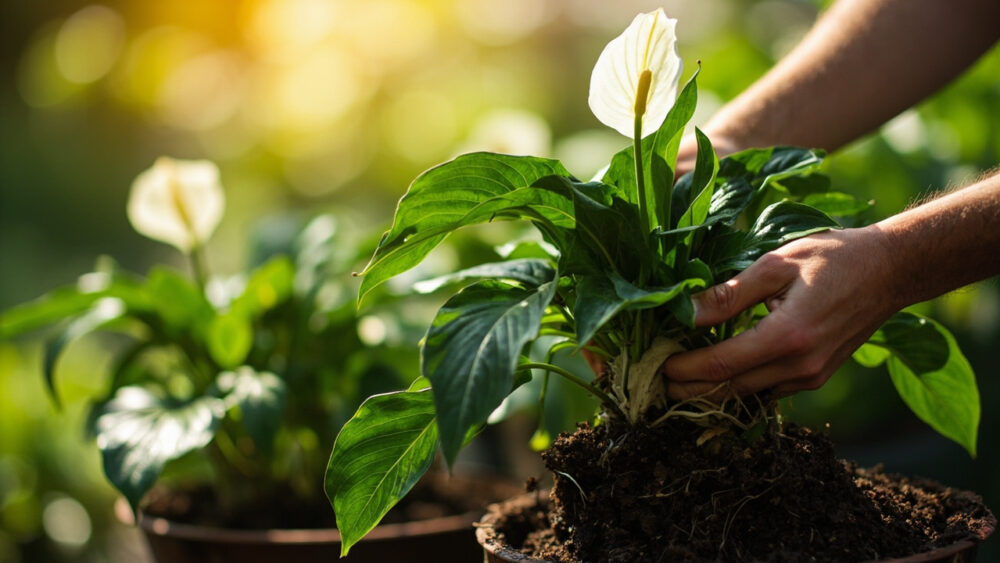
The method that actually works is division, not stem cuttings, because a peace lily does not grow on a stem at all. It grows as a clump of individual crowns packed together at the soil line, each one already carrying its own roots. Pull the plant out of its pot, split the clump into sections by hand, and pot each section separately, and that is how to propagate peace lily with something close to a guaranteed result.
Most failed attempts trace back to one of two mistakes: someone tries to root a cut leaf in water like a pothos, or someone slices through a crown with a knife thinking it is a stem to be cut. Neither works the way people expect, and I will tell you exactly why in a minute.
There is also a timing detail almost everyone misses, a sign that tells you a section is ready to be its own plant before it ever shows a new leaf. Stick around and I will get you there, plus a save-able Peace Lily at a Glance card at the very bottom with the numbers worth keeping on your phone.
Why Division Beats Every Other Method
Peace lily has no true stem to cut and root. What looks like a stem is just tightly overlapping leaf bases rising from a rhizome-like crown at soil level. Cut a leaf off and put it in water, and it will sit there looking fine for weeks while doing absolutely nothing, because a leaf with no growing point attached cannot generate roots. It is not slow, it is just dead-ended.
A mature peace lily is actually a colony. Knock it out of the pot and you will usually find anywhere from three to a dozen distinct crowns, each with its own fan of leaves and its own root mass, all crowded together. Every one of those crowns is a complete plant waiting to be separated.
That is the whole trick. You are not creating a new plant from a piece of an old one, you are just giving an existing plant room to stop sharing.
Step by Step: Dividing a Peace Lily
Taking the Division
Water the plant a day ahead so the root ball is moist and pliable, not bone dry and brittle. Slide the whole plant out of its pot and gently knock or rinse off enough soil to see where the crowns separate. You are looking for natural fault lines, spots where you can see two crowns are only loosely tangled rather than fused.
Work your fingers into those fault lines and pull gently, teasing roots apart rather than tearing blindly. If a crown will not separate by hand, use a clean knife to cut through the connecting tissue right at that junction, not through the middle of a healthy crown.
Every division needs at least a few roots and two or three leaves attached to survive on its own.
Rooting Medium and Conditions
Since each division already has roots, there is no rooting medium to fuss over, just a normal potting mix. A standard peat-free or peat-based houseplant mix with some perlite for drainage works fine. Pot each division into a container only slightly larger than its root mass, water it in well, and set it somewhere with bright, indirect light and no direct sun on the leaves.
Keep the soil evenly moist, not soggy, for the first two to three weeks while roots settle in.
Next comes the part nobody tells you: what a struggling division actually looks like versus a thriving one.
Week by Week: What to Actually Expect
If you assumed a freshly divided peace lily should look perky right away, that guess is wrong more often than not. Expect drooping and even some yellowing on one or two leaves in the first three to five days. That is transplant shock from root disturbance, not a sign the division failed.
By week two, the drooping should stop and leaves should hold themselves upright again, at least during the cooler parts of the day.
Week three to four is when you look for the real sign of success: a new leaf shoot, pale and tightly rolled, emerging from the center of the crown. That is proof the division has resumed active growth on its own roots.
If you see a new shoot by week four, you are past the risky part and this division is going to make it.
Potting Up and Moving Outside
Once a division fills its starter pot with roots, which usually takes two to four months, move it up one pot size, not several sizes at once. An oversized pot holds excess moisture around roots that are not yet big enough to use it, and that is a fast route to root rot.
Peace lilies can spend summer outdoors in shade once nights stay reliably above 50°F, but they are not frost tolerant at all and need to come back inside well before the first fall frost. If you are planting divisions into a shaded garden bed in a warm climate, USDA zones 10 through 12 for outdoor culture, space them 12 to 18 inches apart to give each crown room to bulk up.
Most growers, though, keep every division as a houseplant, which sidesteps the frost question completely.
Why Attempts Fail, and the Honest Fix
Beyond cutting leaves for water propagation, the second most common failure is dividing a crown that was too small to begin with. A crown with only one or two thin leaves and barely any roots often does not have enough stored energy to recover from separation. It sulks for months and sometimes just dies quietly.
The fix is patience: only divide crowns that already have three or more leaves and a visible tangle of their own roots.
The other frequent failure is overwatering a fresh division out of guilt for how droopy it looks. Wilting after division reads as thirst, so people water more, and constantly wet soil on a stressed, damaged root system leads straight to rot.
Water only when the top inch of soil is dry to the touch, and let the plant’s own new growth, not its drooping, tell you whether it is recovering.
Peace Lily at a Glance
- Best method: division of existing crowns, not stem or leaf cuttings, since peace lily has no true stem to root.
- Best timing: spring through early summer, when the plant is actively growing and recovers from disturbance fastest.
- What to look for: crowns with three or more leaves and their own visible root mass before separating.
- Potting mix: a standard houseplant mix with perlite for drainage, no special rooting medium needed.
- Light and water: bright, indirect light, soil kept evenly moist but never soggy, water only when the top inch is dry.
- First sign of success: a new pale, rolled leaf shoot from the crown center, typically three to four weeks after dividing.
- Outdoor limits: not frost tolerant, safe outside only in USDA zones 10 to 12 or once nights stay above 50°F.
Peace lily propagation succeeds or fails on one decision: dividing an already-rooted crown instead of trying to invent roots from a leaf. Get that one choice right, keep the soil on the dry side of moist, and the rest takes care of itself.