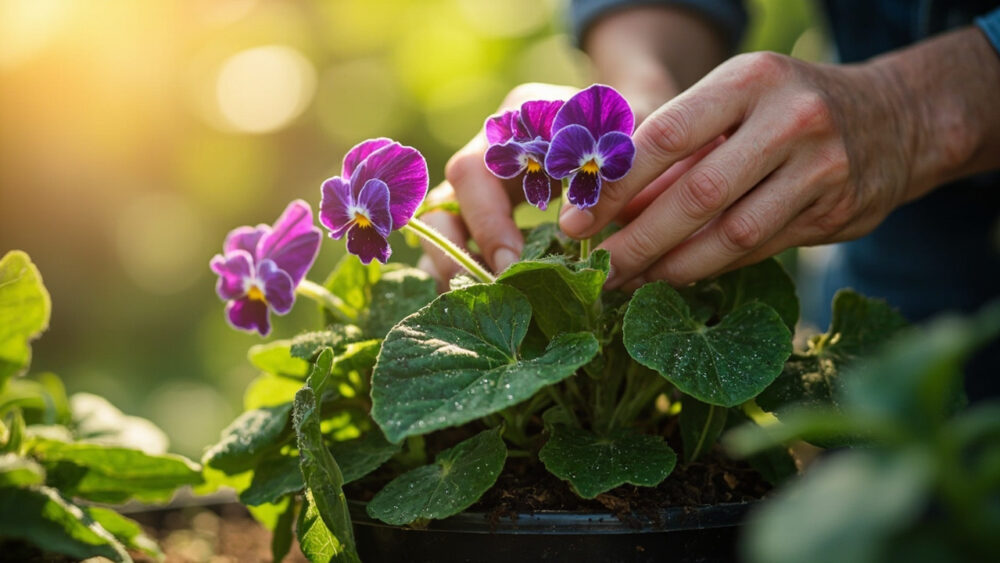
African violet care comes down to four things the plant is picky about: bright indirect light, water that never touches its leaves, a pot it’s slightly too big for, and soil that drains fast but stays barely moist. Get those four right and an African violet will bloom nearly year round, often with a rest of a few weeks here and there. Get one wrong and you get a plant that sits there green and sulking, refusing to flower for months.
Most people who fail with these plants make the same watering mistake, and it is not the one you think. There is also a very specific sign of a happy violet that almost nobody notices until it is pointed out.
Stick with me through the light, the water, the feeding, and the repotting, because the honest, save-able African Violet at a Glance card is waiting at the very bottom, and it is worth screenshotting before you set the plant back down.
Light, Placement, and Temperature
African violets want bright, indirect light, roughly what you get a few feet back from an east or north window, or right at a sheer curtain in a west or south window. Direct sun scorches the fuzzy leaves within a day, leaving pale or brown patches that never heal.
Too little light produces long, stretched leaf stalks reaching for the glass and few or no flowers. If yours has gone months without a bloom, light is the first suspect, not fertilizer.
They like the same temperatures you do, about 65 to 75 F, and hate cold drafts from a winter windowsill or a blast of AC. Keep them off cold glass in winter.
Get the light wrong, though, and even perfect watering won’t save the blooms, which is where most people quietly go astray next.
Watering: The Mistake That Actually Ruins Most Violets
Here’s the part almost everyone gets backward. You’d assume the danger is underwatering, since the leaves look thirsty and soft, but overwatering and wet crowns kill far more African violets than drought ever does.
Water gets the plant’s fuzzy leaves and center crown, sits there, and rots the plant from the inside before you ever see wilting.
The fix is simple: water from the bottom or water carefully at the soil line, never overhead. Let the pot sit in an inch of room-temperature water for 10 to 15 minutes, then dump the runoff. Never let the pot sit in standing water afterward.
Check the top inch of soil with a finger before every watering. If it feels dry, water; if it’s still cool and slightly damp, wait another day or two.
Once the water routine is right, what you feed the plant decides whether it just survives or actually flowers.
Soil and Feeding
Use a dedicated African violet potting mix, or a standard peat-based mix cut with extra perlite so it drains fast and never turns dense and soggy. Regular garden soil or a heavy houseplant mix will suffocate the roots.
Feed with a fertilizer labeled for African violets, following the product’s label rate, generally every second or third watering during active growth. Cut back to once a month or so in the darker winter months when growth slows.
Too much fertilizer shows up as a crust on the soil surface and leaf edges that curl or brown, so when in doubt, feed less rather than more.
Feeding solves half the bloom equation, but the other half is routine upkeep most owners skip entirely.
Pruning, Repotting, and Cleaning: The Tasks Everyone Forgets
Pinch off spent flower stalks and any yellowing or damaged leaves at the base as you see them, using clean fingers or small scissors. This isn’t cosmetic, it redirects energy straight back into new blooms.
Repot once a year, even if the plant looks fine, since the soil breaks down and stops draining well over time. African violets actually prefer being slightly root-bound, so size up only one pot size at a time, never more.
Dust builds up on those fuzzy leaves and blocks light more than people expect. Wipe them gently with a soft, dry brush or soft cloth rather than water, which beads and sits on the fuzz.
Skip these small jobs for a season and the plant doesn’t die, it just quietly stops blooming, which brings us to the problems that actually do threaten it.
The Problems Most Likely to Show Up
Crown or root rot is the big one, caused by that overhead watering habit or a pot with no drainage hole. Once the crown turns soft and dark, there’s usually no saving that plant, so prevention is everything here.
Powdery mildew shows up as a white, dusty coating on leaves, usually from poor air circulation or cool, damp conditions. Improve airflow first, and if it persists, a fungicide labeled for powdery mildew on houseplants works, applied exactly per the label.
Mealybugs and cyclamen mites are the pests to watch for, small pests hiding in leaf crevices and the crown, causing stunted or twisted new growth. Isolate the plant and treat with an insecticidal soap or neem product labeled for houseplants, following the label’s rate and reapplication schedule.
Cold water on the leaves causes yellow or brown ring spots that look disease-like but are actually just cosmetic leaf damage from the temperature shock, not rot.
Rule those out and you’re left asking the real question: how do you know the plant is actually doing well?
The Real Sign of a Thriving African Violet
Most people watch for flowers as the only sign of health, but blooms lag behind what’s actually happening at the plant’s center. The real tell is the crown, the tight rosette of new leaves in the middle.
A thriving plant pushes out small, tightly curled new leaves from that center constantly, even between bloom cycles. If that center looks active and dense, flowers are coming whether you see buds yet or not.
A stalled or thinning crown, by contrast, means something upstream is wrong, usually light or watering, even if the plant still looks green from a distance.
Once you know to check the crown instead of just counting flowers, everything else on this list finally makes sense together.
African Violet at a Glance
- Light: bright, indirect light, a few feet from an east or north window or behind a sheer curtain in a brighter window, never direct sun.
- Watering: bottom-water or water at the soil line only, when the top inch of soil feels dry, never on the leaves or crown.
- Temperature: 65 to 75 F, away from cold glass, drafts, and AC vents.
- Soil: a fast-draining African violet mix or a peat-based mix boosted with extra perlite.
- Feeding: African violet fertilizer at label rate every second or third watering in active growth, monthly in winter.
- Repotting: once a year, sizing up only one pot size, since these plants bloom best slightly root-bound.
- Health check: watch the center crown for tight, active new leaves, that’s the real sign of a plant about to bloom.
Get the light and the watering right and almost everything else on this list becomes easy maintenance. Everything that kills African violets traces back to water touching the wrong part of the plant.