The moment to pick bush beans is when the pods are firm, fully sized for their variety (usually 4 to 6 inches for snap types), and snap cleanly when bent, but before the seeds inside bulge and the pod turns leathery. For most bush varieties that window opens about 50 to 65 days after planting and stays open for roughly two to three weeks if you keep picking. Miss it and the plant does not just give you tougher beans, it quietly shuts down production for the whole season.
That last part is the one nobody warns you about. Most people assume a few overgrown pods left on the vine are no big deal, just less-than-perfect eating. That guess is what kills the harvest. A bean plant that’s allowed to mature seed inside a few old pods reads that as “job done” and stops setting new flowers.
There’s also a sign everyone misreads on the pod itself, and a right way to actually pull the beans off without tearing next week’s flowers loose with them. Stick around, because the save-able Bush Beans at a Glance card is waiting at the bottom with every number in one place.
The Visual and Feel Signs That Say “Pick Me Now”
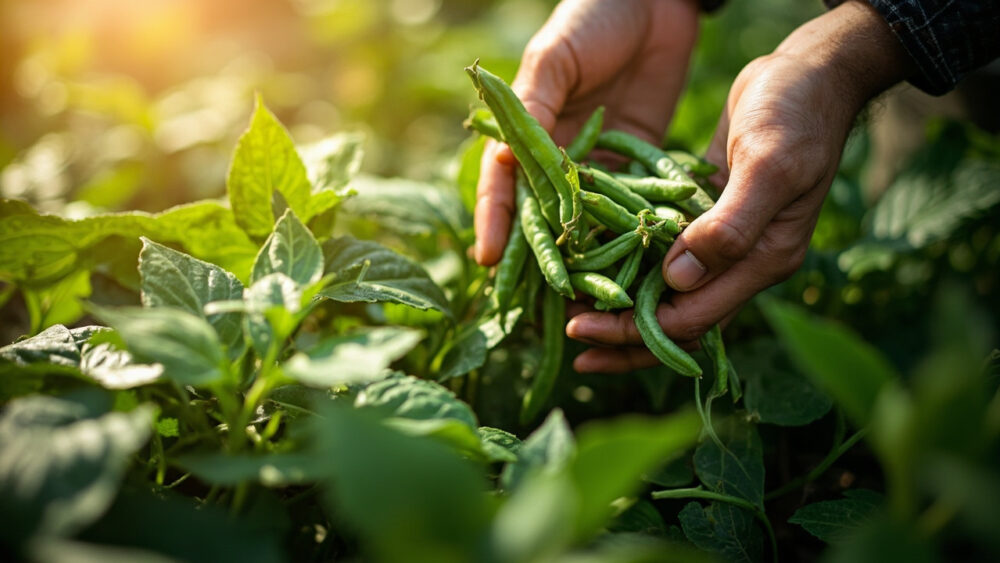
Look at the pod’s shape first. A ready snap bean is slender and rounded, not flat, and you should not be able to see the bumps of individual seeds pushing through the skin. If you can see or feel those bumps, it’s already past its best.
The snap test
Bend a pod in half. It should break with a clean, crisp snap and a little audible pop, with no strings and no bend-without-breaking. A pod that folds like a rubber hose instead of snapping is either too young or, more often, too old and starting to toughen.
The color tell
Green varieties should be a bright, glossy green with no dulling or yellowing. Purple and yellow (wax) varieties should be uniformly colored with no green blush at the tip, which usually means a few more days needed.
Once you know what ready looks like, the harder question is how long that window actually lasts.
The Timing Window, and What Early or Late Really Costs You
Bush beans mature fast and mature together, which is exactly why the window is tight. Most varieties hit first harvest 50 to 65 days from seeding, and once they start, a healthy plant will keep producing pickable pods for two to three weeks before slowing down.
Pick too early and you lose very little, just smaller beans and a lighter first picking. That’s the safe mistake.
Pick too late and the cost is real. Overgrown pods turn fibrous, the seeds inside swell and take over the flavor, and worse, as mentioned above, a plant carrying mature pods slows or stops setting new flowers. Leave several pods to yellow and dry on the vine and you’ve told the plant its work is done for the year.
This is also where the misread sign comes back around: a pod that looks huge and healthy is often the exact one quietly ending your harvest.
So the fix is simple in theory and requires actual discipline in practice, pick on a schedule, not by mood.
How Often You Actually Need to Check the Plants
Check bush beans every 1 to 2 days once flowering starts, especially in warm weather when pods can go from perfect to overgrown in 48 hours. This is the step almost everyone gets wrong, not because it’s hard, but because it feels excessive.
It isn’t. A quick daily or every-other-day pass takes two minutes for a typical row and is the single biggest lever you have over total yield.
Skip a few days during peak production and you’ll come back to a plant that’s converted its energy into seed-filling instead of flowering.
Now let’s get into actually pulling the pods without wrecking tomorrow’s flowers.
How to Harvest Without Damaging the Plant
Bush bean stems are brittle, and yanking pods off is how you snap branches or uproot shallow-rooted plants entirely. Use two hands.
- Hold the stem just above the pod steady with one hand.
- Pinch or snap the pod off at its own short stem with the other hand, pulling toward you rather than down.
- If a pod resists, use scissors or garden snips instead of forcing it.
- Work the whole plant systematically, checking under leaves, since bush beans hide pods low and close to the stem.
Pick in the morning after dew has dried but before the day heats up. Pods are crisper then and the plant handles the disturbance better than in afternoon heat.
Once the pods are off the plant, what you do in the next hour matters almost as much as the picking itself.
What to Do With Them Right After Picking
Get harvested beans out of the sun immediately. They lose sugar and crispness fast at warm temperatures, sometimes within a couple of hours sitting in a garden basket in full sun.
Rinse them briefly, pat dry, and refrigerate unwashed if you’re not eating them same-day, ideally in a perforated bag in the crisper drawer. Fresh snap beans hold their quality for about 4 to 7 days refrigerated, less if they were picked slightly late.
Don’t wash and then store wet. Trapped moisture speeds up rot far faster than the beans would spoil on their own.
If you’re drowning in beans faster than you can eat them fresh, there’s a way to keep the plant productive instead of overwhelmed.
Keeping the Harvest Coming Instead of Petering Out
The number one trick to extending bush bean production is simply never letting a pod go overripe on the plant. Every pod you remove at peak ripeness signals the plant to keep flowering; every pod you leave to mature signals it to wind down.
Beyond that, keep the soil evenly moist, about 1 inch of water a week, since drought stress during flowering causes blossom drop and fewer pods overall.
Bush beans are determinate-ish, meaning they don’t produce indefinitely like pole beans. Expect a strong 3 to 4 week production run, then a natural decline.
If you want beans later into the season, succession planting beats trying to force an old plant to keep going.
Succession planting for a longer season
Sow a new round of bush beans every 2 to 3 weeks through early-to-mid summer, stopping when your remaining frost-free days drop below about 60. That staggers fresh harvest windows instead of one glut followed by nothing.
With picking timing and plant care sorted, here’s everything worth saving in one place.
Bush Beans at a Glance
- When to plant: after your last spring frost once soil hits at least 60°F, beans are frost-tender and rot in cold, wet soil.
- Days to first harvest: roughly 50 to 65 days from seeding, depending on variety.
- Spacing and depth: seeds 1 inch deep, 3 to 4 inches apart, rows 18 to 24 inches apart.
- Ready signs: firm, glossy, fully colored pods that snap cleanly with no visible seed bumps.
- Check frequency: every 1 to 2 days once flowering and pods begin, especially in warm weather.
- How to pick: steady the stem, snap or snip the pod at its own short stem, don’t pull straight down on the plant.
- Storage: unwashed, refrigerated in a perforated bag, good for about 4 to 7 days.
Pick on a schedule, not by eye alone, and never let a pod mature past ready.
That single habit is what separates a two-week trickle of beans from a full month of steady picking.