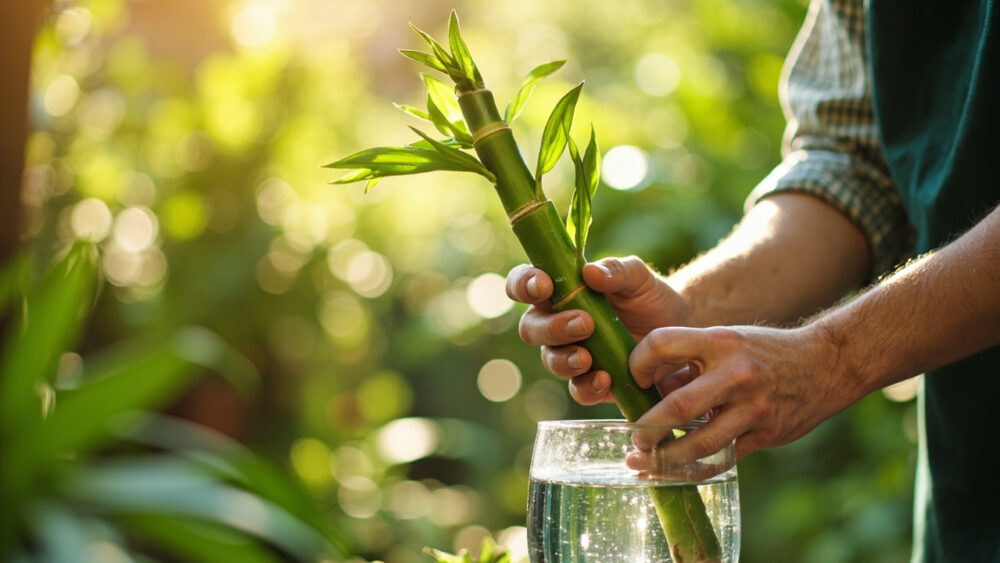
To propagate lucky bamboo, cut a healthy stalk section just below a node, let the cut end dry for about an hour, then stand it in an inch or two of clean water in low to medium light. Roots show up in two to six weeks. That is the whole trick, but the details decide whether you get thick white roots or a mushy stalk that never makes it.
Here is what trips people up before they even get started. Most failed attempts do not fail from bad luck or bad light, they fail from cutting in the wrong spot or leaving the stalk in stagnant water too long. There is also a sign everyone misreads as rot when it is actually normal, and a totally reasonable follow-up question, can you just plant a cutting straight into soil, with an honest answer you will not love.
Stick with me and you will get the exact cut, the right water routine, a week by week timeline of what roots should look like, and the mistakes that cost people a whole stalk. Save the “Lucky Bamboo at a Glance” card at the bottom for your phone, it has every number in one place.
Why Water Rooting Beats Every Other Method
Lucky bamboo, which is actually a Dracaena and not a true bamboo at all, roots almost exclusively from stem sections in water. It does not need rooting hormone, soil, or a greenhouse setup.
The plant is built for this. Each stalk has visible nodes, the slightly raised rings you can see and feel, and roots emerge from the node closest to the cut end sitting in water.
Soil propagation technically works but roots slower and rots faster, since soil holds more moisture around a fresh cut than it can dry out between waterings. Water lets you watch progress and catch problems early.
That visibility is exactly what makes the next part, the actual cut, so forgiving if you get it right.
Step by Step: Taking and Rooting the Cutting
Choosing and Making the Cut
Pick a healthy stalk with at least two or three nodes and green, unblemished growth. Avoid any section with soft brown spots or a sour smell, that stalk is already failing and won’t root.
Using a clean, sharp knife or pruning snips, cut straight across just below a node, angling isn’t necessary. A section 4 to 6 inches long with one or two nodes gives you the best odds.
Let the cut end air dry for 30 to 60 minutes before it touches water. This lets the wound callus slightly, which cuts down on rot risk more than people expect from such a small step.
Rooting Medium and Water
Use filtered or distilled water if your tap water is heavily chlorinated or softened; straight tap water is fine in most areas. Fill a clean glass or vase so the bottom 1 to 2 inches of the stalk, including at least one node, sits submerged.
Change the water every 5 to 7 days, or sooner if it turns cloudy. Stale water is the single biggest silent killer here, since it starves the cut end of oxygen and invites bacteria.
Light and Temperature
Bright, indirect light works best. Direct sun through a window will scorch the leaves and can overheat the water enough to cook the cut end.
Keep the room between 65 and 80°F. Below 60°F, rooting slows to a crawl or stalls out completely.
Get the cut and the water right and the timeline that follows is almost boring in its predictability.
The Timeline: What to Expect Week by Week
Week 1: nothing visible happens, and this is where people panic and start second-guessing the cut. Resist the urge to yank the stalk out to check, you’ll just damage the wound that’s trying to heal.
Weeks 2 to 3: small white or cream-colored bumps appear at the node underwater. These bumps are not rot, even though the color and texture make plenty of people assume the worst and toss a perfectly good cutting.
Weeks 4 to 6: those bumps elongate into visible roots, usually white to pale yellow, sometimes an inch or more long by week six. A few thin roots is normal, a thick tangled mass is a bonus, not a requirement.
If you see nothing at all by week six, check the cut end for softness or a bad smell, that stalk has likely failed and it’s worth starting a new cutting rather than waiting longer.
Once roots hit an inch or two, you’re at the decision point everyone eventually asks about: water forever, or into soil.
When and How to Pot Up (or Just Leave It in Water)
Here’s the honest answer to the soil question: lucky bamboo does not need soil, ever. Plenty of healthy plants live their whole lives in water with a layer of decorative pebbles for support.
If you do want to pot it up, wait until roots are at least 1 to 2 inches long, usually around week five or six. Use a well-draining houseplant mix, a pot with drainage holes, and bury just the root zone, keeping the stalk itself above the soil line.
Water thoroughly at first, then let the top inch of soil dry between waterings once it’s settled in, roughly every 7 to 10 days depending on your humidity and pot size. Transitioning from water to soil is a real shock to the roots, so expect a week or two of slower growth or even a couple of yellowing lower leaves while it adjusts, that’s normal, not failure.
Whichever way you go, most of what actually kills these cuttings happens for the same handful of avoidable reasons.
Why Attempts Fail, and the Fixes
- Stagnant water: the top cause of failure by far, fix it with a strict 5 to 7 day change schedule.
- Cutting too short or nodeless: a section with no node submerged simply cannot root, always include at least one.
- Direct sun exposure: scorches leaves and overheats water, move to bright indirect light instead.
- Skipping the dry-callus step: a fresh wet cut going straight into water rots more often than one given 30 to 60 minutes to dry first.
- Chlorine or fluoride sensitivity: shows up as browning leaf tips, switch to filtered or distilled water if you see this.
Fix those five things and you’ve eliminated almost every reason a cutting fails before it even gets a chance to root.
Lucky Bamboo at a Glance
- Best method: stem cuttings rooted in water, no soil or rooting hormone needed.
- Cutting size: 4 to 6 inches long, with one to two nodes included.
- Water depth: 1 to 2 inches, enough to submerge the lowest node.
- Water change schedule: every 5 to 7 days, or immediately if cloudy.
- Light and temperature: bright, indirect light, 65 to 80°F.
- Rooting timeline: visible root bumps by weeks 2 to 3, usable roots by weeks 4 to 6.
- Potting up: optional, only once roots reach 1 to 2 inches long, using well-draining soil and a pot with drainage.
Get the cut, the water schedule, and the light right, and lucky bamboo roots about as reliably as any houseplant can.
Everything else is just patience while it does its quiet, underwater work.