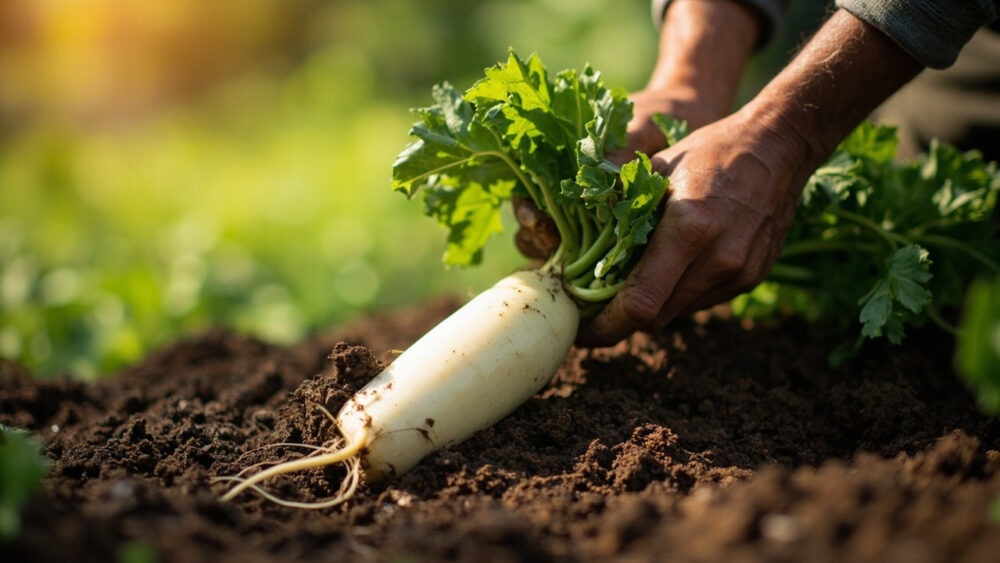
Growing daikon radish means sowing seed directly in loose, deep soil about 6 to 8 weeks before your first fall frost, or as soon as soil is workable in early spring, and giving each root 4 to 6 inches of space to swell to a foot or more underground. Get the timing and the soil depth right and daikon is one of the easiest roots you’ll grow. Get either one wrong and you’ll pull up a forked, stubby, bitter mess that goes straight to the compost pile.
Most people who fail with daikon make the same mistake, and it has nothing to do with watering or fertilizer. It’s about what’s sitting underneath the soil surface before the seed ever goes in.
There’s also a sign gardeners misread constantly: a daikon leaf canopy that looks lush and happy can be sitting on top of a root that’s already cracked, hollow, or gone to seed. And once you know how big these things actually get, the follow-up question everyone asks next is obvious: how do you harvest a two-foot root without snapping it in half. Stick around, because the answer to that, plus the full save-able Daikon Radish at a Glance card, is waiting at the bottom of this guide.
When to Plant Daikon Radish
Daikon is a cool-season crop, and fall is the better season for most gardeners, even though spring planting works too. For a fall crop, count back 60 to 70 days from your average first frost and sow then, usually mid to late summer depending on your zone. For spring, sow as soon as soil hits about 45 to 50 F and can be worked, typically 2 to 4 weeks before your last frost.
Here’s the part that trips people up: daikon bolts fast in rising heat and long daylight. A spring crop that hits a warm stretch before it’s mature will send up a flower stalk and turn woody and hot-tasting almost overnight. Fall-planted daikon avoids that problem entirely, because the days are shortening and cooling as the root matures, which is why most experienced growers treat daikon as an autumn crop first and a spring experiment second.
Zone 3 to 6 gardeners should lean hard into a fall planting window; zone 7 and warmer can often get a decent spring crop in before heat arrives.
Timing gets the seed started right, but the soil underneath decides whether that root ever forms a straight line.
Choosing the Spot and Prepping the Soil
This is the mistake that ruins most attempts, and it’s not fertility, it’s depth and rocks. Daikon roots can run 12 to 18 inches straight down, and some varieties push past 2 feet. Plant into shallow, compacted, or rocky soil and the root has nowhere to go but sideways, forking into two or three legs or stopping short and swelling into a stubby club.
Pick full sunat least 6 hours a day, in a bed you can loosen 15 to 18 inches deep. Double-dig it or run a broadfork through it if your soil is heavy clay. Pull out rocks and clumps of un-decomposed debris as you go; anything bigger than a golf ball in the root zone will deflect growth.
Work in an inch or two of compost, but skip fresh manure or heavy nitrogen fertilizer at planting. Rich, loose, deeply worked soil with moderate fertility grows the straightest roots. Soil that’s too hot with nitrogen pushes leafy top growth at the root’s expense.
Once the bed is loose and clean underneath, the actual planting takes five minutes.
Planting Daikon Radish Step by Step
1. Sow seed directly, don’t transplant
Daikon has a long taproot from the start and resents root disturbance. Direct-sow every time. Transplanted seedlings almost always fork or stall.
2. Depth and spacing
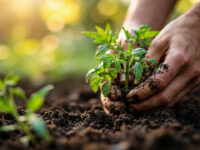
Sow seeds 1/2 to 1 inch deep. Space seeds 2 to 3 inches apart in rows 12 to 18 inches apart, planning to thin later.
3. Thin early and thin hard
Once seedlings show their second true leaf, thin to one plant every 4 to 6 inches. This is the step most people skip or do too timidly, and crowded daikon simply cannot bulk up. Roots will stay thin and tangle with their neighbors underground.
4. Water in well
Give the bed a slow, deep soak right after sowing and keep the top inch of soil consistently damp until germination, usually 4 to 7 days.
Once seedlings are up and thinned, the job shifts from planting to keeping growth steady.
Watering and Feeding Through the Season
Daikon wants consistent moisturenot soaked, not dry. Aim for about 1 to 1.5 inches of water a week between rain and irrigation. Uneven watering, a dry spell followed by a flood, is what causes roots to split lengthwise, and a split root is one you can’t fix, only eat sooner than planned.
Check the soil an inch down with a finger. If it’s dry at that depth, water. Mulch with a couple inches of straw or shredded leaves to even out moisture swings and keep the soil cool, which also helps delay bolting.
Feeding needs are light. A single side-dress of balanced fertilizer or an inch of compost worked in at 3 to 4 weeks is usually plenty. Skip repeated heavy nitrogen feeding. It grows leaves at the root’s expense, the same problem as over-rich soil at planting.
Even with good watering, daikon still draws its share of trouble from the yard.
Problems That Actually Strike Daikon
Flea beetles are the most common early problem, leaving small shotgun-hole punctures in young leaves. Seedlings can handle light damage. Heavy infestations on very young plants can stall growth. Floating row cover laid down at sowing is the most reliable fix, since it blocks the beetles without any spray at all.
Root maggots are the more serious threat, tunneling into the root itself and ruining it for eating. Crop rotation away from other brassicas for at least 2 years, plus row cover early in the season, is your best defense. Once maggots are in the root there’s no rescuing it.
Forked or split roots, as covered above, trace back to rocky soil or uneven watering rather than pests. If you see mature leaves suddenly bolt upward into a flower stalk, that’s heat and daylight stress, not disease, and it means the root below is turning woody fast.
If you do need a pesticide for a heavy flea beetle or aphid problem, choose one labeled for vegetable gardens and follow the label rate exactly.
Assuming your daikon dodges all of that, the real question becomes knowing exactly when to pull it.
When and How to Harvest Daikon Radish
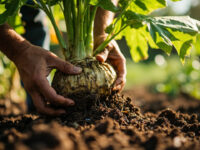
Most daikon varieties mature in 50 to 70 days from seed, though some Asian winter types run longer. The visual cue: the shoulders of the root, the top inch or so, push up and show at the soil surface, usually 1.5 to 3 inches across depending on variety. That’s your sign it’s sized up and ready.
Don’t judge readiness by the leaves. A daikon can look leafy and vigorous on top while the root below is already cracked or starting to bolt, which is exactly the sign most people misread. Pull one test root at the earliest expected date and check it before assuming the whole row is fine.
To harvest without snapping a root that may run a foot or more underground, don’t yank straight up by the leaves. Loosen the soil alongside the root first with a garden fork or trowel, working a few inches out from the shoulders, then grasp low at the base of the leaves and pull with steady, even pressure.
Daikon left too long past maturity turns pithy, hollow, and hot-tasting, and in warm weather it will bolt to flower instead of holding in the ground. Cool fall soil is forgiving and lets you leave roots in place for a few extra weeks. Spring-grown daikon does not give you that grace period.
That’s the whole arc from seed to harvest, and here’s the version you can save and check without scrolling back through all of it.
Daikon Radish at a Glance
- When to plant: mid to late summer for fall harvest, 60 to 70 days before first frost, or early spring 2 to 4 weeks before last frost once soil hits 45 to 50 F.
- Best season: fall planting is more reliable, since spring crops risk bolting in rising heat and daylight.
- Soil needs: loose, rock-free soil worked 15 to 18 inches deep, moderate fertility, no fresh manure or heavy nitrogen at planting.
- Planting depth and spacing: sow 1/2 to 1 inch deep, thin to one plant every 4 to 6 inches, rows 12 to 18 inches apart.
- Watering: steady 1 to 1.5 inches a week, mulch to prevent the dry-then-flood swings that split roots.
- Watch for: flea beetles on seedlings, root maggots in the soil, and roots that bolt or crack from heat or uneven watering.
- Harvest: 50 to 70 days from seed, when shoulders push up at the soil surface, loosen soil beside the root before pulling.
If you remember one thing, remember this: daikon’s whole future is decided by what’s under the soil before you ever drop a seed.
Loosen it deep, keep it watered evenly, and the harvest takes care of itself.