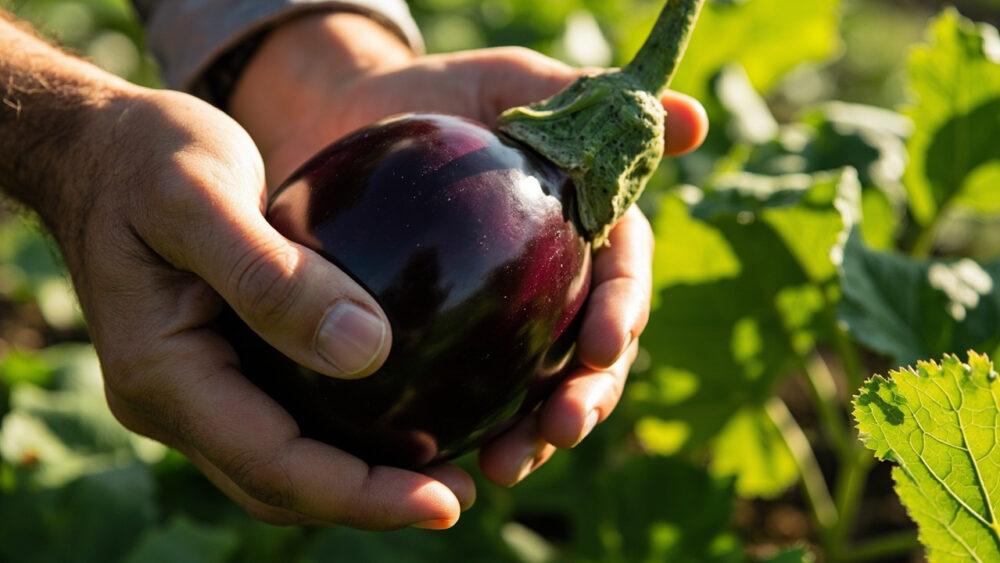
The answer to when to harvest eggplant is skin, not size. A ready eggplant has skin that’s glossy and springs back when you press it gently with your thumb, usually 2 to 3 inches in diameter for smaller types and 5 to 6 inches long for the standard Italian globe types, somewhere around 65 to 80 days after transplanting. If the skin has gone dull or the flesh stays dented after you press it, you waited too long.
Most people ruin their first eggplant harvest the same way: they let the fruit get big because big looks impressive. Bigger is not better here, it’s a sign you’re already late.
There’s also a stem trick almost nobody uses, a truth about how many fruits your plant can actually ripen at once, and a very specific way to cut an eggplant off the plant that keeps it producing instead of sulking for two weeks. All of that is coming, and there’s a save-able Eggplant at a Glance card waiting at the bottom for the exact numbers.
The Real Ready Signs
Forget the calendar for a second. Eggplant tells you it’s ready through touch and shine, not through a date on a seed packet.
The Thumbprint Test
Press the side of the fruit gently with your thumb. If the skin springs back and the little dent disappears in a second or two, it’s ready. If your thumbprint stays pressed in like a memory foam mattress, the eggplant is overripe and the seeds inside have started to harden.
The Shine Test
A ready eggplant has skin with real shine, almost like it’s been waxed. Once that shine flattens out and goes matte or dull, the fruit is past its best window even if the size still looks right.
Size is the least reliable signal of the three, which is exactly why it fools people.
Size Is a Trap, Here’s Why
If you assumed the biggest eggplants on the plant are the best ones to pick, that guess is exactly what leads to bitter, seedy, spongy fruit. Size varies enormously by variety. A Fairy Tale or Ichiban eggplant is done at 3 to 4 inches long, while a big Italian globe type isn’t out of line at 6 inches. Neither one cares what the other looks like.
What matters is proportion to the variety, plus the skin and firmness tests. A small eggplant with tight, glossy skin and good spring-back is riper, in the ways that matter for eating, than a huge dull one that’s been hanging on the vine for an extra two weeks.
Check the seed packet or plant tag for the variety’s typical mature size and treat that as your ceiling, not your goal.
Once you know what “ready” looks like for your variety, the next question is when that window actually opens and closes.
The Timing Window, and What Happens If You Miss It
Eggplant is slow. From transplant, expect 55 to 70 days for smaller Asian types and 70 to 85 days for larger Italian and American types, and that clock only really starts once nights are reliably above 55°F, since eggplant sulks hard in cold soil. Most gardeners transplant 2 to 3 weeks after their last frost date, once soil has warmed to at least 65°F.
Pick too early and the flesh is underdeveloped, watery, and the flavor is thin. This is rare, most people don’t err this direction.
Pick too late and you get the real problem: tough skin, hard seeds, bitterness, and a spongy, less flavorful interior. An overripe eggplant left on the plant too long also signals the plant to slow down new fruit production, because it’s pouring energy into maturing seed instead of setting new flowers.
Near the end of the season, as nights cool below 55°F and frost threatens, harvest everything of usable size even if it hasn’t hit peak ripeness, since eggplant won’t ripen further once picked and frost kills the plant outright.
Timing gets you close, but the actual cut matters just as much as the calendar.
How to Harvest Without Wrecking the Plant
Eggplant stems are woody and the branches are brittle, so yanking or twisting is how people snap branches and lose the next round of fruit along with it.
- Use pruning shears or a sharp knife, never your bare hands pulling at an angle.
- Cut the stem about 1 inch above the fruit’s calyx, the green cap where the fruit meets the stem, leaving a short stub of stem attached to the eggplant itself.
- Support the fruit with your other hand while you cut, since a heavy eggplant swinging on a half-cut stem can tear the branch.
- Watch for spines. Some varieties have small prickly spines on the calyx and stem, so grip carefully or wear light gloves.
That short stub of stem left on the fruit isn’t cosmetic, it actually matters for what happens next.
Right After the Cut: The Part Almost Everyone Skips
That stem stub you left on is doing real work: eggplant without any stem cap rots noticeably faster in storage, sometimes within just a couple of days, because the cut surface where a stem was pulled clean off heals poorly compared to a clean knife cut.
Don’t wash the fruit right away. Wipe off garden dirt with a dry cloth and hold off on water until you’re ready to use it, since surface moisture speeds up soft spots forming.
Store unwashed, uncut eggplant in the refrigerator’s crisper drawer, ideally around 50 to 54°F if you have anywhere that runs that warm, and use it within 5 to 7 days. Standard fridge temperatures in the mid-30s are colder than eggplant actually likes and can cause chilling injury, which shows up as pitted, browned skin after a few days.
Getting the fruit off cleanly and storing it right buys you time, but the plant itself needs attention too if you want more eggplant coming.
Keeping the Harvest Coming
Eggplant plants can hold 4 to 6 fruits ripening at once on a healthy, well-fed plant, sometimes more on larger varieties in a long, hot season. Beyond that, the plant starts prioritizing the fruit it already has over setting new flowers.
Harvest regularly, every 2 to 4 days once fruiting starts, rather than letting several fruits mature together and sit. Frequent picking is the single biggest lever for total season yield, more than fertilizer, more than watering.
Keep up consistent watering, about 1 to 1.5 inches per week including rain, since drought stress during fruit set causes blossom drop and stalls production entirely.
A side dressing of balanced fertilizer once fruit starts forming helps the plant keep setting new flowers instead of quitting after its first flush.
All of that adds up to a plant that keeps producing into fall instead of one big harvest and then silence, and the numbers behind all of it are worth keeping on hand.
Eggplant at a Glance
- When to plant: transplant 2 to 3 weeks after your last frost, once soil is at least 65°F and nights stay above 55°F.
- Days to harvest: 55 to 70 days for small Asian types, 70 to 85 days for larger Italian and American types, counted from transplant.
- Ready signs: glossy, shiny skin that springs back within a second or two when pressed, at the size typical for your variety.
- Overripe signs: dull, matte skin, a thumbprint that stays dented, tough skin, and hard, bitter seeds inside.
- How to cut: use shears, cut about 1 inch above the calyx, leave the short stem stub attached to the fruit.
- Storage: unwashed, in the crisper drawer around 50 to 54°F if possible, used within 5 to 7 days.
- Keep it producing: harvest every 2 to 4 days, water 1 to 1.5 inches weekly, feed once fruiting begins.
Trust the thumbprint over the ruler, and cut clean with a stem stub left on every time. Get those two habits right and everything else about eggplant harvest takes care of itself.