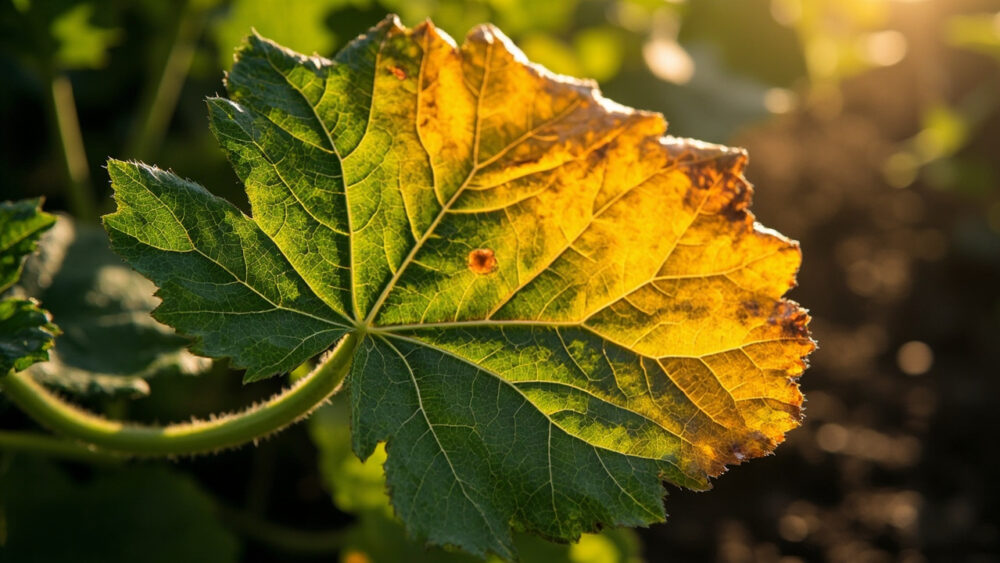
Nine times out of ten, pumpkin plant leaves turning yellow starting with the big lower leaves near the base of the vine is just the plant retiring old growth as it pushes energy into new leaves and fruit. That’s normal aging, not a crisis, and the fix is simply to leave those leaves alone until they’re crispy and pull them off by hand. But if the yellowing is spreading fast, showing up on new growth, or coming with spots, wilting, or sticky residue, you’re looking at something else entirely.
Everyone blames water first, and sometimes that’s right, but overwatering and underwatering can produce almost identical yellow leaves, which means guessing wrong here is easy and common. There’s one detail on the plant, where the yellowing starts and whether it comes with a pattern like veins staying green or leaves going crispy at the edges, that tells you exactly which cause you’re dealing with. And whether the vine bounces back depends entirely on which cause it is, so I’ll give you the honest recovery odds for each one.
Stick with me through the causes and the tell-apart guide, and save the diagnosis checklist at the very bottom, it’s built to run in two minutes standing right next to the plant.
Most Likely Causes, Ranked
1. Natural leaf aging (lower leaves only)
Confirm it: only the oldest leaves near the base of the vine are yellowing, the newer leaves toward the growing tips look dark green and healthy, and there’s no spotting or fuzz on the yellow leaves themselves.
This is the pumpkin plant’s normal life cycle, especially once fruit starts sizing up and the plant redirects resources.
Fix: nothing to fix. Snip or pull the fully yellow leaves off to improve airflow and reduce hiding spots for pests, and let the plant keep doing what it’s doing.
If that’s not your pattern, the next cause is where most watering mistakes hide.
2. Inconsistent watering (both too much and too little)
Confirm it: push a finger 2 to 3 inches into the soil near the root zone. Bone dry and crumbly points to underwatering; cold, soggy, and dense points to overwatering or poor drainage. Overwatered plants often show yellowing leaves that go limp and soft before they yellow, while underwatered plants show yellowing that starts crispy at the leaf edges.
Fix: pumpkins need about 1 to 1.5 inches of water a week, more in hot, dry stretches once fruit is sizing. Water deeply at the base 2 to 3 times a week rather than a light daily sprinkle, and make sure the bed drains, raised rows help a lot in heavy clay.
Water problems are common, but nutrient shortages leave a signature water never does.
3. Nitrogen deficiency
Confirm it: older leaves yellow first in a fairly uniform way, sometimes with a pale, washed-out green rather than true yellow, and the whole plant looks smaller and slower than it should for its age. No spots, no pattern along the veins.
Pumpkins are heavy feeders and can run out of nitrogen by midseason, especially in sandy soil or after heavy rain has leached nutrients out.
Fix: side-dress with a balanced or nitrogen-leaning fertilizer, or work in aged compost around the root zone. Avoid overdoing nitrogen once flowering starts, you want the plant setting fruit, not just growing leaves.
If the yellowing has a distinct pattern between the veins, you’re probably not dealing with nitrogen at all.
4. Vine borers or squash bugs
Confirm it: check the base of the main stem for a small entry hole with sawdust-like frass (a sign of squash vine borer), or flip nearby leaves to look for clusters of brown eggs or gray-brown squash bugs. Yellowing here often starts on one section of vine or one leaf and spreads outward from that point, not evenly across the plant.
Fix: for vine borers, slit the stem carefully along its length to remove the larva if caught early, then mound moist soil over the wound to encourage new roots. For squash bugs, hand-pick adults and crush egg clusters, and if infestation is heavy, use a labeled insecticide exactly per the product instructions.
Pests cause damage you can find with your hands; disease usually shows up as a pattern you can only see with your eyes.
5. Fungal disease (powdery mildew or downy mildew)
Confirm it: powdery mildew looks like a white, flour-like dusting on leaf surfaces before the leaf yellows and dies. Downy mildew shows angular yellow blotches on top of the leaf with a fuzzy gray-purple growth on the underside. Both usually start on older, shaded leaves in the canopy interior.
Fix: remove and discard affected leaves, improve airflow by thinning crowded foliage, water at the soil line instead of overhead, and apply a fungicide labeled for cucurbits per the label if it’s spreading fast.
These two diseases are common enough that most pumpkin growers see them eventually, and they rarely kill a healthy vine outright.
6. Bacterial wilt or mosaic virus
Confirm it: for bacterial wilt, individual leaves or whole vines wilt suddenly during the day even with adequate soil moisture, then yellow and collapse. Cutting the stem and squeezing it may show a milky ooze. For mosaic virus, new leaves emerge mottled yellow and green in a blotchy pattern, often stunted and curled, usually spread by aphids or cucumber beetles.
Fix: there’s no cure for either. Remove and destroy infected plants to protect the rest of the patch, and control cucumber beetles and aphids going forward since they’re the main vectors.
This is the one cause on this list where the honest fix is removal, not treatment, and that’s exactly what the next section covers in full.
How to Tell the Causes Apart
Where it starts is your fastest clue. Aging and nitrogen deficiency begin on the oldest, lowest leaves. Pests and vine borers start at one specific point and spread outward. Mosaic virus shows up first on new growth, which is the opposite of most other causes.
The texture and pattern matter as much as the color. Uniform pale yellowing means nutrients or water. Blotchy or mottled yellow-and-green means virus. White dust or fuzzy gray growth means fungal disease. Sudden daytime wilting with no dry soil means bacterial wilt.
Once you’ve matched the pattern, the real question is what happens to the plant next.
Will It Recover?
Natural aging and nutrient deficiency have the best outlook. The plant recovers fully once fed or once it simply moves past that growth stage, usually within 1 to 2 weeks of correction.
Watering issues also recover well if caught early, expect improvement in new growth within a week of establishing a consistent schedule, though already-yellowed leaves won’t turn green again.
Pest damage recovery depends on how early you catch it. A vine borer caught before it’s tunneled far can save the plant. One that’s hollowed out a long stretch of main stem often can’t be saved past that point.
Fungal disease is manageable, not curable, on an established plant, you’re containing it and keeping the vine productive rather than eliminating it.
Bacterial wilt and mosaic virus are the honest bad news. There’s no treatment, and the kindest move for your other plants is removing infected ones rather than hoping they pull through.
Recovery odds are good for most of this list, which makes prevention worth the ten minutes it takes.
How to Keep It From Happening Again
Water consistently at the soil line rather than overhead, and check soil moisture by hand instead of guessing by the calendar.
Feed with compost or a balanced fertilizer at planting and again when vines start running, since pumpkins are hungry plants for their whole season.
Space vines generously, 3 to 5 feet apart depending on variety, so airflow keeps fungal disease from taking hold in a crowded canopy.
Scout the base of stems weekly for frass or holes, and control cucumber beetles and squash bugs early since they carry the diseases with no cure.
Rotate where you plant cucurbits each year if you’ve had wilt or virus before, since some pathogens overwinter in soil and old plant debris.
All of that is easier to apply once you know exactly which cause you’re looking at right now, which is what the checklist below sorts out fast.
Diagnosis Checklist
- Check which leaves are yellow: if only the oldest, lowest leaves are affected and new growth looks healthy, suspect natural aging or nitrogen deficiency, not disease.
- Push a finger 2 to 3 inches into the soil: bone dry means underwater, soggy and cold means overwater or poor drainage.
- Look for a uniform pale yellow across older leaves with no spots or fuzz: treat as a nitrogen shortage and feed accordingly.
- Inspect the base of the main stem for a hole with sawdust-like debris: if found, check for a vine borer and act the same day.
- Flip nearby leaves and look for egg clusters or gray-brown bugs: if present, treat for squash bugs.
- Check leaf surfaces for white dust or leaf undersides for fuzzy gray-purple growth: if present, it’s fungal, improve airflow and treat per label if needed.
- Watch for sudden daytime wilting despite moist soil: cut a stem and check for milky ooze to confirm bacterial wilt.
- Look at the newest leaves specifically: mottled, blotchy yellow-and-green on new growth points to mosaic virus, remove the plant if confirmed.
- If nothing above matches and the plant looks otherwise vigorous, it’s most likely just normal leaf aging, so leave it be.
Most yellow leaves on a pumpkin vine are the plant doing exactly what it’s supposed to do.
Run the checklist once, match your pattern, and you’ll know within two minutes whether to relax or act.