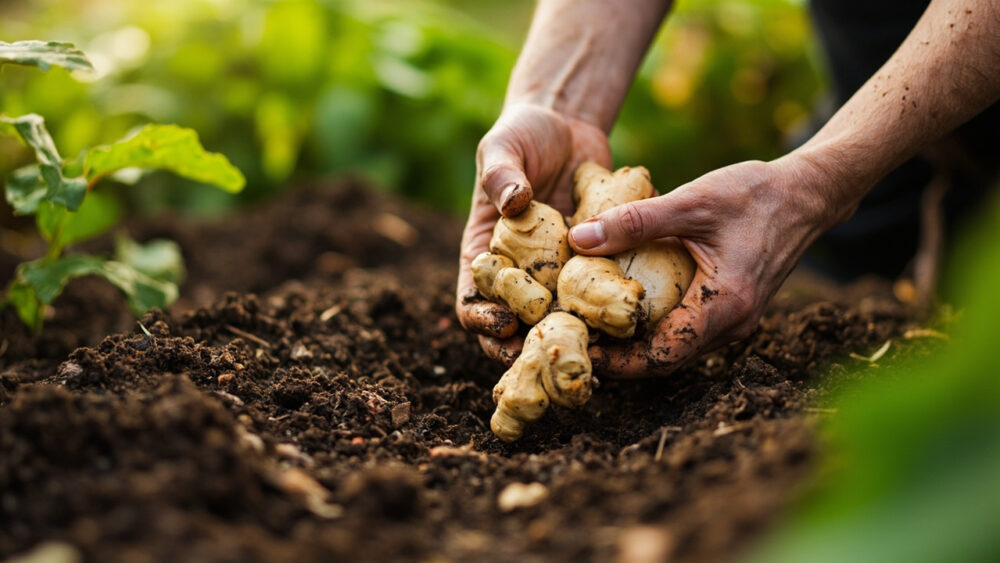
Plant ginger rhizomes 1 to 2 inches deep, eyes or buds facing up, spaced 8 to 12 inches apart in every direction. That is the whole answer for how deep to plant ginger, but the reasoning behind those numbers is what actually determines whether you harvest a decent crop or a handful of skinny knuckles in fall. Ginger is not fussy about precision to the quarter inch, but it is unforgiving about a few specific mistakes that show up months later, long after you could have fixed them cheaply.
Most people either bury the rhizome too deep because it feels like a “root” and should go down like a potato, or they crowd pieces close together because the starting chunk looks small and harmless. Both mistakes look fine in week one. Both cost you real yield by the time the foliage dies back.
Stick around for the part on what overcrowded ginger actually looks like above ground, because it is not what most gardeners expect, and for the fix if you already planted too tight this season. There’s also a save-able Ginger at a Glance card at the very bottom with every number in one place for your phone.
The Right Depth, and Why Shallow Wins
Ginger rhizomes want to sit just under the surface, not buried like a bulb. One to two inches of soil over the top is the target, with the buds or “eyes” pointing upward if you can identify them, and sideways if you cannot tell.
The reason is simple biology: ginger rhizomes push new growth up and out horizontally near the soil surface, and they need warmth to break dormancy. Soil that’s four or five inches deep stays cooler and slower to warm in spring, which delays sprouting by weeks in cool climates.
Buried too deep, a piece can rot before it ever finds the energy to reach light.
Depth solved, but depth alone will not save a crowded bed.
Spacing That Actually Gives Rhizomes Room to Spread
Space individual rhizome pieces 8 to 12 inches apart, and if you’re working in rows, keep 12 to 16 inches between rows. Ginger spreads outward as it grows, adding new fingers in a fan pattern from the original piece, so the plant needs lateral room even though it starts as a small chunk.
In a raised bed or large container, think in terms of one piece per square foot as a comfortable minimum, more like 15 inches apart if you want maximum-size rhizomes rather than a heavier but smaller-fingered harvest.
Commercial ginger growers in tropical climates plant tighter because their season is longer and warmer, but home gardeners in temperate zones get better results erring toward the wider end.
Here’s where the guessing usually goes wrong on both ends.
What Happens When Ginger Is Planted Too Close
If you assumed overcrowded ginger just gives you smaller individual pieces, that is the easy guess, and it is only half right. The real damage shows up as poor airflow at soil level, which invites rot and fungal issues in the humid, consistently moist soil ginger needs to thrive.
Crowded rhizomes also compete hard for the same shallow root zone. You end up with a thick mat of foliage on top and a disappointing tangle of thin, fibrous rhizomes underneath, because none of them had the lateral space to bulk up.
Harvest day is when overcrowding really stings. You’ll dig up a snarl of intertwined roots that’s genuinely hard to separate cleanly without breaking fingers off pieces you wanted intact.
Too far apart causes a different problem, and it is not what you’d expect either.
Planted Too Far Apart: The Underrated Mistake
Wide spacing does not hurt the plant itself. Ginger does not mind having extra elbow room. But it does waste a surprising amount of bed space and warmth, and in shorter growing seasons that matters.
Ginger needs 8 to 10 months of warm season to bulk up into substantial rhizomes, and every square foot of bed that isn’t producing is a square foot not pulling its weight during a season that’s already tight in zones cooler than 9 or 10.
Wide spacing also means more bare soil between plants, which dries out faster and invites more weeding.
Row and bed layout is where you decide which of these tradeoffs actually fits your space.
Row Layout vs. Loose Bed Planting
In-ground rows work well if you’re growing ginger as a dedicated crop: straight lines at 12 to 16 inches apart make weeding, mulching, and eventual harvesting far easier since you know exactly where to dig.
Raised beds and casual garden corners do better with a loose grid pattern instead of strict rows, since ginger doesn’t care about symmetry and a grid uses irregular bed shapes more efficiently.
Either way, mulch heavily after planting, 2 to 3 inches of straw or shredded leaves, since ginger is a rainforest understory plant by nature and wants consistently moist, shaded soil while it establishes.
Containers change a few of these numbers, and not in the direction most people expect.
Ginger in Containers: Depth Stays the Same, Spacing Gets Tighter
Depth doesn’t change in a pot. Still 1 to 2 inches of soil over the rhizome. What changes is how many pieces you can reasonably fit.
A container at least 12 inches deep and 14 to 16 inches wide can comfortably hold two to three rhizome pieces, spaced about 6 to 8 inches apart, slightly tighter than in-ground spacing because containers limit total spread anyway.
Bigger containers, half-barrel size or larger, can handle a small grid at standard 8 to 10 inch spacing and will out-produce several small pots for the same total soil volume.
Drainage matters more in containers than depth or spacing ever will.
Good drainage holes and a loose, rich potting mix prevent the rot that container-grown ginger is genuinely prone to, since pots hold water differently than open ground.
If you’ve already planted too tight this year, there’s still a way to save the harvest.
Fixing a Crowded Ginger Planting Mid-Season
You can thin an overcrowded planting without starting over, but timing matters. Do it early, within the first 8 to 10 weeks after sprouting, while root systems are still small enough to separate without major damage.
Dig gently around the crowded cluster, lift the whole group, and tease apart individual rhizome sections by hand, keeping at least one healthy shoot per piece. Replant the extras elsewhere at proper spacing right away, since exposed rhizomes dry out fast.
Past mid-season, leave it alone. Digging into an established planting later in the year does more root damage than the crowding itself, and you’re better off harvesting slightly early than gambling on a rescue that costs you the whole bed.
An honest note here: crowded ginger still produces something, just less of it and messier to clean, so a mistake this season is not a disaster, only a lesson for next year’s spacing.
All of these numbers, in one place, are exactly what’s below.
Ginger at a Glance
- Planting depth: 1 to 2 inches of soil covering the rhizome, eyes facing up or sideways.
- Spacing between pieces: 8 to 12 inches in-ground, 6 to 8 inches in containers.
- Row spacing: 12 to 16 inches between rows if planting in rows.
- When to plant: once soil is consistently above 55 to 60°F, generally a few weeks after your last frost.
- Container minimum: at least 12 inches deep, 14 to 16 inches wide, two to three pieces per pot.
- Mulch after planting: 2 to 3 inches of straw or shredded leaves to hold moisture and warmth.
- Fix overcrowding: divide and replant within 8 to 10 weeks of sprouting, not later.
Get the depth shallow and the spacing generous, and ginger mostly takes care of itself from there.
Everything else, from mulch to containers to rescuing a crowded bed, is just protecting that one basic setup.