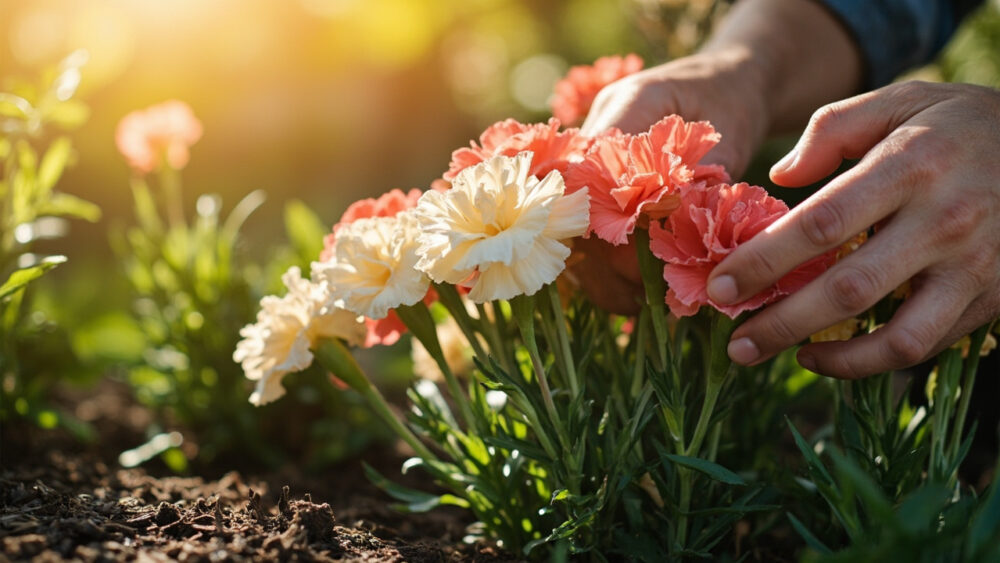
Carnations want full sun, at least six hours a day, cool roots, sharp drainage, and a steady hand with water rather than a generous one. Get those four things right and the rest of carnation care is small maintenance. Most of the plants that struggle got planted too deep, watered like a thirsty annual instead of a drought-tolerant perennial, or crowded into humid, still air where fungal disease moves in fast.
Here is what most people get wrong first: they treat carnations like the delicate florist flowers they remember from a vase, when garden carnations are tough, sun-loving, almost Mediterranean in their tastes. That mismatch is the mistake that ruins most attempts, and it shows up in the first month as yellow leaves from too much love, not too little.
Below I will walk through light, water, soil, the pruning and grooming tasks nobody mentions until the plant gets leggy, the diseases that actually show up on carnations, and the honest signs of a thriving plant versus one that is just surviving. Save the Carnations at a Glance card at the very bottom for the numbers you will want again next week.
Light, Placement, and Temperature
Carnations need full sun, six to eight hours minimum. Less than that and you get sparse blooms and floppy, weak stems reaching for light. They actually prefer cooler air than most sun lovers, thriving in the 60 to 75 F range and slowing down hard once summer nights stay above 75 F.
Good airflow matters as much as sun. Plant them where breeze can move between plants, not tucked against a warm wall or crammed between taller neighbors.
If you garden somewhere with brutal summer heat, afternoon shade during the worst of it will save the blooms even though the label says full sun.
Where you place a carnation decides more of its future than almost anything you do to it afterward.
Watering: How Much, How Often, and How to Tell
Water deeply, then let the top inch or two of soil dry before watering again, roughly once or twice a week for established plants, more often in containers or during heat waves. Carnations root fairly shallowly but hate sitting in wet soil, so the goal is even moisture, not constant moisture.
If you assumed yellow, wilting leaves mean the plant is thirsty, that guess is what kills most garden carnations. Yellowing lower leaves combined with soft, mushy stem bases almost always means overwatering or poor drainage, not drought.
Check by pushing a finger into the soil an inch down. Dry and crumbly means water. Cool and damp means wait, even if the leaves look tired.
Get the water right and you have solved the problem behind most carnation failures before it starts.
Soil, Containers, and Feeding
Carnations want sharp drainage above almost everything else in a soil mix. A loose, slightly sandy or gritty loam with a neutral to slightly alkaline pH, around 6.5 to 7.5, suits them best. Heavy clay that holds water is the single most common soil mistake.
In containers, use a quality potting mix cut with perlite or coarse sand, and make sure the pot has real drainage holes, not just a token one.
Feed lightly. A balanced fertilizer at half strength every four to six weeks during the growing season is plenty. Heavy nitrogen pushes soft, floppy growth and fewer flowers, which is the opposite of what you want.
Good soil does the quiet work that fertilizer can never fully make up for.
Pruning, Deadheading, and the Grooming Nobody Mentions
Carnations get leggy and woody at the base if you never touch them, and this is the step almost everyone skips. Pinch the growing tips of young plants once they reach 4 to 6 inches to force bushier, sturdier growth instead of one tall stalk.
Deadhead spent blooms right below the flower head as they fade. This is what actually keeps a carnation reblooming through summer, not fertilizer.
Every year or two, cut plants back by about a third after the main flush of bloom to keep the base from turning into a woody, sparse tangle. Divide overcrowded clumps in early spring if the center starts dying out while the edges stay green.
Skip the grooming and you will still get flowers, just fewer of them on a plant that looks tired by midsummer.
The Problems Most Likely to Strike
The two real threats to garden carnations are fungal: rust, which shows up as orange-brown powdery pustules on leaves and stems, and various leaf spot or stem rot diseases that thrive in wet, still, humid conditions. Both spread faster with overhead watering and crowded plants.
Fix airflow and watering habits first. Water at the soil line in the morning so foliage dries by afternoon, space plants so leaves are not touching, and remove and discard infected foliage rather than composting it.
If a fungal problem is established and cultural fixes are not enough, a fungicide labeled for the specific disease can help. Follow the product label exactly rather than guessing at mixing rates.
Aphids and spider mites show up occasionally too, usually on stressed plants, and a strong water spray or insecticidal soap handles light infestations.
Catch the fungal problems early and they are a nuisance, not a death sentence for the plant.
How to Tell a Carnation Is Actually Thriving
A healthy carnation has tight, compact growth, blue-green foliage with no yellowing at the base, and stems stiff enough to stand without flopping. New buds should keep forming through the growing season, not just one big flush and silence.
Here is the honest follow-up question most people have next: is it normal for a carnation to slow down or stop blooming in the hottest weeks of summer? Yes, completely normal.
Carnations often pause in extreme heat and pick back up as temperatures ease, especially if you kept deadheading through the lull.
A plant that is merely surviving looks stretched, pale, and sparse. A thriving one looks dense and self-supporting, with color that holds all the way down the stem.
Once you know what thriving actually looks like, the at-a-glance numbers below are what you will keep coming back to check.
Carnations at a Glance
- When to plant: after the last frost once soil has warmed to at least 60 F, or in fall in mild climates for spring bloom.
- Light: full sun, six to eight hours daily, with afternoon shade in extreme heat.
- Spacing: 9 to 12 inches apart to keep airflow moving between plants.
- Planting depth: set at the same depth as the nursery pot, crown just at soil level, never buried deep.
- Watering: deeply, once or twice weekly, letting the top inch or two of soil dry between waterings.
- Soil: loose, well-drained, slightly sandy, pH 6.5 to 7.5.
- Feeding: balanced fertilizer at half strength every four to six weeks during the growing season.
If you remember one thing, remember drainage and airflow, since almost every carnation problem traces back to one of those two.
Everything else, the pinching, the feeding, the deadheading, is just fine-tuning a plant that was already set up to succeed.