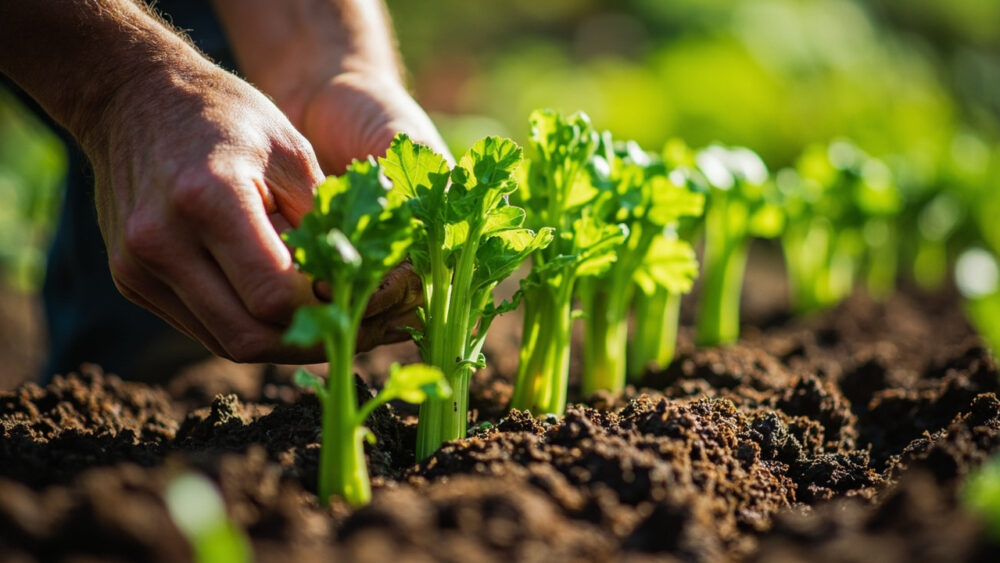
Space celery plants 8 to 10 inches apart within the row, with rows set 18 to 24 inches apart. Set transplants no deeper than they were growing in their pots, just barely burying the root ball, since celery planted too deep sulks and stalls. That single spacing decision determines whether you get thick, crisp stalks or a bed of skinny, bitter ones fighting each other for water.
Most people who ask how far apart to plant celery are standing in front of a flat of seedlings, six-pack in hand, trying to decide whether to cram them in or trust the gap. Here is the honest answer: that gap looks wasteful in April and feels exactly right by July.
Before you dig, I want to flag the mistake that ruins more celery patches than drought does, the sign of trouble that shows up weeks before you’d expect it, and what to do if you already planted too tight. Stick around for the Celery at a Glance card at the bottom too, it’s the version worth saving to your phone before you touch a trowel.
The Exact Numbers, and Why Celery Needs Them
Celery is not a plant that shrugs off crowding the way lettuce does. It’s a heavy feeder and a heavy drinker, with a shallow, fibrous root system that spreads wide rather than deep. Give it 8 to 10 inches between plants and those roots have room to pull in the steady moisture and nutrients celery demands all season.
Depth matters more than people expect. Celery transplants sitting too deep in cold, wet spring soil are slow to establish and prone to rot at the crown. Plant so the base of the stalks sits right at soil level, roots covered, nothing more.
Direct-seeded celery is a different game entirely, seeds barely covered, an eighth of an inch at most, then thinned to that same 8 to 10 inch spacing once seedlings get their second set of true leaves.
Get the spacing right and the layout decisions ahead get a lot easier.
Row Spacing and Bed Layout Options
In traditional rows, keep 18 to 24 inches between rows so you can walk through to weed, water, and eventually blanch or mulch the stalks without trampling neighbors. Tight home gardens can shave that to 18 inches if you’re hand-watering and not running a hose or tiller through.
Raised beds and square-foot layouts work differently. Think in a grid rather than rows: one celery plant per 9 inch square gives each one its own breathing room without wasting bed space on wide aisles it doesn’t need.
Some gardeners plant celery in blocks of 4 rather than long rows, four plants spaced 9 inches apart in a small square. This concentrates the humidity celery likes around the base of the plants, which can actually help in dry climates.
Whatever layout you choose, the real test of whether you got it right won’t show up until the plants are half grown.
What Actually Goes Wrong When Celery Is Too Close
If you assumed crowding just means smaller stalks, that’s true but it’s not the whole story, and it’s not even the main problem. Crowded celery stays wet. Air can’t move between the plants, the lower leaves stay damp long after morning dew should have burned off, and that damp, still air is exactly what fungal diseases like leaf blight and pink rot want.
You’ll see it first as small brown or grayish spots on the outer leaves, spreading inward. By the time it hits the crown, the plant is done, there’s no fixing rot once it sets in at the base.
The other quiet cost of crowding is water competition. Celery is roughly 95 percent water and needs consistent moisture, an inch or more per week, to stay stringless and sweet. Packed too tight, plants compete for that moisture and you get hollow, stringy, bitter stalks even when you’re watering plenty.
Too far apart has its own cost, just a gentler one: plants grow fine individually but you waste bed space, and wide-set celery in hot climates loses the natural shading and humidity that close (but not crowded) neighbors provide, so stalks can turn tough and strongly flavored in full, unbroken sun.
Both mistakes are fixable if you catch them early, which brings up the question you’re probably already asking.
Growing Celery in Containers
Celery does fine in containers, but the pot has to be bigger than people expect for such a slender-looking plant. One plant per 5-gallon container minimum, or for a shared pot, the same 8 to 10 inch spacing applies inside anything wide enough to fit three or four plants, usually an 18 to 24 inch diameter container or a deep, wide trough.
Depth matters here too: give celery at least 10 to 12 inches of soil depth, since that root system, while wide, still needs room to establish without hitting the bottom of the pot and stalling.
Container celery dries out faster than garden celery, full stop. Check the soil daily in warm weather, an inch down should still feel damp, and water before it fully dries rather than after.
If your containers are already crowded, don’t panic, there’s a real fix coming next.
How to Fix an Overcrowded Planting
Caught it early, within the first two or three weeks after transplanting or thinning? Just move some plants. Celery transplants reasonably well while small, roots and all, into a new spot or a new container, watered in well and shaded for a day or two to recover from the shock.
Caught it later, stalks already touching, lower leaves yellowing? Thin by harvesting. Pull every other plant for immediate eating, they’ll be smaller than a full-grown stalk but perfectly usable in soups and stocks, and give the remaining plants the breathing room they were missing.
Either way, once you’ve fixed the spacing, mulch around the remaining plants with a couple inches of straw or shredded leaves. This keeps soil moisture even, which matters more to celery than to almost anything else you’re growing, and it’s the detail most people skip until stalks turn stringy and bitter and they can’t figure out why.
Once the spacing and moisture are dialed in, the rest of celery care is mostly just staying consistent, and that’s where the quick-reference card below earns its spot.
Celery at a Glance
- Plant spacing: 8 to 10 inches apart within the row or grid.
- Row spacing: 18 to 24 inches between rows for walking and airflow.
- Planting depth: transplants set at soil level, root ball just covered, never buried deep; seeds covered only an eighth of an inch.
- When to plant: transplants go out 2 to 3 weeks after your last frost, once soil has warmed and nighttime temps stay reliably above the low 40s F.
- Container spacing: one plant per 5-gallon pot, or 8 to 10 inches apart in a wide container with at least 10 to 12 inches of soil depth.
- Water needs: about 1 to 1.5 inches per week, consistent, never letting soil dry out between waterings.
- Warning sign of crowding: brown or gray spotting on outer leaves, or stringy, bitter stalks despite regular watering.
Get the spacing right at planting and most of celery’s reputation for being fussy just disappears.
Everything else, the water, the mulch, the airflow, is easy once the plants aren’t fighting each other for room.