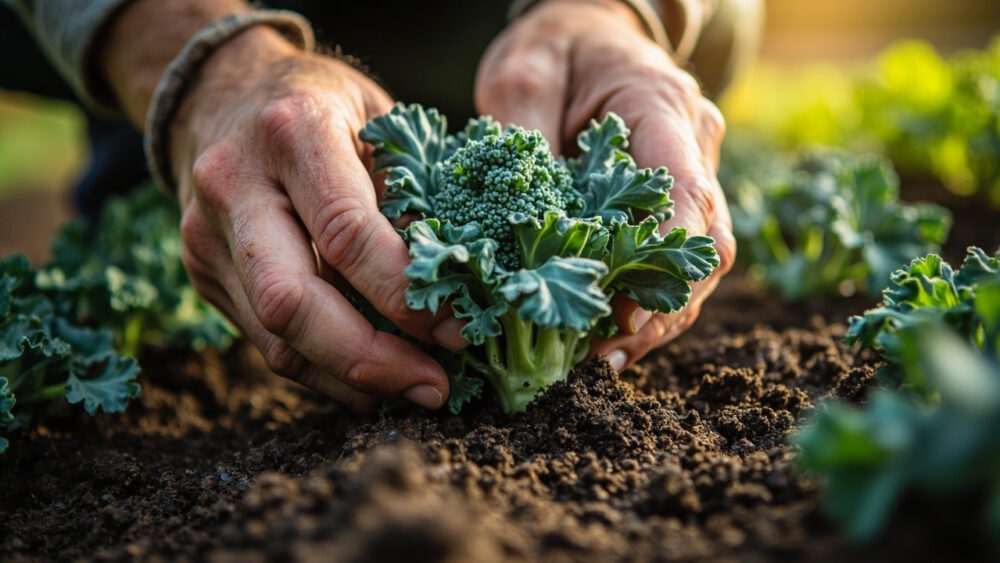
Plant broccoli 18 to 24 inches apart in every direction, with seeds or transplants set about 1/4 to 1/2 inch deep. Rows should sit 24 to 36 inches apart to give you room to walk through and to keep air moving around those big leaves. That is the answer to how far apart to plant broccoli, but the spacing you pick actually depends on the size of head you want, and that part surprises most first-time growers.
Here is the loop worth opening right away: tighter spacing does not fail because plants “compete,” it fails in a much more specific and annoying way that shows up weeks later, after you have already invested the season. There is also a sign of overcrowding that almost everyone reads backwards, blaming the wrong cause entirely. And if you already planted too close, there is an honest answer about whether you can fix it now or whether you are stuck riding it out.
Stick with me through the spacing logic, the row layouts, the container math, and the fix for a too-tight bed, and I will hand you a save-able Broccoli at a Glance card at the very bottom with every number in one place.
The Exact Numbers, and Why They’re a Range
Broccoli spacing is not one fixed number because it depends on what you’re optimizing for. Space plants 12 to 14 inches apart if you want more, smaller heads and don’t mind a lower per-plant yield. Space them 18 to 24 inches apart if you want the classic large central head plus a good flush of side shoots afterward, which is what most home gardeners actually want.
Depth is simpler and doesn’t flex much. Direct-seeded broccoli goes 1/4 to 1/2 inch deep in soil that’s already reliably above 45°F, ideally 50 to 65°F for fastest germination. Transplants go in at the same depth they were growing in their cell, buried no deeper than the base of the first true leaves.
The spacing number you choose now determines the head size you get in 60 to 90 days.
Row and Bed Layout Options
In traditional rows, set plants 18 to 24 inches apart within the row and leave 24 to 36 inches between rows. That row gap isn’t wasted space, it’s what lets you get in there to weed, water, and eventually fight off cabbage worms without trampling anything.
In a raised bed or block planting, skip rows entirely and use a grid instead. Space plants 18 inches apart in every direction, staggered like a checkerboard, and you’ll fit more into the same footprint than a row layout allows.
Intensive square-foot methods suggest one broccoli plant per square foot, but that’s the tight end of the range and trades head size for count. If you’ve got the room, give it more.
Layout decides how many plants fit, but what happens inside that spacing decides how well each one grows.
What Actually Goes Wrong When Plants Are Too Close
If you assumed crowded broccoli just makes smaller heads and calls it a day, that’s the guess almost everyone makes, and it’s only half true. The real damage from tight spacing is airflow loss, and it shows up as disease, not just small yields.
Crowded lower leaves stay wet longer after rain or irrigation because sun and wind can’t reach them. That damp, still air is exactly what black rot and downy mildew want. You’ll see yellowing, water-soaked spots, or a fuzzy gray-white coating on leaves that touch their neighbors, and it spreads plant to plant fast in a tight block.
Here’s the sign everyone misreads: a broccoli head that “buttons,” meaning it forms a tiny, premature head the size of a golf ball instead of a full crown. Most people blame the weather. Often it’s actually root competition from being planted too close, on top of a transplant that got stressed or stunted early.
Too-close plants shade each other’s lower leaves right when those leaves are working hardest to feed the developing head.
What Goes Wrong When Plants Are Too Far Apart
Spacing too generously has its own cost, just a quieter one. Broccoli planted 30 to 36 inches apart doesn’t get sick more often, it just wastes bed space and invites weeds into all that open soil between plants.
Wide-open ground also dries out faster in full sun since there’s no leaf canopy shading the soil, which means more watering to keep that shallow root zone consistently moist. Broccoli’s roots are shallower than people expect, mostly in the top 6 to 8 inches, and inconsistent moisture at that depth is a direct cause of loose, bitter heads that bolt to flower early.
So neither extreme is really about the plant fighting for space, it’s about moisture and airflow management, which is the honest follow-up question most people don’t know to ask yet.
Get the spacing wrong in a container and these same problems just happen faster.
Container and Small-Space Equivalents
One broccoli plant per container is the rule, and the container needs to be at least 5 gallons, ideally closer to 3 to 5 gallons of actual soil volume with a pot at least 12 inches across and 12 inches deep. That shallow-but-wide root system needs the width more than the depth.
Don’t try to fit two plants in a standard 5-gallon bucket. You’ll get the same crowding problems as a too-tight garden bed, just concentrated in less soil with less buffer for mistakes.
If you’re using a long trough or grow bag instead, treat it like a mini row bed and give each plant the same 18 to 24 inches of center-to-center space you’d use in the ground.
Containers forgive almost nothing, which is exactly why the spacing rule matters more there, not less.
How to Fix an Overcrowded Planting
If your broccoli is already in the ground too tight, the fix depends entirely on how far along it is. Caught within the first two to three weeks after transplanting, you can still dig up and relocate the extra plants; broccoli transplants reasonably well while young if you move it in the evening and water it in immediately.
Past that window, once heads are forming or plants are more than 8 to 10 inches tall, transplanting does more root damage than it’s worth. At that point, thin instead of transplanting.
Thinning means sacrificing the weakest plants to give the strongest ones room. Cut the extras at the soil line rather than pulling them, since pulling disturbs the roots of the plants you’re keeping.
Either way, get more air moving through what’s left. Remove yellowing lower leaves that touch the ground or neighboring plants, and space out your watering to let the top inch of soil dry between sessions.
A crowded bed you catch early is a quick fix, a crowded bed you catch late is a management problem you ride out to harvest.
Broccoli at a Glance
- Spacing: 12 to 14 inches apart for smaller, more numerous heads, or 18 to 24 inches apart for large central heads and strong side-shoot production.
- Row spacing: 24 to 36 inches between rows, or an 18 inch staggered grid in raised beds.
- Planting depth: 1/4 to 1/2 inch for seed, transplants set at the same depth they were growing in their cell.
- Soil temperature: 45 to 85°F range for germination and growth, 50 to 65°F is the sweet spot.
- Container size: one plant per container, minimum 3 to 5 gallons, at least 12 inches wide and deep.
- Overcrowding sign: premature buttoning, yellowing lower leaves, or fuzzy gray-white leaf spots from poor airflow.
- Fix window: transplant crowded seedlings within 2 to 3 weeks of setting out, thin by cutting at the soil line after that.
Get the spacing right at planting and most of broccoli’s problems never get a chance to start.
When in doubt, give it the extra few inches, air moving through the leaves matters more than squeezing in one more plant.