Leeks are ready to harvest once the stalk reaches about 1 inch thick, usually 90 to 120 days after transplanting, but the honest answer is that leeks do not have one sharp deadline the way corn or garlic do. You can start pulling them at pencil thickness for a mild, tender leek, or leave them in the ground for months longer and just keep harvesting as needed. That flexibility is the best thing about growing them, and also the reason so many gardeners either yank them too early or forget them until they bolt.
Before you grab the fork, there are a few things worth knowing. There is a common mistake with spacing and mounding that leaves people with leeks that look fine on top and are all green, tasteless leaf below the soil line. There is a sign gardeners misread as “done for the season” when it actually means something closer to “harvest now or lose it.” And there is the honest answer to the question you are probably about to ask next: can leeks survive a hard frost, and how long can you really leave them out there.
All of that is coming, section by section. Stick around to the bottom and you will find a save-able Leeks at a Glance card with the exact numbers so you never have to guess again.
The Real Signs a Leek Is Ready
Forget waiting for a dramatic visual cue like you’d get with a ripe tomato. Leeks give you size, not color.
Stalk thickness
The single best test is diameter at the base, right where it meets the soil. Anywhere from 3/4 inch to 1.5 inches is harvestable. Under 3/4 inch and you’re rushing a leek that has a lot more growing left to do.
The feel test
Grip the stalk gently and give it a light squeeze. A ready leek feels firm and solid all the way down, not spongy or hollow-feeling near the base.
Size tells you it’s ready, but timing tells you whether you should pull it now or wait.
The Timing Window, and What Early or Late Actually Costs You
Most leeks planted in spring are ready starting in late summer through fall, roughly 90 to 120 days after transplanting depending on variety. Summer types mature faster; winter-hardy types are bred to sit in the ground through hard frosts and even light snow, and many gardeners harvest those clear into winter.
Harvesting too early just means a thinner, milder leek. That’s not a disaster, it’s a style choice, and thinning your patch early actually gives the remaining leeks more room.
Harvesting too late is where people get surprised. If you assumed a leek left in the ground too long just gets bigger and better, that guess is only half right. Past a certain point, especially once a leek is triggered by a spring warm-up after overwintering, it will send up a tough, woody flower stalk. Once that happens the center becomes fibrous and unpleasant, and there’s no walking it back.
Frost is not the enemy here. Leeks handle cold better than almost any allium you’ll grow, and a freeze actually sweetens the flavor. The real cutoff to watch for is spring bolting on overwintered leeks, not the first frost of fall.
So the calendar matters less than watching the plant, which brings us to actually getting it out of the ground.
How to Harvest Without Snapping the Stalk
This is the part where the wrong technique costs you the leek entirely.
Do not just grab and pull. Leeks root deeply and stubbornly, and yanking straight up either snaps the stalk at soil level or leaves half the root system behind while the leek itself stays stuck.
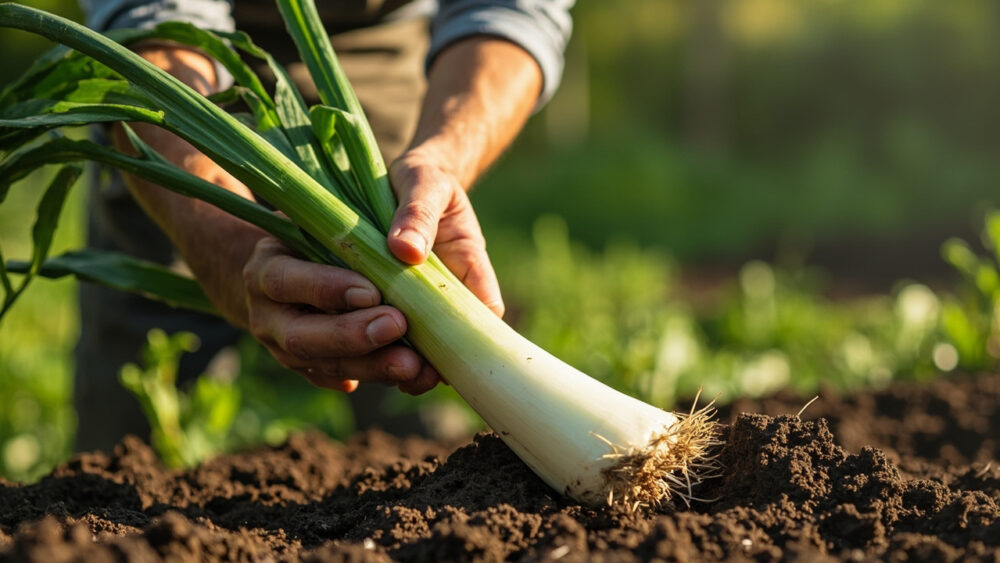
Instead, work a garden fork or trowel into the soil 3 to 4 inches out from the stalk, angled slightly toward the root ball, and loosen the soil on at least two sides. Once the soil gives, grip low near the base and pull with steady upward pressure.
If your leeks were mounded or planted in a trench (the classic method for getting long white shanks), you may need to loosen soil down 6 to 8 inches, since that blanching technique buries a good portion of the usable stalk.
- Loosen soil on both sides before pulling, never pull cold
- Grip at the base, not the leafy top, so you don’t strip leaves off a keeper leek
- Harvest one at a time and re-firm soil around neighbors so you don’t expose their roots
Getting it out cleanly is only half the job, what you do in the next ten minutes matters almost as much.
Right After You Pull It
Trim the roots down to about half an inch and cut back the leafy green tops to 2 to 3 inches above the white and light-green shank. This stops the leaves from pulling moisture out of the part you actually want to eat.
Shake or brush off loose soil rather than washing it immediately if you’re not eating it that day. Wet leeks in storage break down faster.
Leeks are one of the few vegetables that don’t need a curing period like garlic or onions do. Their layered structure holds moisture well.
Once you’ve got one harvested and trimmed, the next question is how to keep the rest of the row producing.
Keeping the Harvest Going, and Storing What You Pull
Leeks don’t regrow from a cut stalk the way scallions sometimes do, so each one you pull is done. The trick to a steady supply is staggered harvesting: pull the biggest ones first and let smaller stalks in the same row keep sizing up over the following weeks.
In the ground is actually the best storage you have. If your ground doesn’t freeze solid, or you mulch heavily with 6 to 8 inches of straw, leeks will hold for weeks to months right where they are, especially hardy winter varieties.
Once pulled, trimmed leeks keep in the refrigerator, unwashed and wrapped loosely, for 1 to 2 weeks. For longer storage, leeks slice and freeze well, though they turn soft on thawing, so they’re best saved for soups and braises rather than anything meant to hold its shape and crunch.
Now that you know when, how, and what happens next, here’s everything condensed into one list worth saving.
Leeks at a Glance
- When to plant: transplant seedlings outdoors 2 to 4 weeks before your last spring frost, once soil is workable.
- Days to harvest: 90 to 120 days after transplanting, depending on variety and thickness desired.
- Spacing and depth: space plants 4 to 6 inches apart in rows or trenches, planting them 4 to 6 inches deep or mounding soil up as they grow for a longer white shank.
- Ready size: stalks about 3/4 inch to 1.5 inches thick at the base, firm all the way down when squeezed.
- Harvest window: late summer through fall for standard types, and clear into winter for cold-hardy varieties left mulched in the ground.
- The one thing to avoid: letting overwintered leeks sit into a spring warm-up, which triggers a tough, woody flower stalk with no fix.
- Storage: trim roots and tops, refrigerate unwashed 1 to 2 weeks, or leave in the ground under heavy mulch for the longest hold.
Watch the base, not the calendar, and you’ll rarely get this wrong.
When in doubt, pull one and check it, that single test tells you more than any date on a seed packet.