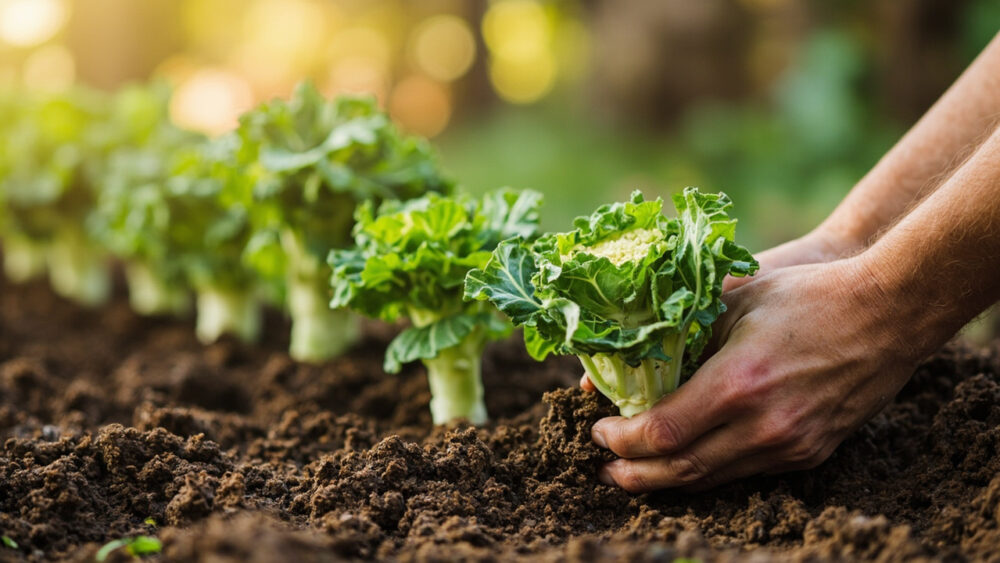
Cauliflower needs 18 to 24 inches between plants and 24 to 36 inches between rows, set about a quarter inch deep if you’re direct sowing, or planted at the same depth it sat in its nursery pot if you’re transplanting. That’s the number to work from when you’re figuring out how far apart to plant cauliflower, but the number by itself will not save a bad planting.
Most people space cauliflower too tight, because the transplants look small and harmless going in the ground. Six weeks later those same plants are two feet wide and shading each other into failure. There’s also a sign almost everyone misreads when heads stall out, and it has nothing to do with spacing at all, though people always assume it does.
Stick with me and you’ll get the layout options for rows and raised beds, what actually happens when plants sit too close or too far apart, container spacing if you’re growing in pots, and how to rescue a planting you already crammed in too tight. There’s also a save-able Cauliflower at a Glance card at the bottom with every number in one place, worth screenshotting before you head back out to the garden.
The Exact Spacing and Depth, and the Reasoning Behind It
Cauliflower is a big plant pretending to be a small one for its first month. A transplant that fits in a 4 inch pot will eventually spread 24 to 30 inches across, with outer leaves that need room to catch light and feed the head developing in the center.
Eighteen inches is the tight minimum, workable if your soil is rich and you’re staying on top of water and fertility. Twenty-four inches gives you a cushion and tends to produce larger, more uniform heads.
Depth is simple by comparison. Direct-sown seed goes a quarter inch to half an inch deep. Transplants go in at the same soil line they had in the pot, no deeper, since burying the stem invites rot in cool, damp spring soil.
Get the spacing right and the layout questions answer themselves.
Row Spacing and Bed Layout Options
In traditional rows, give plants 18 to 24 inches within the row and 30 to 36 inches between rows. That wider row gap isn’t wasted space, it’s room for you to walk through, weed, and eventually get a wheelbarrow in for harvest without trampling anything.
In a raised bed or block planting, switch to a grid instead of rows. Twenty-four inches on center, staggered in offset rows rather than a strict grid, uses the space efficiently and still gives every plant equal access to light.
A standard 4 foot wide bed fits two staggered rows of cauliflower comfortably. Try to force three rows into that width and you’re back to the overcrowding problem, just with better soil.
Bed or row, the spacing number stays the same, only the geometry changes.
What Goes Wrong When Plants Are Too Close
This is the mistake that ruins most home cauliflower crops, and it doesn’t show up right away. Plants set 10 or 12 inches apart look fine for weeks, then the outer leaves start overlapping and shading each other just as heads should be forming.
Shaded, crowded plants put energy into reaching for light instead of building a head. You end up with small, loose, sometimes hollow curds, or plants that never form a proper head at all, just leafy growth and disappointment.
Crowding also traps humidity between plants, which is exactly what fungal diseases like downy mildew and black rot want. Airflow is not a luxury for cauliflower, it’s part of the pest and disease defense.
If you assumed tight spacing just means slightly smaller heads, the real cost is usually no head at all, and that’s the trade nobody wants to make for saving a foot of garden bed.
What Goes Wrong When Plants Are Too Far Apart
Too far apart is the rarer mistake, but it happens, usually from someone overcorrecting after reading a warning like the one above. Spacing plants 36 or 40 inches apart doesn’t hurt the individual plant much, cauliflower does not mind elbow room.
The real cost is wasted bed space and a longer, harder weeding season, since bare soil between widely spaced plants is prime real estate for weeds that then compete for the same water and nutrients you’re trying to give the cauliflower.
Wide spacing also means fewer heads per square foot of garden, which matters if you’re working with a small bed and trying to get a real harvest out of it rather than a decorative one.
Eighteen to 24 inches is the sweet spot for a reason, tight enough to use your space, loose enough to let every plant finish what it starts.
The Sign Everyone Misreads: Stalled Heads Aren’t Always a Spacing Problem
Here’s the follow-up question you’re probably about to ask: if your cauliflower is stalling out or refusing to head up even with good spacing, is it still a crowding issue? Usually not.
Cauliflower is far more sensitive to heat and inconsistent water than to modest spacing errors. Temperatures consistently above 75°F, or a week of drought stress followed by a heavy watering, will stall head formation just as fast as bad spacing will, sometimes faster.
Check soil moisture an inch down before you blame your layout. Cauliflower wants steady, even moisture, roughly 1 to 1.5 inches of water a week, never bone dry and never swampy.
Good spacing sets the stage, but heat and water write most of the actual story.
Container Spacing for Cauliflower
Cauliflower works in containers, but each plant wants its own generous pot, not a shared planter. One plant per container, minimum 12 inches wide and equally deep, ideally closer to 16 to 18 inches across for a full-sized variety.
Smaller pots produce smaller, often disappointing heads, since the roots simply run out of room to support the leaf growth that feeds curd development. If you’re set on containers, look for compact or dwarf cauliflower varieties bred for exactly this situation.
Multiple containers can sit closer together than in-ground spacing, 6 to 8 inches between pots, since the roots are physically separated even if the leaves eventually touch overhead.
Get the pot size right and container cauliflower performs almost as well as garden-grown.
How to Fix a Planting You Already Crowded
If your cauliflower is already in the ground at 10 or 12 inches apart and you’re reading this too late, you have two honest options, and neither one is free.
- Thin now: if plants are still small, under 6 inches tall, transplant every other one to a new spot with proper 18 to 24 inch spacing. Cauliflower transplants reasonably well while young.
- Selectively remove: if plants are already large and interlocking, pull the weakest plant from each crowded pair rather than trying to move anything. This isn’t as good as starting with correct spacing, but it beats losing the whole planting to shade and disease.
Either way, water well after disturbing roots and expect a short setback before growth resumes.
A rescued planting rarely performs as well as one spaced right from day one, but it beats a bed full of leafy plants with no heads at all.
Cauliflower at a Glance
- When to plant: transplant 2 to 4 weeks before your last frost for a spring crop, or in mid to late summer for a fall crop timed to mature in cool weather.
- Spacing between plants: 18 to 24 inches, with 24 inches preferred for larger, more uniform heads.
- Spacing between rows: 30 to 36 inches for walking room and airflow.
- Planting depth: a quarter to half inch for seed, same depth as the nursery pot for transplants.
- Container size: one plant per pot, minimum 12 inches wide, 16 to 18 inches ideal.
- Water needs: steady, even moisture, about 1 to 1.5 inches per week, never letting soil dry out completely.
- Best growing temperature: 60 to 70°F, heads stall or turn poor quality above 75°F.
Get the spacing right and give it steady water, and cauliflower does the rest on its own timeline.
Crowd it or let it dry out, and no amount of fertilizer will talk it into forming a head.