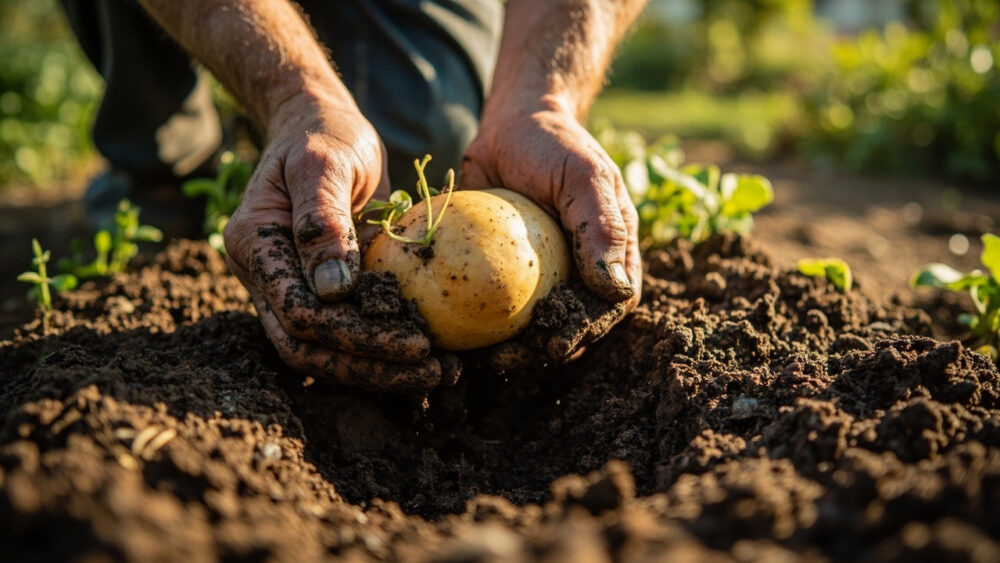
Here is the honest answer before you go any further: true potato seed, the tiny black seeds from the berries a potato plant sometimes produces, is a real thing, but it is a slow, unpredictable path compared to growing potatoes the normal way from seed potatoes (small whole tubers or cut pieces). If you want food this year with minimum drama, you plant seed potatoes 2 to 4 weeks before your last frost date, once soil hits at least 45 to 50°F. If you actually want to learn how to grow potatoes from seedthe true botanical seed, that takes a full extra season just to grow tubers worth planting, and this guide covers both so you know exactly which one you are signing up for.
There is one mistake that wrecks more potato patches than anything else, and it has nothing to do with watering. There is also a sign most people misread as disease when it is actually completely normal. And there is a question you are about to ask right after this one: why do garden centers sell “seed potatoes” instead of seed packets like everything else.
Stick with this, because the save-able Potatoes at a Glance card is waiting at the very bottom, after you know exactly what you are doing and why.
True Seed vs Seed Potatoes: Which One You’re Actually Growing
Potato plants can flower, and if pollinated, they form small green berries that look like tiny tomatoes. Inside are hundreds of true seeds. This is genuine sexual reproduction, and it is how new potato varieties get bred in the first place.
The catch is that true seed does not grow you a copy of the parent plant. Potatoes are wildly variable from seed, so every plant you grow from those tiny black seeds is a genetic wildcard, different size, color, yield, and flavor from its neighbor.
Seed potatoes, the small whole or cut tubers you buy at the garden center, are clones. Plant a piece of a Yukon Gold seed potato and you get Yukon Gold, guaranteed. That reliability is why nearly everyone growing potatoes for food uses seed potatoes, not true seed.
Once you know which route you’re on, the timing looks completely different.
When to Start: Timing for True Seed Versus Seed Potatoes
True potato seed gets started indoors like a tomato, 8 to 10 weeks before your last frost date, because it needs a full season just to grow small first-year tubers you’ll replant the following year.
Seed potatoes work on a totally different clock. You plant them directly in the ground 2 to 4 weeks before your last spring frost, as soon as the soil is workable and has warmed past about 45°F.
Potatoes tolerate a light frost on emerging foliage, but a hard freeze will blacken new growth to the ground. If that happens, don’t panic, most plants push new shoots from the tuber within a couple of weeks.
Get the timing right and the sowing method matters just as much.
Sowing Step by Step
For True Potato Seed (Indoors)
- Depth: sow seeds barely 1/8 inch deep in a seed-starting mix, almost surface-sown, and press down rather than burying.
- Medium: a light, well-drained seed-starting mix, never garden soil, which crusts and smothers seedlings this small.
- Temperature: keep at 65 to 70°F; a heat mat helps a lot since these seeds germinate slowly in cool soil.
- Light: bright light immediately after sprouting, 14 to 16 hours a day under grow lights kept just a couple inches above the leaves.
For Seed Potatoes (Direct in the Ground)
- Prep: cut larger seed potatoes into pieces with at least one or two eyes each, and let cut pieces dry and callus for 1 to 2 days before planting so they resist rot.
- Depth: plant pieces 3 to 4 inches deep, eyes facing up.
- Spacing: 10 to 12 inches apart in rows spaced 30 to 36 inches apart, which gives you room to hill soil later.
- Soil: loose, well-drained soil worked deeply; potatoes forming in heavy clay come out stunted and misshapen.
What happens next looks very different depending on which method you chose, and this is where most people start second-guessing themselves.
Germination and Early Growth: What’s Normal and What Isn’t
True potato seed germinates in 1 to 3 weeks at warm temperatures, and the seedlings look exactly like tiny tomato seedlings, which surprises almost everyone the first time. That resemblance is normal, not a mix-up. They stay small and slow for weeks.
Seed potatoes take longer to show anything, often 2 to 4 weeks before a shoot breaks the soil surface, and cold, wet soil can stretch that to 5 weeks or more.
Here’s the sign that trips people up: if you dig around impatiently and find the seed piece has gone soft and slimy with a bad smell, that’s rot, usually from soil that stayed too cold and wet too long, and that piece is done. But a firm seed piece with no shoots yet after three weeks is not a failure. It is just being slow. Resist digging it up to check.
Once your true seedlings are a few inches tall, or your seed-potato shoots have pushed a couple inches above ground, you’re moving into the next phase.
Hardening Off and Transplanting
Only true-seed seedlings need hardening off, since seed potatoes go straight into the garden with no transition. Give true-seed seedlings 7 to 10 days outside in a sheltered spot, starting with an hour or two of dappled light and building up to a full day before transplanting.
Transplant true-seed seedlings into the garden after your last frost, spacing them the same 10 to 12 inches apart you’d use for seed potatoes, once nighttime temperatures stay reliably above 45 to 50°F.
The honest part nobody tells you: those first-year plants from true seed produce small, often marble-to-golf-ball-sized tubers. You don’t eat most of these. You save and replant them next spring to finally get a normal, productive crop.
Whichever path brought you here, the season-long care from this point forward is identical.
Care Through the Season: Hilling, Water, and the Mistake That Ruins Yields
Here’s the mistake that costs more potato harvests than anything else: planting shallow and never hilling. Potatoes form along the buried stem above the seed piece, not below it, so if that stem isn’t covered, tubers push up into sunlight, turn green, and develop solanine, a compound that makes them bitter and unsafe to eat in quantity.
Hill soil or mulch up around the stems when plants reach 6 to 8 inches tall, and again 2 to 3 weeks later, building a mound 6 to 8 inches high total.
Water consistently, about 1 to 2 inches per week, especially once plants flower, which is when tubers are bulking up fastest. Uneven watering, drought followed by a soak, is the classic cause of hollow heart and misshapen tubers.
Watch for Colorado potato beetles and their orange egg clusters on leaf undersides. Hand-picking early keeps small infestations from becoming big ones, and for anything beyond that, follow the label on an appropriate garden insecticide rather than guessing at mixing rates.
All that care is building toward one visual signal that tells you exactly when to stop watching and start digging.
Flowering, Bloom, and Knowing When to Harvest
Potato plants usually flower 6 to 10 weeks after planting, white, pink, or purple depending on variety, and it’s a good sign, not a requirement. Some varieties barely flower at all and still yield a full crop, so don’t panic if you never see a bloom.
If you assumed flowering means harvest time, that guess is close but not quite right. Flowering signals tuber formation is underway, not that tubers are full-sized yet.
The real signal is the foliage. For new “baby” potatoes, you can dig gently at the plant’s edge once flowering finishes. For a full-sized main crop, wait until the foliage yellows and dies back on its own, usually 90 to 120 days after planting depending on variety, then dig within 2 weeks.
Let harvested potatoes cure in a cool, dark, dry spot for about 1 to 2 weeks before storage, which toughens the skin and helps them keep for months instead of weeks.
Everything above gets easier once you’ve got the numbers in one place, so here’s the version worth saving.
Potatoes at a Glance
- When to plant seed potatoes: 2 to 4 weeks before your last frost date, once soil is at least 45°F.
- When to start true seed: indoors, 8 to 10 weeks before last frost, then transplant after frost risk passes.
- Depth and spacing: seed potato pieces 3 to 4 inches deep, 10 to 12 inches apart, rows 30 to 36 inches apart.
- Germination window: true seed sprouts in 1 to 3 weeks indoors at 65 to 70°F, seed potato shoots emerge in 2 to 4 weeks outdoors.
- Hilling: mound soil around stems when plants reach 6 to 8 inches tall, and again 2 to 3 weeks after that.
- Water: 1 to 2 inches per week, kept consistent, especially during flowering.
- Harvest signal: dig baby potatoes after flowering, dig the main crop once foliage yellows and dies back, roughly 90 to 120 days from planting.
If you take one thing from all of this, take this: seed potatoes get you food this year, true seed gets you a breeding project. Pick the one that matches what you actually want out of this season, and the rest of the process takes care of itself.