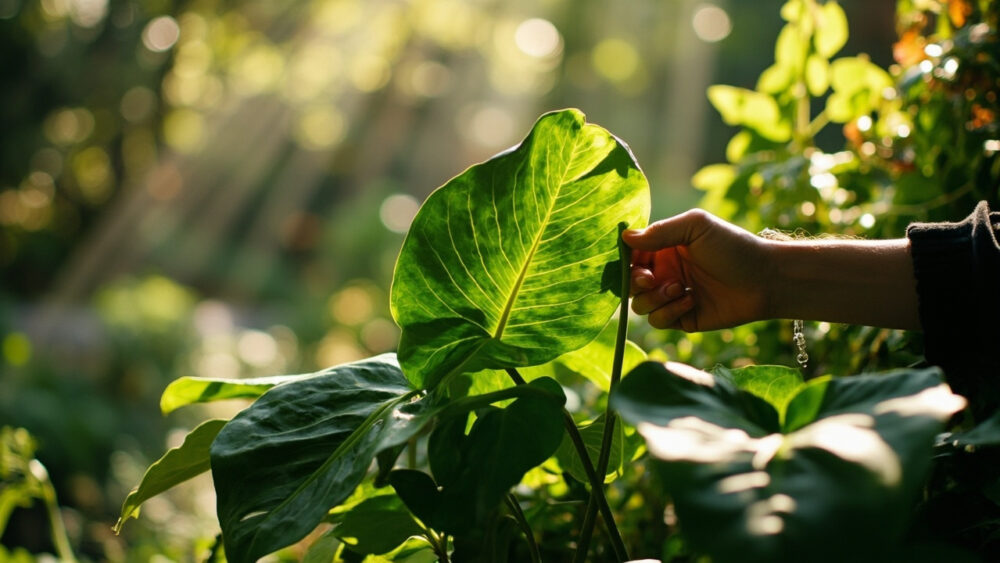
Philodendron light requirements come down to one simple standard: bright, indirect light, the kind you get a few feet back from an east or west window, with a few hours of gentle sun but no harsh midday rays hitting the leaves. Most philodendrons will survive in lower light too, just slower and less full. But “survive” and “thrive” are different plants, and I want to get you to the second one.
Here is where most people go wrong, and it is not where you think. Everyone assumes the danger is too little light because their philodendron looks a little sparse.
The real damage usually happens the other direction, from well-meaning owners who move a leggy plant straight into a sunny south window trying to fix it. There’s also a seasonal shift almost nobody accounts for, and a handful of no-cost placement tricks that fix 90 percent of light problems without buying a single grow light. All of that is coming, and I’ll give you a save-able Philodendron at a Glance card at the very bottom with the numbers in one place.
The Plain Answer: What “Bright Indirect” Actually Means
Philodendrons are understory plants in their native range, growing under a forest canopy where light is filtered and shifting, never direct and blasting. That’s the light level you’re aiming to recreate indoors.
Bright indirect light means the room is well lit enough to cast a soft, defined shadow if you hold your hand a foot off a piece of paper, but the sun itself isn’t touching the leaves for hours at a stretch. Vining types like heartleaf philodendron tolerate more shade than upright, big-leafed types like Philodendron selloum or the fenestrated varieties, which want more light to hold their shape and leaf size.
Low light won’t kill most philodendrons quickly, but it will slowly starve them, and that story is next.
What Good Light Looks Like In An Actual Room
Forget lumens and meters for a second. Here’s the version you can check right now, standing in your living room.
An east-facing window is close to ideal. Place the plant within 2 to 4 feet of the glass and it gets gentle morning sun plus bright light the rest of the day.
A west-facing window works too, but afternoon sun there runs hotter, so keep the plant 4 to 6 feet back or filter it with a sheer curtain. A south-facing window is the trickiest: fine 6 to 8 feet back or off to the side, risky right up against the glass in summer. A north-facing window is the one place vining philodendrons genuinely do fine but big-leaf types will slowly decline.
Distance and direction only tell half the story, the plant itself will tell you the rest.
The Sign Everyone Misreads: Too Little Light vs Too Much
If you assumed yellow leaves mean too much water, that’s a fair guess, but with philodendron light problems the leaf itself gives you a more specific clue than color alone.
Too little light shows up as small new leaves that never quite catch up in size to the older ones, long bare stretches of stem between leaves called legginess, and a plant that leans hard toward the nearest window. Variegated types often lose their variegation and revert to solid green, which is the plant abandoning the pattern to make more chlorophyll.
Too much direct light looks different: bleached, papery patches on the leaf that look almost sunburned, crispy brown edges, or leaves that curl and pale as if they’re flinching. This is the mistake people make when they “fix” a leggy plant by shoving it into a hot south window, and it can scorch leaves within days.
Neither problem is permanent, but one is far easier to correct than the other, and that’s worth knowing before you move anything.
Which Mistake Actually Costs You More
Here’s the honest answer to the question you’re probably about to ask: which is worse, too much or too little?
Too little light is more forgiving. Move the plant closer to a window, and new growth comes in fuller within a few weeks, though the old leggy stems stay leggy, you’re growing new proportions from that point forward.
Too much direct sun is less forgiving. Scorched leaf tissue does not heal or turn green again. Those leaves stay damaged until you trim them and the plant replaces them with new growth in better light.
So the safer error, if you have to guess, is a little dim rather than a little too bright.
Light needs don’t stay fixed all year either, and that catches a lot of people off guard.
The Seasonal Shift Nobody Accounts For
The same spot by the same window delivers very different light in December than it does in June, and not just because days are shorter.
The sun’s angle drops lower in winter, so a spot that was comfortably indirect in summer can end up getting direct, low-angle sun beaming straight across a room in winter. Meanwhile a philodendron in a bright summer spot may need to move a foot or two farther from the glass, or behind a sheer curtain, once the sun climbs higher and hotter into a west or south window.
Growth also slows in winter regardless of light, since lower ambient temperatures and shorter days naturally throttle back new leaf production. Don’t mistake seasonal slowdown for a light problem and panic-move the plant.
Instead, do a light check twice a year, and here’s exactly how.
The Two-Minute Light Check
Pick a sunny hour, whatever counts as midday for that window, and watch the plant’s spot for that hour.
- If you see a crisp, sharp-edged sun patch land directly on the leaves, that’s too much direct light for most philodendrons.
- If the whole room is bright but no distinct sun patch ever lands on the plant, that’s the bright indirect light you want.
- If the room feels dim enough that you’d turn on a lamp to read there during the day, that’s too low for consistent growth.
Run this check once in early summer and once in early winter, since the sun’s path changes enough between the two to matter.
If your space fails that check, you don’t need a greenhouse, you need a few small fixes.
Placement Fixes That Don’t Require a Greenhouse
Most light problems get solved with furniture and glass, not equipment.
Too dark: move the plant within 3 feet of the brightest window you have, add a sheer curtain removed rather than added if the room already feels dim, or supplement with a basic full-spectrum grow light for 8 to 10 hours a day set a foot or two above the foliage.
Too bright or hot: pull the plant back a few feet, hang a sheer curtain between plant and glass, or move it a few feet to the side of the window rather than directly in front of it.
Uneven growth, where the plant leans and grows thick on one side, is fixed by rotating the pot a quarter turn every week or two so all sides get equal time facing the light.
Once the spot is right, the plant tells you fast, usually within one or two new leaves.
Philodendron at a Glance
- Light needed: bright, indirect light, with a few hours of gentle sun and no direct midday rays on the leaves.
- Best window: east-facing, 2 to 4 feet from the glass, with west-facing acceptable 4 to 6 feet back or filtered by a sheer curtain.
- Lowest tolerable light: north-facing windows or a few feet from any bright window, workable for vining types, weaker for big-leaf and variegated types.
- Sign of too little light: small new leaves, long bare stem gaps, reverting variegation, leaning toward the window.
- Sign of too much light: bleached or papery patches, crispy brown edges, curling pale leaves.
- Seasonal check: re-check light exposure at the same spot in early summer and early winter, since sun angle shifts enough to matter.
- Quick fix: move closer to light or add a grow light for low conditions, pull back or add a sheer curtain for scorching conditions.
Get the light roughly right and philodendron forgives almost everything else. Check the leaves every week or two, they’ll tell you before you need to guess again.