Harvest cauliflower when the head, called a curd, is fully sized for its variety (usually 6 to 8 inches across), tight, and firm, before the individual florets start separating and before it turns yellow or fuzzy. That window is often just 5 to 7 days long, which surprises a lot of first-time growers. Miss it and the head does not ruin overnight, but it goes downhill fast.
Most of the trouble with cauliflower has nothing to do with harvest day itself. It happens weeks earlier, when the head is still small and hidden, and by the time you notice the mistake it is too late to fix that plant this season.
There is also a sign most gardeners misread completely, and a follow-up question almost everyone asks right after they cut their first head. I will get to both, and I am putting a save-able Cauliflower at a Glance card at the very bottom of this guide so you can check it from your phone while you are standing in the garden.
The Real Ready Signs, Not the Guessable Ones
If you assumed a cauliflower is ready when it “looks big enough,” that guess is exactly what causes most people to cut too early or too late. Size alone is not the signal. Density and surface texture are what actually matter.
The tightness test
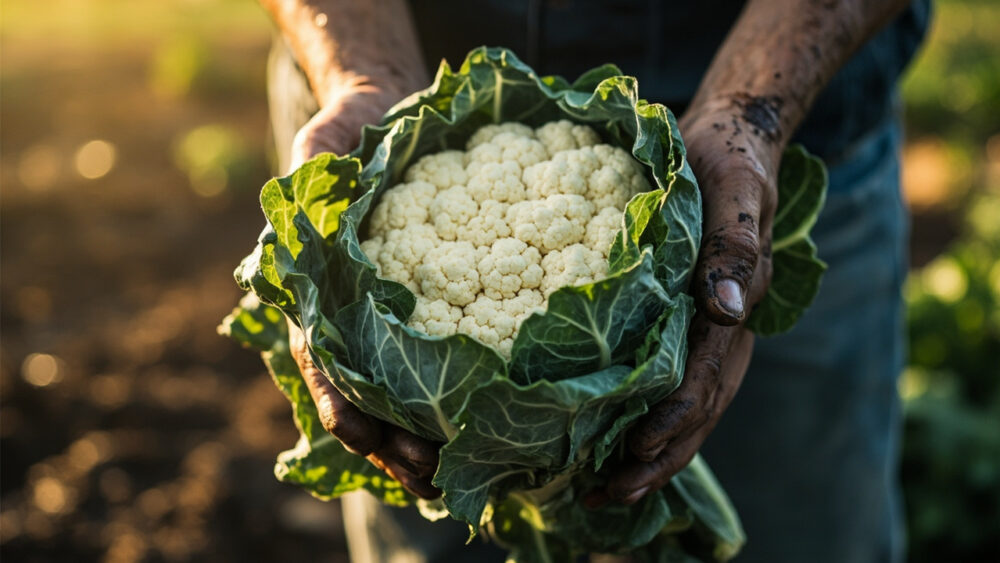
Press gently on the curd. A ready head feels dense and solid, almost like a smooth stone under the leaves. If it feels springy or the florets shift under light pressure, give it a few more days.
The surface check
Look closely at the curd’s surface. It should be smooth and uniformly white (or purple, orange, green, depending on variety), not grainy or starting to separate into individual rice-like bumps. That separated, “ricey” texture is the clearest sign you waited too long.
Size matters too, but only as a rough guide: most standard varieties mature at 6 to 8 inches in diameter, mini varieties closer to 3 to 4 inches.
Once you know what to feel for, the next question is when this actually happens on the calendar.
The Timing Window, and What Blanching Has to Do With It
Cauliflower runs 55 to 100 days from transplant to harvest depending on variety, and most home gardens hit that window 2 to 3 weeks after the head first becomes visible in the center of the plant. Spring crops mature as days warm toward early summer; fall crops mature as days cool, which most growers agree gives the better-tasting, more tender head.
Here is the part that trips people up: white varieties need blanching, which means tying or folding the outer leaves over the curd once it is about egg-sized, roughly 2 to 3 inches across. Sunlight turns exposed white curd yellow-green and bitter-edged. Self-blanching and colored varieties (purple, orange, green romanesco types) skip this step entirely.
Go early and you get a small but usable head, no real loss there if you are short on time. Go late and the curd turns ricey, then loose and flowering, then bitter. A bolted cauliflower head does not recover. That plant is done, and the only fix is starting a new one.
Heat is the other timing wrecker. A stretch of days above 80°F while the curd is forming pushes it to bolt fast, sometimes in 48 hours, which is why fall crops are more forgiving than late-spring ones.
So once the head is sized and firm, the clock is already running. Here is how to take it off the plant without damaging what is still growing.
How to Cut It Without Hurting the Plant
Cauliflower does not regrow a second main head the way broccoli sometimes throws side shoots, so there is no reason to baby the main stalk once you are cutting.
- Check firmness one more time by pressing the curd through the leaves.
- Use a sharp knife, not scissors or a twist, to cut cleanly through the stalk about 1 to 2 inches below the head.
- Leave a few wrapper leaves attached around the curd. They protect it from bruising and sunburn on the walk to the kitchen.
- Cut in the morning if you can, while the head is cool and hydrated. Midday heat softens the curd and shortens its storage life.
Do not yank or twist the head off. That can tear the stalk and let disease into the rest of the plant if you are hoping for side shoots.
The cut itself takes ten seconds, but what you do in the next hour decides how long that head actually lasts.
What Everyone Gets Wrong Right After the Cut
Here is the sign most gardeners misread: they think a cauliflower head that looks perfect at harvest will hold that way on the counter for a week. It will not. Cauliflower loses quality fast once cut, faster than most people expect from something that looks so solid.
Cool it immediately. Rinse off garden debris, pat dry, and get it into the refrigerator within an hour if possible. Wrapped loosely, unwashed heads keep 1 to 2 weeks in the crisper; washed and cut florets last closer to 5 to 7 days.
Do not leave it sitting on a warm porch “to admire it.” Every hour at room temperature is an hour off its storage life.
If you are harvesting more than you can eat fresh, that is the real follow-up question worth answering before you have a full basket sitting on the counter.
Keeping the Harvest Coming (and Storing What You Cut)
Cauliflower is a one-shot crop per plant, unlike zucchini or beans, so “keeping it coming” means staggering plantings, not coaxing more from the same stalk.
Succession planting is the real answer. Start a new set of transplants every 2 to 3 weeks through your early planting window, or plan a fall crop timed so heads mature as temperatures drop back into the 60s. That spreads harvest over a month or more instead of dumping every head on you the same week.
For storage beyond a week or two, cauliflower freezes well. Cut into florets, blanch in boiling water for 3 minutes, then plunge into ice water before freezing. It will not have quite the crunch of fresh, but it holds flavor for months.
Pickling is the other reliable option if you end up with more heads than your fridge can hold at once.
None of that matters if you missed the ready window in the first place, so here is everything worth saving in one place.
Cauliflower at a Glance
- When to plant: transplant 2 to 4 weeks before your last spring frost for a spring crop, or in mid to late summer for a fall crop that matures as temperatures cool.
- Days to maturity: 55 to 100 days from transplant depending on variety, with most home garden types landing around 70 to 80 days.
- Spacing and depth: space plants 18 to 24 inches apart in rows 24 to 30 inches apart, transplanting at the same depth they sat in the pot.
- Ready signs: curd is 6 to 8 inches across (3 to 4 inches for mini varieties), dense and firm to the touch, smooth surfaced, not grainy or separating.
- Blanching: for white varieties, tie outer leaves over the curd once it reaches egg size, about 2 to 3 inches, to prevent yellowing and bitterness.
- How to cut: use a sharp knife, cut 1 to 2 inches below the head, leave a few wrapper leaves on for protection, harvest in the morning when possible.
- Storage: refrigerate unwashed within an hour of cutting, use within 1 to 2 weeks fresh, or blanch and freeze for longer storage.
The single thing worth remembering is that firmness beats size every time you are deciding whether to cut.
Check by hand, not by eye, and you will rarely miss the window again.