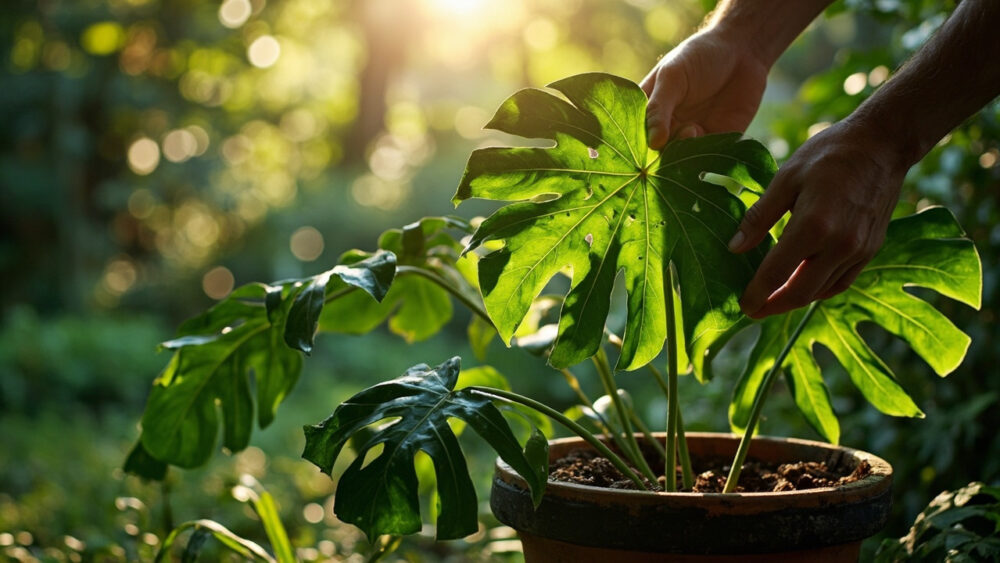
Monstera light requirements come down to one simple standard: bright, indirect light for at least six hours a day, the kind you get a few feet back from an east or south window with a sheer curtain or no direct sun hitting the leaves. Too little light and the plant survives but never splits a leaf. Too much direct sun and you get bleached, crispy patches within days.
Most people get this wrong in one of two directions, and both feel reasonable at the time. They either shove the monstera into a dim corner because it is a “jungle plant” and jungles are shady, or they park it in a south window thinking more sun always means more growth.
Neither guess is right, and I will untangle both below. Stick around for the placement fixes that work in ordinary rooms, the seasonal shift almost nobody accounts for, and the save-able Monstera at a Glance card at the very bottom of this page.
How Much Light a Monstera Actually Needs
A monstera deliciosa grows on the forest floor as a seedling, then climbs. As it climbs, it moves toward brighter, dappled canopy light, not full shade.
That is the light level you are recreating indoors: bright and indirect, not dim, not direct. Six to eight hours of it daily is the real target.
Fenestration, the splits and holes in mature leaves, is directly tied to light. A monstera in mediocre light will grow, but the new leaves stay solid and heart-shaped indefinitely.
Give it real brightness and the next several leaves start showing splits, then holes, then the full mature leaf shape.
Here is the honest answer to the question you are probably about to ask next: yes, a monstera can survive in low light, but survive is the ceiling, not the floor.
Next up: what that bright, indirect light actually looks like in a room you can picture.
What the Right Spot Looks Like in a Real Room
Forget lumens and foot-candles for a second. Use your eyes and your hand.
An east-facing window is close to foolproof. Set the monstera within 2 to 4 feet of the glass and it gets a few hours of gentle morning sun plus bright light the rest of the day.
A south-facing window works too, but back the plant 3 to 6 feet from the glass, or filter it with a sheer curtain, so the midday sun does not hit the leaves directly.
A west window is workable at 4 to 6 feet back; the afternoon sun there runs hotter and more direct than morning sun of the same intensity.
North-facing windows are the one direction that struggles on their own. Even right up against north glass, most homes cannot deliver six hours of truly bright light without help.
The quick test: at midday, hold your hand a foot above the leaves. A soft, blurry-edged shadow means good indirect light. A crisp, sharp-edged shadow means direct sun is hitting that spot.
No shadow at all, even in daytime, means the room is too dim for a monstera to thrive long term.
Now here is where most people misread what their plant is actually telling them.
The Signs of Too Little Light (and the Guess That’s Usually Wrong)
If you assumed a monstera in low light just grows slower, that guess is only half true and it costs people a whole season of confusion.
Small new leaves with no splits are the first tell. Even a mature plant will start throwing out juvenile, solid leaves if light drops.
Long gaps between leaves, called leggy or stretched growth, mean the plant is reaching for something brighter and spacing nodes farther apart to get there.
Leaning hard toward the nearest window is the plant voting with its whole body. Pale, washed-out green on new growth, as opposed to healthy deep green, is another low-light signal, and it is easy to mistake for a nutrient problem when it is really a light problem.
The fix is not fertilizer. Feeding a monstera that is light-starved just asks it to grow more of the same weak, unsplit leaves.
Move it closer to a window first, then worry about feeding.
Too little light is forgiving and reversible. Too much light is a different story, and it is the mistake that actually costs people leaves.
The Signs of Too Much Light (This Is the One That Ruins Leaves Fast)
Direct, hot sun on monstera leaves does not build a tougher plant. It scorches tissue that cannot repair itself.
Bleached, yellow-white patches that turn crispy and brown, usually on the side of the plant facing the window, are classic sunburn. This can show up in as little as a day or two of unfiltered afternoon sun through south or west glass.
Curling leaf edges and a generally scorched, dry look, especially combined with soil that dries out unusually fast, point the same direction.
Sunburned tissue does not turn green again. Once a patch is bleached and papery, that damage is permanent on that leaf, though the plant will grow past it with healthy new leaves once you fix the light.
The fix is simple: pull the plant back a foot or two from the glass, or add a sheer curtain between the plant and direct rays during the brightest hours.
You do not need to abandon that bright window, just soften what reaches the leaves.
Light this strong does not stay constant all year, which brings up the seasonal shift almost nobody plans for.
Why the Same Window Changes on You Season to Season
A spot that was perfect in June can turn into a low-light dead zone by December, and the plant does not lie about it, it just gets ignored.
Winter sun sits lower in the sky and the days are shorter, so total light hitting an east or north window can drop sharply even though the window itself never moved.
A south window often gets more usable light in winter, since the lower sun angle reaches farther into the room instead of blasting the sill.
Watch new growth every few months rather than assuming last season’s placement still works. If leaves start coming in smaller or paler as days shorten, that is your cue to move the plant closer to the glass, not to panic.
Come spring and summer, watch for the opposite: a spot that was gentle in January can scorch by July as the sun angle climbs and intensifies.
The plant asks for small adjustments twice a year, not a permanent decision made once.
If your rooms just do not have a window that swings from good to great, there are still real fixes short of buying a greenhouse.
Placement Fixes for Ordinary Rooms
You do not need a conservatory. You need to work with the windows you actually have.
Rotate the pot a quarter turn every week or two so growth does not all lean and lopsided toward one side.
If your only bright window is small, cluster the monstera there and move lower-light plants elsewhere in the room, rather than splitting good light between too many plants.
A sheer curtain is doing real work in a strong south or west window, cutting direct rays down to filtered bright light without you having to relocate anything.
For genuinely dim rooms, a full-spectrum grow light run for 10 to 12 hours a day, positioned 12 to 24 inches above the foliage, will carry a monstera through a north-facing apartment or a windowless office corner.
It will not look identical to a plant in a bright east window, but it will hold steady and keep producing fenestrated leaves instead of slowly declining.
Wipe dust off the leaves occasionally, too. A dusty leaf surface blocks a surprising amount of light and it costs nothing to fix.
Get the light right and most other monstera problems, slow growth, small leaves, leggy stems, sort themselves out on their own.
Monstera at a Glance
- Light needed: bright, indirect light for six to eight hours daily, with a little gentle direct morning sun tolerated.
- Best windows: east-facing at 2 to 4 feet back, or south or west-facing at 3 to 6 feet back or behind a sheer curtain.
- Too little light looks like: small unsplit new leaves, long gaps between leaves, pale color, leaning toward the window.
- Too much light looks like: bleached or crispy patches facing the glass, curled edges, fast-drying soil.
- Seasonal check: reassess placement in early winter and again in early summer as sun angle and day length shift.
- No good window fix: a full-spectrum grow light, 12 to 24 inches above the leaves, run 10 to 12 hours a day.
- Simple maintenance: rotate the pot every one to two weeks and wipe dust off the leaves monthly.
Get the light within that range and the plant tells you almost everything else it needs through its new leaves.
When in doubt, err toward brighter and indirect rather than dim or direct, and adjust from there.