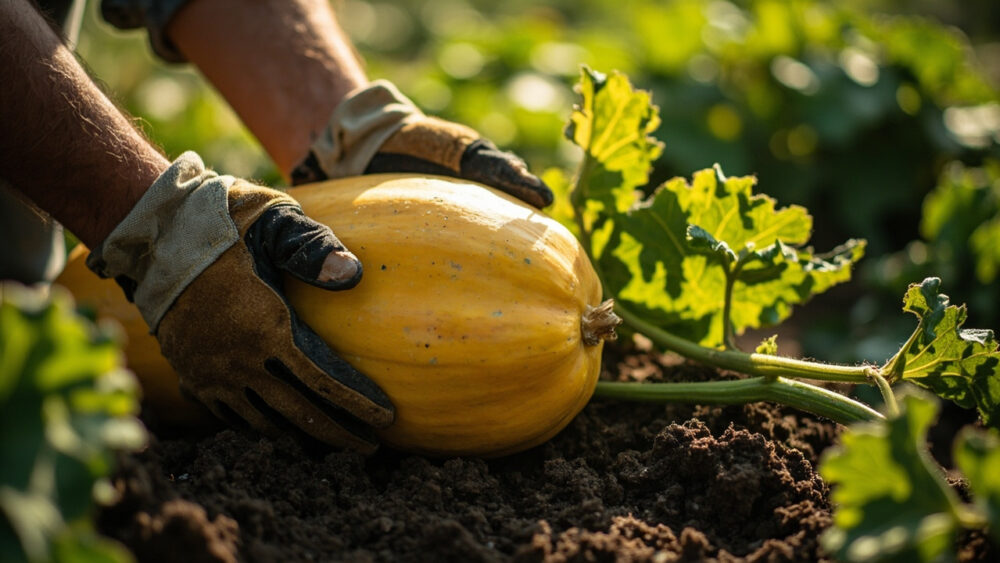
Spaghetti squash is ready when the rind turns a deep, even golden yellow (not the pale straw color it was three weeks ago) and your fingernail can’t dent the skin. That usually lands 75 to 100 days after planting, depending on the variety, roughly late summer into early fall for most gardeners. If any part of the squash still looks green or the skin gives a little under pressure, it needs more time on the vine.
Most people harvest spaghetti squash by guessing off the calendar, and that guess is exactly what leaves them with a squash that’s watery, bland, and short-lived in storage. There’s also a size trap almost everyone falls into that has nothing to do with when the fruit is actually ripe.
And once you’ve got it off the vine, there’s a step people skip that determines whether that squash lasts two weeks or four months. All of it, including the exact stem length to leave, the frost question, and the full at-a-glance card you can save to your phone, is coming up.
The Real Ready Signs, Not Just Color
Color is the first clue, but it’s not the only one, and relying on it alone is the guessable mistake. A ripe spaghetti squash is a solid, uniform golden yellow all over, including the side that was resting on the soil.
The fingernail test
Press a fingernail into the skin near the stem end. Unripe rind dents or punctures easily. Ripe rind resists and feels almost hard, like a gourd rather than a vegetable.
The stem
Check where the vine attaches. The stem should be dry, tan or brown, and starting to shrink and harden, not thick and green.
The leaf clue
Nearby leaves on that section of vine will often yellow and die back naturally as the fruit finishes ripening, even if the rest of the plant still looks healthy.
Size tells you almost nothing here, and that’s the trap.
Why Size Is a Trap and Timing Actually Matters
A spaghetti squash can hit full size, 8 to 10 inches long and a couple pounds, weeks before it’s actually ripe. If you cut it based on size alone, you’ll get a squash with thin, translucent flesh that cooks up mushy instead of forming those signature strands.
The real window is 75 to 100 days from transplant or direct seeding, and it always ends before your first fall frost, ideally with a couple of weeks of cushion. Vines planted after soil hits 65 to 70°F in late spring typically size up fruit by mid to late summer, with full ripening following four to six weeks later.
Harvest too early and you get bland, watery flesh that won’t cure or store. Wait too long, past a hard frost or into rot, and the fruit softens, the skin cracks, or the stem detaches and invites mold straight into the flesh.
One light frost on the vine, if the fruit itself isn’t damaged, actually won’t ruin it, but a hard freeze will.
That frost question is exactly where most people get nervous and cut too soon, so let’s settle it.
What Frost Actually Does to an Unripe Squash
A light frost that only touches the leaves is not an emergency. The vines can die back from cold while the fruit sitting on the ground stays fine for another week or more, especially if you toss a blanket or row cover over it on a frosty night.
A hard freeze is different. If the squash itself gets hit hard enough to feel cold and slightly soft to the touch, that fruit is done. It won’t cure properly and it won’t store, so use it soon or not at all.
The honest answer most people want here: if a frost is forecast and your squash still isn’t fully golden, cover the fruit, not just the vine, and check again in the morning. Don’t panic-harvest a squash that’s still green just because the weather app says 34°F.
Once you’ve made the call that it’s actually ready, how you cut it matters more than people expect.
How to Harvest Without Costing Yourself Storage Life
Use pruning shears or a sharp knife, not a twist-and-yank. Twisting tears the vine and often pulls the stem right out of the fruit, and a squash without its stem cap rots fast.
- Locate the stem where it meets the fruit, a few inches back from the squash itself.
- Cut cleanly through the vine, leaving 1 to 2 inches of stem attached to the squash.
- Support the fruit with your other hand as you cut so it doesn’t drop and bruise or crack.
- Set it down gently on a tarp or in a box, never tossed, since even a ripe rind can bruise internally from an impact.
Leave the vine and remaining fruit undisturbed if there are still squash ripening nearby.
Cutting it right is only half the job, what you do in the next 48 hours decides how long it keeps.
Curing: The Step Almost Everyone Skips
Fresh off the vine, spaghetti squash still has surface moisture and a soft spot where the stem was attached. Skipping curing is the second big mistake, right behind harvesting too early, and it’s the reason “fresh” squash sometimes rots in storage within two weeks.
Cure it by setting the squash in a warm, dry spot, around 80 to 85°F with decent airflow, for 7 to 10 days. A sunny porch, a garage with a fan, or a warm windowsill all work. This hardens the skin further and heals over the stem scar.
After curing, move it somewhere cool, dark, and dry, ideally 50 to 60°F. Stored this way, a properly cured spaghetti squash keeps for one to three months, sometimes longer for thick-skinned specimens.
Don’t stack them or store them touching each other, and check weekly for soft spots.
Curing handles what’s already picked, but there’s still the matter of everything left on the vine.
Keeping the Rest of the Harvest Coming
Spaghetti squash ripens over a period, not all at once, so most vines will have fruit at several different stages right up until frost. Keep harvesting individually as each one turns fully golden and passes the fingernail test, rather than waiting to clear the whole vine at once.
As the season winds down and frost approaches, stop watering as heavily. This nudges the plant toward ripening its remaining fruit rather than putting energy into new blossoms that won’t have time to mature anyway.
Any small green fruit still on the vine within two to three weeks of your first expected frost is honestly not going to ripen well. You can let it try, or pull it and use it young like a summer squash rather than losing it to cold.
Once the vine is spent and everything worth saving is cut and curing, the whole job comes down to the numbers below.
Spaghetti Squash at a Glance
- When to plant: after your last frost, once soil hits 65 to 70°F, either by direct seed or transplant.
- Spacing and depth: seeds 1 inch deep, plants spaced 24 to 36 inches apart in rows 4 to 6 feet apart for sprawling vines.
- Days to harvest: 75 to 100 days from planting, variety dependent.
- Ready signs: deep, even golden yellow rind all over, skin resists a fingernail, stem dry and tan.
- How to cut: clip the vine with shears, leaving 1 to 2 inches of stem attached, never twist it off.
- Curing: 7 to 10 days at 80 to 85°F with airflow before long-term storage.
- Storage: cool, dark, and dry around 50 to 60°F, keeps 1 to 3 months once cured.
Color and a firm rind tell you it’s ready, curing tells you how long you get to keep it.
Get both right and one squash plant will feed you well into winter.