Asparagus moves through four distinct growing stages over its life: the crown establishment year, the emerging spear stage each spring, the fern stage through summer, and dormancy in fall and winter. If you’re looking at asparagus growing stages because your bed looks nothing like the pictures online, the short version is that most “problems” are actually just the plant being younger than the reader expected.
Here’s the loop that trips up almost everyone: the harvest you’re waiting for does not happen the year you plant, and for most home gardeners it barely happens the second year either. There’s also a stage where the bed looks like it’s dying that actually means it’s working exactly right, and a stage where healthy asparagus and struggling asparagus look nearly identical unless you know the one thing to check.
Stick with me through the stages below and I’ll walk you through what’s normal, what’s a real warning sign, and what to do at each point. The savable “Asparagus at a Glance” card with every timing and spacing number is waiting at the bottom.
Year One: Crown Establishment
Timeframe: the first growing season after planting, typically planted 2 to 4 weeks before your last frost when soil hits about 50°F.
You plant crowns (the octopus-looking root clumps) 6 to 8 inches deep in trenches, spaced 12 to 18 inches apart, then cover with just 2 inches of soil, filling the trench gradually as shoots grow. What emerges the first year are thin, spindly spears, sometimes just a few pencil-width shoots per crown.
This is the stage almost everyone misreads. If those first spears look weak and sparse, your instinct is to assume something’s wrong with the soil or the crowns. It isn’t. The crown is building its root system underground, and top growth is intentionally minimal.
What it needs from you: consistent moisture, weeding by hand (asparagus roots are shallow and hate competition), and zero harvesting. None. Let every spear grow into fern.
The mistake that costs gardeners their whole bed happens right here, and it’s not a planting mistake.
The Mistake That Ruins Most Asparagus Beds
It’s harvesting too early. Cutting spears in year one or two robs the crown of the energy it needs to build the root mass that will feed you for the next 15 to 20 years.
The honest rule: no harvest at all in year one, a light harvest of just a few spears over 1 to 2 weeks in year two, and a full harvest window of 6 to 8 weeks starting in year three.
Gardeners who cut hard in years one and two often get a decent bed for a few seasons, then watch it decline permanently. There’s no fixing that after the fact. You start over.
Patience here is the entire skill, and it’s harder than it sounds when spears look ready to eat.
Year Two: Light Spears, Still Building
Timeframe: the second spring after planting.
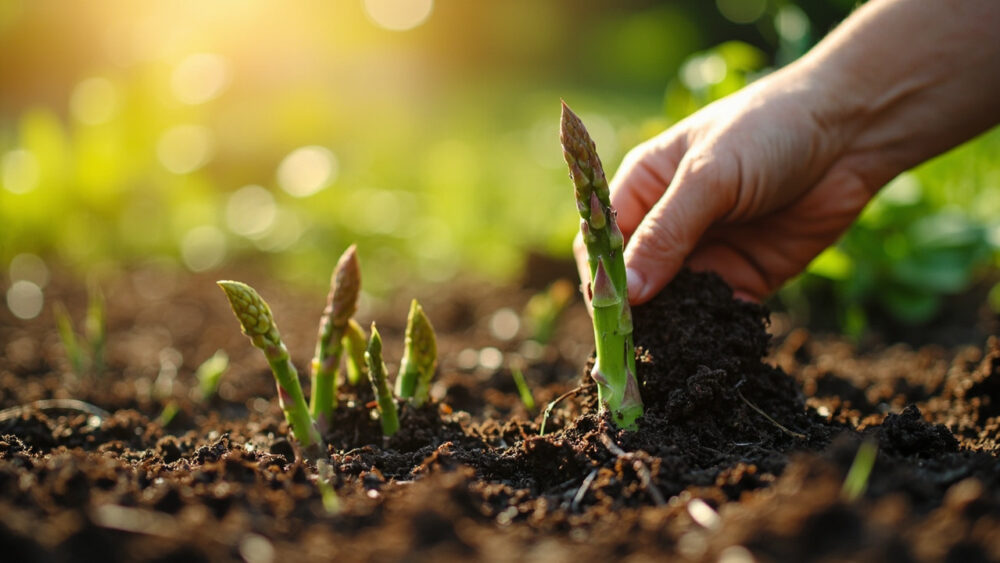
Spears come up thicker than year one, often 1/4 to 1/2 inch across, and there are more of them. This is where the guessable assumption is that thicker spears mean it’s fully time to harvest normally.
The real answer is a limited harvest only: take spears for 1 to 2 weeks, then stop and let everything else go to fern, even if more spears keep emerging. Fertilize lightly once growth starts, using a balanced fertilizer or compost worked in near the row, not directly on the crowns.
The fern that follows is doing the real work, converting sunlight into sugars the roots store for next year’s spears.
Year three changes the rules, and it’s the payoff every asparagus grower is actually waiting for.
Year Three and Beyond: Full Spear Harvest
Timeframe: spring, starting when soil warms to around 50°F, usually a few weeks after your last frost.
Established crowns push up spears fast, sometimes an inch or more of growth per day in warm weather. Harvest by snapping or cutting spears at soil level once they reach 7 to 9 inches tall, before the tips start to loosen and open.
Harvest window: 6 to 8 weeks. After that, stop cutting entirely, even though spears keep coming.
Check the bed daily during peak season. Warm spells push growth so fast that spears go from perfect to overmature in a single day, turning woody and the tips opening into feathery bracts.
Once you stop harvesting, the bed transforms into something that looks nothing like a vegetable garden anymore.
The Fern Stage: Why the “Dead” Look Is Actually Success
After harvest ends, uncut spears grow into tall, feathery fern, often 3 to 5 feet high, sometimes taller. This is the stage where the plant looks the least like food and does the most work.
Fern photosynthesizes all summer, sending sugars down to the roots for storage. Cutting fern back early is one of the quieter mistakes gardeners make, thinking they’re tidying up. Doing that starves next year’s harvest the same way over-cutting spears does.
Let it stand until it yellows and browns on its own in fall, usually after the first hard frosts.
That yellowing is your next stage starting, not a problem to fix.
Dormancy: Fall and Winter
Timeframe: from first hard frost through late winter, varying widely by zone but generally USDA zones 3 through 8 for outdoor asparagus.
Ferns turn brown and dry out completely. At this point, cut them down to 1 to 2 inches above soil level and clear the debris, since old fern can harbor asparagus beetle eggs and fungal spores over winter.
The crowns sit dormant underground through cold months, needing nothing from you except a layer of mulch in harsher climates to buffer temperature swings.
Come spring, the whole cycle restarts, and this is where a healthy bed and a stalled one finally reveal themselves.
Healthy Progress vs. a Stalled Bed
Healthy asparagus sends up more spears each year and thicker ones, with harvest windows that hold steady or lengthen slightly over the first several seasons. A stalled bed sends up fewer, thinner spears year over year, or spears that emerge weak and spindly even in an established, mature bed.
The check most people skip is looking at spear diameter across the whole bed rather than judging by spear count alone. Thin spears everywhere, even in year four or five, usually point to overcrowding, poor drainage, or a bed that was harvested too hard too early.
Weedy competition and waterlogged soil are the next most common causes, since asparagus roots resent both.
If your bed is thinning out rather than filling in, the fix is almost always patience and less harvesting, not more fertilizer.
Asparagus at a Glance
- When to plant crowns: 2 to 4 weeks before your last frost, once soil reaches about 50°F.
- Planting depth and spacing: 6 to 8 inches deep, 12 to 18 inches apart, rows 3 to 4 feet apart.
- Year one: no harvest, let all spears grow into fern to build roots.
- Year two: light harvest only, 1 to 2 weeks, then stop and let ferns grow.
- Year three and beyond: full harvest for 6 to 8 weeks, cutting spears at 7 to 9 inches tall.
- After harvest: stop cutting completely and let fern grow all summer to recharge the roots.
- Fall and winter: cut back browned fern to 1 to 2 inches after frost, mulch in cold climates, crowns stay dormant until spring.
Asparagus rewards patience more than any other vegetable in the garden. Skip the first two years’ restraint and you’re rebuilding the whole bed, not just replanting a few crowns.