The answer to when to harvest lettuce depends on the type, but the check is the same every time: leaf lettuce is ready to cut once the outer leaves reach 4 to 6 inches, usually 25 to 45 days after planting, while head types like romaine and butterhead want a firm, closed center at 55 to 75 days. You do not need a calendar so much as a hand on the plant and an eye on the leaves.
Most people blow this in one of two directions. Either they harvest too early because the lettuce “looks small” and never let it bulk up, or they let it sit too long chasing a bigger head and end up with something bitter and bolted. There is also a sign almost everyone misreads as “it’s fine, give it another week” when it actually means the window just slammed shut.
I will walk through exactly what to look and feel for, the harvest method that keeps leaf lettuce producing for weeks instead of once, and what to do in the ten minutes after you cut it. Save-able specifics, including days to maturity by type, are in the Lettuce at a Glance card at the bottom.
The Ready Signs: What to Actually Check
Forget counting days as your only signal. Days to maturity gets you in the neighborhood, but weather moves the timeline around by a week or more in either direction.
Leaf size and firmness
For loose-leaf types (oakleaf, green leaf, red leaf, mesclun mixes), outer leaves at 4 to 6 inches are harvest-ready. They should feel crisp, not floppy, when you fold one gently between two fingers.
Head firmness
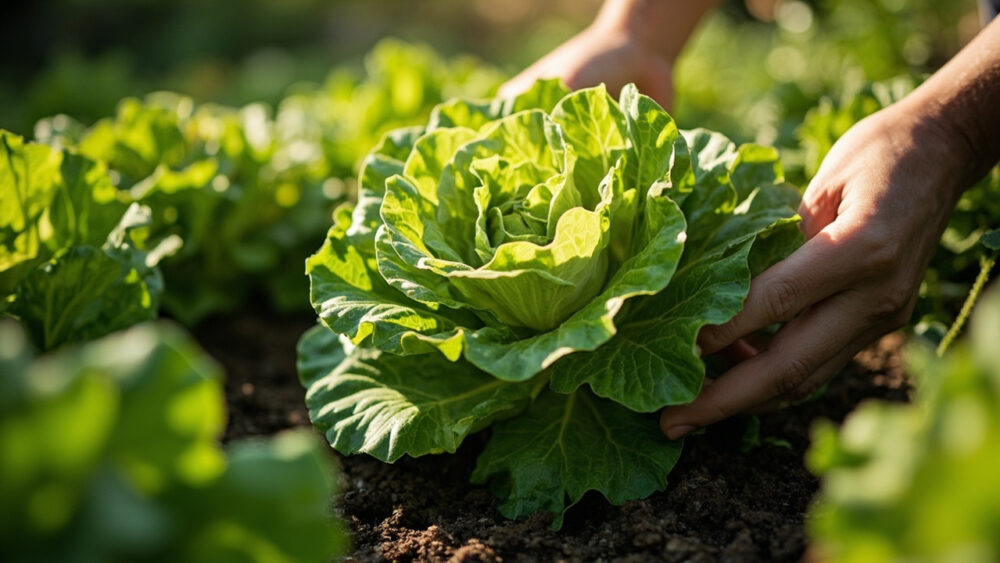
For romaine, butterhead, and iceberg-type crisphead, gently squeeze the top of the plant. A ready head pushes back with some resistance. A loose, floppy top means it needs more time.
Next up is the sign most people get backwards, and it is the one that actually costs you the whole plant.
The Sign Everyone Misreads: Bolting
If you assumed a tall center stalk shooting up from the middle of the plant just means “give it another week to fill out,” that guess is what turns your lettuce bitter. That stalk is the plant bolting, sending up a flower stem because heat or day length told it the season is ending.
Bolting is not a pause, it is the finish line. Once that center stem elongates, the leaves start pumping out a bitter compound within days, and there is no reversing it. A little bitterness is tolerable if you catch it fast. A lot is not.
Warm weather, usually consistent days above 75 to 80 F, is the main trigger, which is why spring and fall crops usually beat a full-summer planting in anything but a cool climate.
The moment you see that center stalk rising, your timing window is closing, not opening.
The Timing Window: Early, Late, and Right on Time
Harvest early and you lose yield, nothing more. Baby leaf lettuce cut at 2 to 3 inches is genuinely delicious, just less of it. That is a legitimate choice, not a mistake, if that is what you are going for.
Harvest late on loose-leaf types and the outer leaves get tough, sometimes with a milky sap when you snap the stem. That sap is a bitterness preview.
Harvest late on head lettuce and you get the bolting problem above, plus heads that split or turn woody at the core.
The forgiving direction is early. The unforgiving direction is late, especially once daytime temperatures climb. In warm weather, check plants every 2 to 3 days once they’re in the size range, because the gap between “perfect” and “bitter” can be less than a week.
Knowing when is half the job. Knowing how to cut it without wrecking the plant is the other half.
How to Harvest Without Damaging the Plant
The method changes depending on whether you want one cut or repeated cuts, and this is where a lot of gardeners waste a plant’s full potential.
- For a full head: cut the entire plant at the base with a sharp knife or garden scissors, right at soil level. Do this in the cool of the morning if you can, when leaves are fully hydrated and crisp.
- For repeat harvests of leaf lettuce: snip or pinch outer leaves individually, leaving the inner 2 to 3 inches of young growth and the central growing point untouched.
- Never strip a leaf-lettuce plant bare. Take no more than a third to half of the leaves at once, or the plant won’t have enough left to keep photosynthesizing and regrowing.
- Cut, don’t tear. Torn stems bruise and invite rot; a clean cut heals over faster.
Get the cut right and you either get one clean head or weeks of repeat cuttings, your choice, but only one of those choices survives being handled wrong.
Right After the Cut: The First Ten Minutes
Lettuce wilts fast, faster than almost anything else in the vegetable garden, so what you do immediately after cutting matters more than people expect.
Get it out of direct sun immediately. Leaves left in a harvest basket in full sun can go limp in under 20 minutes on a hot day.
Rinse in cool water, shake or spin dry, and refrigerate in a loosely sealed bag or container. Dry storage, not wet, is what keeps it from turning slimy; excess water left clinging to leaves speeds up rot in the fridge.
Stored this way, most lettuce holds well for 7 to 10 days, sometimes longer for sturdier types like romaine.
One harvest is satisfying, but the real payoff is getting several from the same bed.
Keeping the Harvest Coming
This is the honest answer to the question you’re about to ask: yes, you can cut the same lettuce plant more than once, but only if it was leaf lettuce and only if you left the center intact.
After cutting outer leaves, water the bed and give it a light feeding with a balanced fertilizer or compost tea. New leaves typically regrow enough for a second harvest in 2 to 3 weeks.
Head lettuce is one-and-done. Once you cut a romaine or butterhead head at the base, that plant is finished. There’s no regrowth worth waiting for.
To keep a steady supply all season, succession plant a new short row every 2 to 3 weeks during your cool season rather than planting it all at once.
Everything above boils down to a handful of numbers worth keeping on your phone.
Lettuce at a Glance
- When to plant: 2 to 4 weeks before your last frost for a spring crop, or 6 to 8 weeks before first fall frost for a fall crop. Lettuce germinates best in soil between 40 and 75 F.
- Spacing and depth: seeds sown 1/4 inch deep, thinned to 6 to 8 inches for leaf types and 8 to 12 inches for head types.
- Days to maturity: 25 to 45 days for leaf lettuce, 55 to 75 days for romaine and butterhead, 70 to 85 days for crisphead types like iceberg.
- Ready signs: outer leaves at 4 to 6 inches and crisp for leaf types, a firm head that pushes back when squeezed for head types.
- Bolting warning: a rising center stalk means harvest now, since sustained heat above 75 to 80 F triggers bitterness within days.
- How to cut: whole plant at soil level for a single harvest, or outer leaves only, taking no more than half at once, for repeat cuttings.
- Storage: rinse, dry thoroughly, refrigerate loose in a bag or container. Keeps about 7 to 10 days.
Check the leaf, not the calendar, and cut before the center stalk ever shows up.
Do that and one packet of seeds can feed you for a solid month or more.