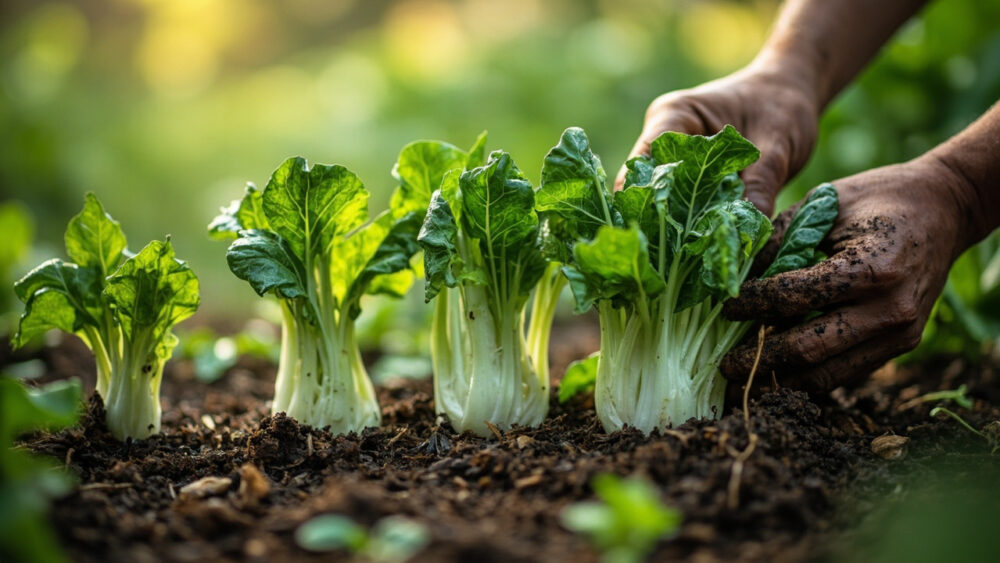
Bok choy moves through five clear stages in 45 to 60 days: germination in the first week, a slow seedling stage for about two weeks, a rapid leafy growth phase for two to three weeks, mature head formation, and then bolting if you leave it too long in warm weather. From seed to harvest you’re usually looking at six to eight weeks depending on the variety and the heat.
Most of the trouble with bok choy growing stages happens at one specific point, and it is not the one people worry about. Everyone braces for pest damage or bad germination.
The stage that actually wrecks the crop is the one where the plant looks totally fine right before it ruins itself. I’ll flag exactly where that happens, plus the sign that tells you the plant has stalled versus the sign that tells you it’s simply moving slower because of weather. Save-worthy specifics, including a full Bok Choy at a Glance card, are waiting at the bottom.
Stage 1: Germination (Days 1 to 7)
Bok choy seeds sprout fast when soil temperature sits between 50 and 75 F. In that range, expect a sprout in 4 to 7 days. Below 50 F, germination slows way down or stalls entirely.
Sow seeds a quarter inch to half an inch deep, direct in the garden or in cell trays if you’re starting indoors. Keep the soil consistently moist, not soggy. Bok choy seeds are small and shallow, so they dry out fast if you let the top layer crust over.
This is the easiest stage to get wrong by planting too early. Bok choy can go in the ground 2 to 3 weeks before your last frost for a spring crop, or in mid to late summer for a fall crop, but the soil has to have warmed past that 50 F floor first, not just the calendar.
Once you see the first two leaves unfold, you’re into the part where the plant seems to just sit there.
Stage 2: Seedling stage (Weeks 1 to 3)
This is the slow part, and it is where most people panic for no reason. The seedling puts up a pair of true leaves, then seems to barely grow for a week or two while it builds roots below ground.
If you assumed slow top growth means the plant is struggling, that guess sends a lot of gardeners straight to the fertilizer bottle when the plant didn’t need it. Root establishment is invisible, and it’s exactly what’s supposed to happen here.
What the plant actually needs at this stage is thinning and space, not feeding. Thin seedlings to 6 to 10 inches apart for full-size bok choy, or 4 to 6 inches for baby bok choy varieties. Crowded seedlings stunt each other permanently, and you can’t fix that later by thinning after the fact.
Once the roots are established, growth speeds up fast, almost overnight.
Stage 3: Rapid vegetative growth (Weeks 3 to 5)
This is the stage everyone actually enjoys watching. Leaves widen, the stalks thicken and turn glossy, and the whole plant can visibly change day to day. This is where bok choy earns its reputation as a fast, satisfying crop.
Water is the main lever here. Bok choy wants consistent moisture, about 1 to 1.5 inches a week, and it punishes inconsistency more than most greens do. Let it dry out hard and then soak it, and you’ll see leaves turn tough or bitter even if the plant recovers visually.
Feed once with a balanced fertilizer or a nitrogen-leaning one partway through this stage if your soil is average. Rich soil from the start often doesn’t need it at all.
Watch the center of the plant closely now, because the next stage sneaks up on people who stop paying attention right when things look great.
The stage where most bok choy crops actually fail
Here’s the honest answer to the question you’re about to ask: it’s not pests, and it’s not disease. It’s bolting, and it happens right at the edge of maturity, which is exactly when the plant looks its best.
Bok choy is a cool-season crop, and a stretch of heat, often several days above 75 to 80 F, combined with the plant hitting a mature size, triggers it to send up a flower stalk from the center. Once that stalk appears, the leaves turn bitter fast and the head is basically done as a vegetable.
The visual tell is a thick stem shooting up from the middle, taller than the surrounding leaves, sometimes with a slight point on top. By the time you see yellow flower buds, it’s too late to reverse.
This is why fall crops often outperform spring ones for bok choy: cooling weather instead of warming weather means less bolting pressure as the plant matures.
Stage 4: Head maturity and harvest window (Weeks 5 to 8)
Full-size bok choy is ready when heads reach 8 to 12 inches tall with a wide, upright rosette of leaves and thick white or pale green stalks. Baby bok choy varieties mature much smaller, often at 4 to 6 inches, and are ready weeks earlier.
Harvest by cutting at the base, just above the soil line, using a knife or shears. You can also pick individual outer leaves gradually if you want a longer harvest window instead of one clean cut.
Don’t wait for “bigger is better” here. Bok choy left too long past maturity is exactly what tips it into bolting, especially once warm days arrive.
Knowing what a stalled plant looks like versus a slow one saves you from pulling a perfectly good crop too early.
Healthy progress versus a real stall
Slow growth from cool weather still looks healthy: leaves are deep green, stalks are firm, and the plant is simply taking its time. That’s weather, not failure.
A true stall looks different. Leaves turn pale or yellow from the bottom up, growth stops even as temperatures warm, and the plant may look slightly wilted even with wet soil. That combination usually points to nitrogen deficiency, root crowding, or root damage from pests like cabbage root maggot.
Check the roots if you suspect the second scenario. Healthy bok choy roots are white and firm. Mushy, dark, or chewed roots mean the problem is below ground, not something a top dressing of fertilizer will fix.
If the roots check out fine and it’s just slow, patience is the actual answer, not intervention.
Bok Choy at a Glance
- When to plant: 2 to 3 weeks before last frost for spring, or mid to late summer for a fall crop, once soil is above 50 F.
- Days to maturity: 45 to 60 days from seed, faster for baby bok choy varieties.
- Spacing: 6 to 10 inches apart for full-size heads, 4 to 6 inches for baby varieties.
- Planting depth: a quarter inch to half an inch, kept consistently moist until germination.
- Water needs: about 1 to 1.5 inches per week, kept even rather than feast or famine.
- Bolting risk: highest once mature plants hit several days above 75 to 80 F, watch for a thick center stalk.
- Harvest signs: 8 to 12 inch upright heads for full-size, 4 to 6 inches for baby bok choy, cut at the base.
Bok choy rewards attention more than effort. Watch the center of the plant as it nears full size, and you’ll catch the one moment that decides whether you eat it or lose it to bolting.