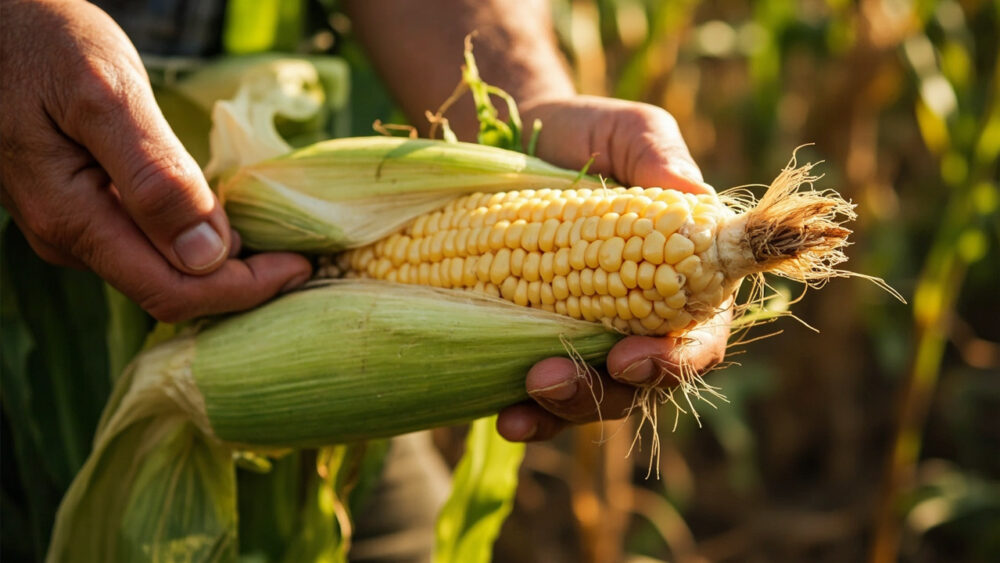
Corn is ready to harvest when the husks are still green but the silks have turned brown and dry, usually 18 to 24 days after the silks first appear. The surest test is the thumbnail check: pierce a kernel, and if it squirts a milky white liquid instead of clear watery juice, that ear is ready to pick now. Knowing when to harvest corn comes down to reading the ear, not counting days on a calendar, because heat and rainfall speed things up or slow them down by a week in either direction.
Most people ruin their corn one of two ways. They either pick too early because the ear “looks” full sized, or they let it hang too long waiting for some perfect moment that already passed a few days ago.
There is also a mistake almost nobody sees coming: harvesting correctly but yanking the ear off in a way that snaps the whole stalk over, which kills the other ears still ripening on it. I will walk through the exact twist-and-pull motion that avoids that, plus how to keep a longer harvest window going instead of getting all your corn at once. The full save-it-to-your-phone rundown is waiting at the bottom.
The Real Ready Signs, Not Just “It Looks Big”
Size lies. An ear can look full and still be starchy and underdeveloped inside, or look modest and be perfect. You need three signs together, not one.
Silk color and dryness
Fresh silks are pale green or yellow and slightly moist. Ready silks have turned brown, dry, and slightly crispy, usually while the husk around them is still tightly wrapped and green. Silks browning is the first flag, not the final proof.
Husk fill and firmness
Squeeze the ear through the husk. It should feel firm and full from tip to base, with no soft or narrow taper at the top. A tapered tip usually means the kernels up there never filled in.
The kernel juice test
Peel back just enough husk to expose a few kernels near the middle of the ear. Press one with a thumbnail. Milky white liquid means ripe and ready. Clear liquid means wait a few more days. No liquid at all, just a dent, means you waited too long.
Once two of these three signs line up, the ear is ready and the clock is now working against you, not for you.
The Timing Window, and What Early or Late Actually Costs You
Sweet corn typically hits harvest readiness 60 to 100 days after planting depending on the variety, but the window you actually have to pick each ear at its peak is short, often just 4 to 6 days.
If you assumed early picking just means slightly less sweet corn, that guess undersells the problem. Corn picked too early is watery, thin fleshed, and starchy rather than sweet, because the sugars in the kernel have not finished converting yet. It will not ripen further once cut from the stalk. There is no windowsill trick that fixes an early ear.
Late corn is the more common regret. Once kernels pass peak ripeness, sugars convert to starch fast, especially in hot weather. The kernels get tough, doughy, and dull tasting within a few days of peak. In sustained heat above 85°F, that decline happens even faster, sometimes in 48 hours.
Cool nights slow the whole process down and buy you a longer window, which is why fall corn often tastes better and holds longer than a July crop planted in a heat wave.
How to Pick an Ear Without Wrecking the Stalk
Grab the ear firmly near its base, where it attaches to the stalk. With your other hand, steady the stalk itself just below that point.
Twist the ear a quarter turn while pulling downward and away from the stalk in one motion. It should separate cleanly at the base with a distinct snap. Do not yank straight out sideways or upward, that is what tears the stalk over or snaps it, and a broken stalk stops feeding any other ears still growing on it.
Work through the row checking each stalk individually. Many stalks produce two ears, and the top one often ripens several days before the lower one, so do not assume one pass through the row gets everything.
Getting the ear off clean is only half the job, what you do in the next hour matters just as much.
What to Do in the First Hour After Picking
Corn starts losing sweetness the moment it is cut from the stalk, so speed matters more here than with almost any other vegetable.
Get it cool fast. Move harvested ears out of direct sun immediately and into shade, a cooler, or the refrigerator within an hour if possible. Warm corn sitting in a garden cart in the sun can lose a noticeable amount of sweetness within just a few hours.
Leave the husks on until you are ready to cook or process the corn. The husk protects moisture and slows sugar loss better than any wrap you own.
If you are not eating it within a day or two, freezing is your best option, and that decision needs to happen soon after picking, not next weekend.
Keeping the Harvest Going Instead of Getting It All at Once
If you want corn over weeks instead of one overwhelming pile, the fix happens at planting time, not harvest time.
Stagger your plantings every 10 to 14 days through your safe planting window, or plant an early, mid season, and late maturing variety at the same time. Either approach spreads out your silk-and-ripen windows naturally.
Once you are in harvest mode, check the patch every day or two rather than once a week. Corn does not wait politely for your schedule, and a few days of inattention during peak ripeness is how a chunk of the crop goes from perfect to starchy.
Pull ears as they hit peak rather than waiting to harvest the whole block at once, even if that means multiple small trips to the garden instead of one big one.
That daily habit is really the whole secret, and here is everything else worth keeping close at hand.
Corn at a Glance
- When it’s ready: silks brown and dry, husk full and firm, kernel juice runs milky white when pierced, usually 18 to 24 days after silks first appear.
- Days to maturity: roughly 60 to 100 days from planting depending on variety, so check the seed packet for your specific type.
- Peak picking window: about 4 to 6 days per ear, shorter in hot weather, longer in cool conditions.
- How to pick: grip the ear at its base, steady the stalk, twist a quarter turn while pulling down and away until it snaps free.
- After picking: get ears out of the sun and into shade or the fridge within an hour, and leave husks on until you cook or freeze.
- If you’re unsure: the thumbnail juice test beats guessing by size every time, milky means ripe, clear means wait, dry means past peak.
- For a longer harvest: stagger plantings by 10 to 14 days or grow early, mid, and late varieties together, and check the patch daily once silks start browning.
When in doubt, trust the thumbnail over your eyes. Pick a little on the early side of your best guess, because a slightly immature ear still tastes fine, but an overripe one never recovers.