The fastest way to sort out types of purple flowers is by growth habit first, color second: is it a spike, a mound, a climber, or a single stem, because purple shows up in every one of those shapes and the shape tells you where it actually fits in your yard. Once you know the habit, the shade of purple (true violet, blue-purple, wine, or lavender-gray) narrows it the rest of the way.
Most people reach for the same three purple flowers for the wrong reason: they look good in the nursery pot, not because anyone checked how they behave three months later. One of them turns into an aggressive spreader that outcompetes everything near it by August.
Experienced gardeners quietly favor a plainer-looking entry lower on this list because it blooms for months and asks for nothing. Number 13 below is the one most people get completely wrong, usually planting it somewhere it will rot within a year. Stick around for that one and for the choosing method at the very bottom, it will save you a wasted season.
Spikes and Tall Bloomers
These give you vertical structure and read as purple from across the yard.
1. Salvia (Salvia nemorosa and relatives)
Dense flower spikes on square stems, blooming spring through midsummer with a second flush if you shear it back. Hardy in zones 4 through 9, full sun, drought tolerant once established, and a magnet for bees. Grows 18 to 30 inches depending on variety.
2. Russian Sage (Salvia yangii, formerly Perovskia)
Silvery stems with airy purple haze rather than dense spikes, giving a see-through effect in a border. Zones 4 through 9, needs full sun and lean, well-drained soil, and gets woody and shrub-like at 2 to 4 feet. This is the one that shrugs off heat and neglect better than almost anything on this list.
3. Foxglove (Digitalis purpurea)
Tall bell-shaped florets stacked on a single spike, 3 to 5 feet, blooming late spring into early summer. Biennial in most climates, meaning it grows foliage the first year and flowers the second, then often self-seeds. All parts are toxic if eaten, so keep it away from areas where pets graze and call a veterinarian immediately if you suspect ingestion.
4. Liatris (Liatris spicata), the Blazing Star
Bottle-brush spikes that open from the top down, an unusual trait that confuses people expecting bottom-up bloom. Zones 3 through 9, full sun, tolerates poor soil and drought once its tuberous roots are established, and draws butterflies hard.
Tall spikes give you height, but the next group works in soft, rounded drifts instead.
Mounding and Border Purples
These fill in low to mid-height and are the backbone of most purple flower beds.
5. Lavender (Lavandula angustifolia and hybrids)
Gray-green foliage with narrow purple spikes, unmistakable by scent alone. Zones 5 through 9 for English types, needs full sun and sharp drainage, and rots fast in heavy clay or if overwatered. This is the popular one people plant for the smell without checking their soil, and it’s also the aggressive spreader people misjudge in reverse: it doesn’t spread, it just dies quietly in wet ground.
6. Catmint (Nepeta faassenii)
Loose lavender-blue spikes over soft gray foliage, blooming nearly nonstop from late spring to frost if you cut it back hard after the first flush. Zones 3 through 8, full sun to light shade, and genuinely hard to kill.
7. Bellflower (Campanula species)
Cup or star-shaped blooms in violet-blue, ranging from low creeping types to 3-foot clump formers depending on species. Zones 3 through 8, prefers morning sun with afternoon shade in hot climates, and some spreading types (like Campanula rapunculoides) will take over a bed if you don’t stay ahead of them.
8. Purple Coneflower (Echinacea purpurea)
Daisy-form petals in rosy purple around a spiky bronze cone, blooming summer into fall. Zones 3 through 9, full sun, thrives on neglect once rooted, and leaving spent blooms standing feeds goldfinches all winter.
Mounding purples fill the middle of a bed, but a few purples want to climb or trail instead.
Climbers and Trailers
Vertical space and hanging baskets both have purple options worth knowing by name.
9. Clematis (Clematis hybrids, purple-flowered types)
Large star-shaped or bell blooms on twining vines that climb 6 to 12 feet given a trellis or fence. Zones 4 through 9, prefers roots shaded and cool while the top grows in sun, which is the classic mistake, planting the whole thing in a hot exposed spot.
10. Wisteria (Wisteria species, particularly American wisteria)
Long hanging clusters of purple pea-like flowers in spring, on a woody vine that gets heavy and needs serious support. Zones 5 through 9, full sun, and Asian species (Chinese and Japanese wisteria) can become invasive and structurally destructive if left unchecked, so choose American or Kentucky wisteria if you want a better-behaved version.
11. Petunia (purple and violet cultivars)
Trumpet-shaped blooms in solid or veined purple, grown as an annual almost everywhere, spilling nicely over pot edges and hanging baskets. Full sun, regular feeding, and pinching back leggy stems keeps it blooming through summer heat instead of going bare in the middle.
Climbers solve vertical space, but a handful of purples are grown for structure, foliage, or a single unmistakable bloom instead of mass color.
Bulbs, Foliage, and Single Statement Blooms
This group is smaller in number but does more specific work in a design.
12. Allium (Allium hollandicum and relatives)
Perfectly round purple globes on bare stems, emerging from bulbs planted in fall. Zones 4 through 8, full sun, and deer and rodents generally leave them alone because of the onion-family scent.
13. Bearded Iris (Iris germanica)
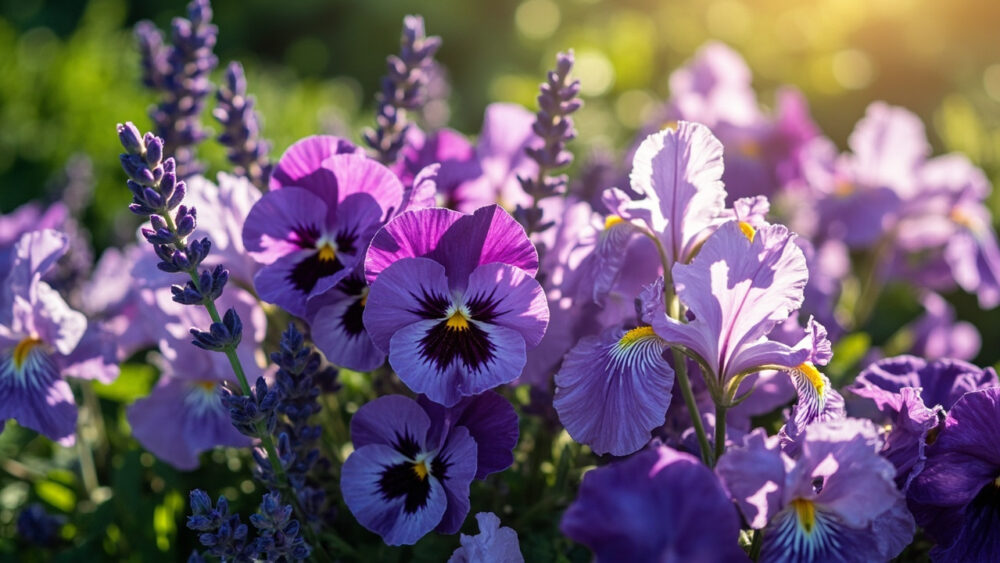
Ruffled purple petals with a fuzzy “beard” marking, growing from thick rhizomes rather than true bulbs or roots. This is the one most people get wrong: they plant the rhizome too deep or in soil that stays wet, and it rots within a year. Plant it with the top of the rhizome just barely exposed at the soil surface, in full sun, zones 3 through 9, with sharp drainage, and it will reward you for a decade.
14. Heuchera (Coral Bells, purple-leaf cultivars)
Grown mainly for deep purple foliage rather than the small bell-shaped flowers, which are a bonus, not the main event. Zones 4 through 9, does best with morning sun and afternoon shade, and gives you season-long color when nothing else is blooming.
15. Verbena bonariensis
Tiny purple clusters on tall, nearly see-through stems, 3 to 5 feet, giving height without blocking the view of what’s behind it. Grown as an annual in colder zones and a short-lived perennial in zones 7 through 10, full sun, and it self-seeds generously, which is either a gift or a nuisance depending on how much you want it spreading.
How to Choose the Right One
- Start with space: know your actual square footage and vertical clearance before you fall for a photo, since wisteria and clematis need real structure and Russian sage needs real width.
- Match your climate zone honestly: a lavender that struggles through humid summers in zone 8 will outperform expectations in a dry zone 6, so check both cold hardiness and heat tolerance, not just one.
- Decide the job first: mass color from a distance points to salvia or coneflower, a single specimen bloom points to iris or allium, foliage color that lasts all season points to heuchera.
- Be honest about your care appetite: catmint and coneflower tolerate neglect, lavender and clematis punish wet feet, and petunias want regular feeding and deadheading to keep performing.
- Check your drainage with a shovel, not a guess: dig a hole, fill it with water, and if it hasn’t drained within an hour, cross lavender and iris off your list until you fix that spot.
- If pets or kids use the yard, skip foxglove and be selective about wisteria placement, since ingestion of either warrants a call to a veterinarian or doctor rather than a wait-and-see approach.
Purple covers more ground than any other flower color, from waist-high spikes to a single ruffled iris bloom, and the right pick has more to do with your soil and sun than your taste in shade.
Walk your space with this list in hand and you’ll know within five minutes which of these fifteen actually belongs there.