Learning how to grow snapdragons starts with one decision most people get backward: plant too late in warm soil and you get a handful of half-hearted blooms before summer heat shuts the whole show down. Get them in while the soil is still cool, four to six weeks before your last frost for transplants, and you get tall, sturdy spikes for months instead of weeks. Snapdragons are a cool-season flower pretending to be a summer annual, and that single fact explains almost every mistake people make with them.
There is a pinching step almost everyone skips because it feels like vandalism, and skipping it is the reason so many snapdragon patches end up leggy and floppy by July. There is also a watering habit that looks responsible but actually invites the one disease that kills snapdragons outright. And there is an honest answer to the question you are about to ask, which is why your snapdragons stalled out mid-summer when they were doing so well in spring.
Stick with me through the timing, the planting, and the troubleshooting, and I will put a full Snapdragons at a Glance card at the bottom you can screenshot and take straight to the garden.
When to Plant Snapdragons
Snapdragons want cool soil, not warm air, so the timing anchor is soil temperature, not the calendar. Start seeds indoors six to eight weeks before your last frost date, or set out nursery transplants four to six weeks before that same date. They tolerate a light frost once established, so you are not racing the freeze, you are racing the heat.
In mild-winter zones, roughly zone 8 and warmer, snapdragons are best treated as a fall or winter planting. Set them out in early autumn and they will bloom through winter and into spring before summer heat ends them.
In colder zones, spring planting as soon as the soil can be worked is correct. Direct-sown seed works too, scattered on the surface as soon as soil hits about 50 to 55°F, since the seed needs light to germinate and should barely be covered.
Get this window right and everything else gets easier.
Choosing the Spot and Prepping the Soil
Snapdragons want full sun, at least six hours a day, though in hot climates they will thank you for a little afternoon shade once summer arrives. Good drainage matters more than rich soil. They will sit and rot in a low spot that stays soggy after rain.
Work a couple inches of compost into the top 6 to 8 inches of soil before planting. Snapdragons are not heavy feeders at the start, but loose, well-drained soil is non-negotiable.
If your soil is heavy clay, raised beds or mounded rows solve most drainage problems without any other intervention.
The spot is easy, the spacing is where people go wrong next.
Planting Snapdragons Step by Step
1. Set transplants at the same depth they were growing
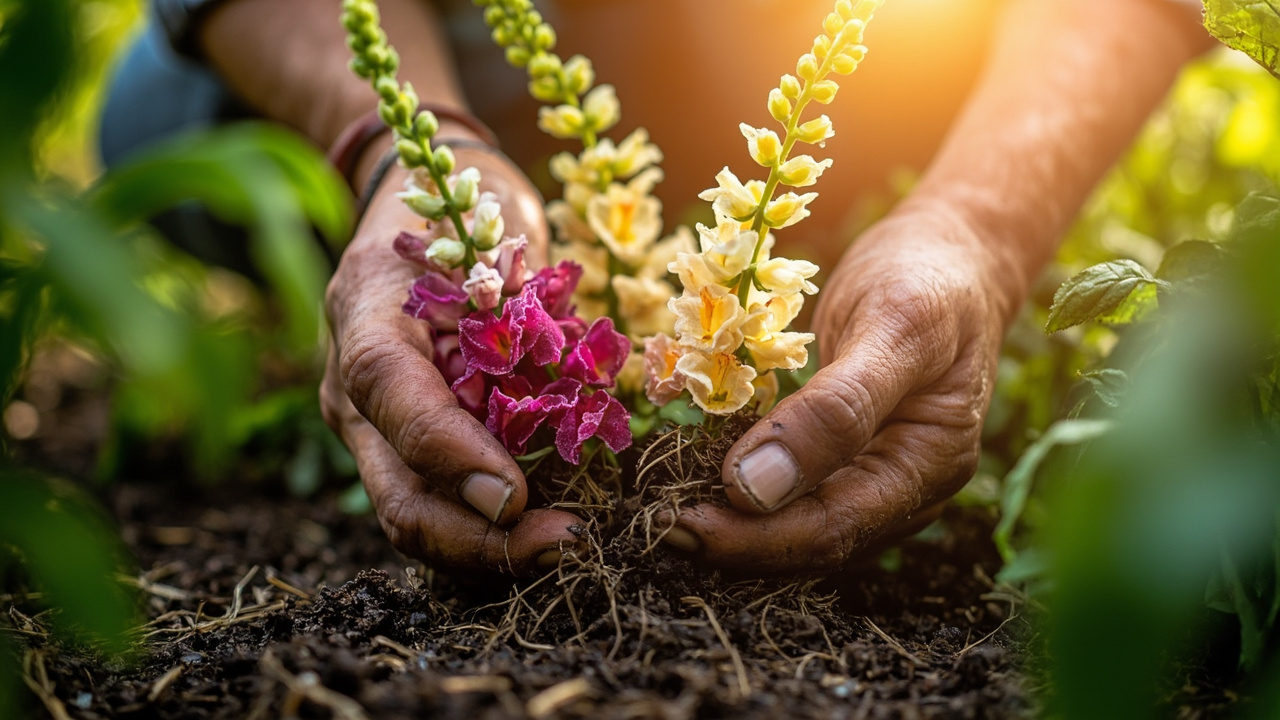
Do not bury the stem. Snapdragon crowns rot if planted too deep, so keep the soil line on the transplant even with the surrounding bed.
2. Space by variety height
Dwarf types, 6 to 12 inches tall, go 6 to 9 inches apart. Tall types, 24 to 36 inches, need 9 to 12 inches of space. Crowding is the single most common spacing mistake, and it invites the fungal problems we will get to shortly.
3. Water in immediately
Soak the root zone right after planting to settle soil around the roots and eliminate air pockets.
4. Pinch the top when the plant hits 3 to 4 inches
This is the step everyone hesitates on. Pinching out the top set of leaves feels like you are undoing your own work, but it forces the plant to branch instead of growing one tall, weak stem.
Skip the pinch and you will get a snapdragon that looks fine in May and flops over in June.
Watering and Feeding Through the Season
If you assumed more water always means healthier plants, that guess is exactly what invites the fungal disease that ends most snapdragon patches early. Water at the base, not overhead, and water deeply but less often, aiming for consistently moist soil rather than wet soil. An inch of water a week is a reasonable baseline, more in sandy soil or hot spells.
Wet foliage sitting overnight is what starts rust and powdery mildew, not the amount of water itself.
Feed lightly. A balanced fertilizer every four to six weeks, or a slow-release granular worked in at planting, is enough. Overfeeding nitrogen gives you soft, floppy growth and fewer flowers, which is the opposite of what you’re after.
Deadhead spent spikes regularly. This is what keeps the plant producing new ones instead of going to seed and quitting.
Get the water habit right and you have already dodged the biggest disease risk, but there are a few more culprits worth knowing by sight.
Problems That Actually Show Up, and How to Head Them Off
Here is the honest answer to why a thriving spring snapdragon patch stalls in the heat of summer: it is not a disease, it is the plant’s biology. Snapdragons are cool-season bloomers, and most varieties simply slow down or stop when nights stay warm. That is not a mistake you made, it is the plant doing what it does.
Rust shows up as orange-brown powdery pustules on leaf undersides, usually after a stretch of humid weather. Space plants for airflow, water at the soil line, and remove infected foliage promptly. Fungicide labeled for rust can help if caught early, follow the label exactly.
Powdery mildew looks like a white dusting on leaves and stems, most common late in the season. Same fix: airflow, base watering, and removing the worst-affected leaves.
Aphids cluster on new growth and buds. A strong water spray or insecticidal soap knocks them back without much drama.
Root rot from soggy, poorly drained soil is the one problem you cannot fix after the fact, so prevention through drainage is everything.
Handle the season’s stresses and you get to the part everyone actually clicked for: the bloom.
When and How to Harvest Snapdragon Blooms
Snapdragons typically bloom 8 to 12 weeks after planting, and the spike is ready to cut when the bottom third of florets have opened while the top buds are still closed. Cutting this early feels wrong to a lot of people, but the remaining buds keep opening in the vase over the next several days.
Cut spikes in early morning when stems are full of water, using clean shears angled just above a leaf node. Strip lower leaves that would sit in the vase water.
In the garden, regular deadheading of spent spikes is what pushes the plant into a second and third flush rather than letting it set seed and stop.
That steady cut-and-rebloom cycle is exactly what the at-a-glance card below is built to help you keep track of.
Snapdragons at a Glance
- When to plant: transplants four to six weeks before last frost, seed direct-sown once soil hits 50 to 55°F, fall planting in zone 8 and warmer for winter and spring bloom.
- Light and soil: full sun, at least six hours daily, well-drained soil enriched with a couple inches of compost.
- Spacing and depth: plant at the same depth as the nursery pot, space dwarf types 6 to 9 inches apart and tall types 9 to 12 inches apart.
- Watering: deep, base-level watering, roughly an inch a week, never letting foliage sit wet overnight.
- Feeding: light balanced fertilizer every four to six weeks, avoid heavy nitrogen.
- Key technique: pinch the top at 3 to 4 inches tall to force branching, then deadhead spent spikes all season.
- Bloom and harvest: flowers in 8 to 12 weeks, cut spikes when the bottom third of florets are open and the top buds are still closed.
Get the timing and the pinch right, and snapdragons practically grow themselves from there.
Everything else is just deadheading your way to the next flush.