Poppies move through five distinct stages: germination in 7 to 21 days, a low grassy rosette for several weeks, rapid stem elongation, buds that hang nodding before they crack open, and finally the seed pod stage that stretches on for a month or more. The whole run from seed to bloom takes about 90 to 120 days for annual poppies, longer for perennial types that may not flower at all their first year. Following these poppies growing stages closely tells you exactly what’s normal and what’s a real problem.
Most people lose their poppies at one specific point, and it’s not the one they worry about. It happens weeks before any bud shows, and by the time you notice, the damage is already done.
There’s also a stage everyone misreads as trouble when it’s actually the plant doing exactly what it should. And there’s an honest answer to the question you’re already forming: can you speed any of this up? Stick around, because the full Poppies at a Glance card is waiting at the bottom, saveable to your phone before you walk back out to the garden.
Germination: the first 7 to 21 days
Poppy seeds are tiny and need light to germinate, so they get scattered on the surface and barely covered, if at all. Press them into moist soil with your palm rather than burying them under a layer of dirt. In cool spring soil, around 50 to 65°F, expect thread-like seedlings in 10 to 21 days; warmer soil can pull that down to a week.
Keep the surface consistently damp during this window. Poppy seed is small enough that it dries out and dies in hours if the top quarter inch goes bone dry on a sunny afternoon.
This is also where most attempts quietly end, and it has nothing to do with frost or bugs.
The mistake that ends most poppy patches before they start
If you guessed the killer stage was transplanting shock or a late frost, that’s a reasonable guess, and it’s wrong. Poppies resent being transplanted at all because of their long, fragile taproot, but most home gardeners never even get that far.
The real damage happens during germination and the two weeks after, when seedlings are thinner than a blade of grass and utterly invisible to a hose on full blast or a hungry sparrow. Overwatering with a heavy stream washes seeds away or rots the thread-thin roots before they anchor. Underwatering for even a day during a warm stretch is just as lethal.
The fix is mundane but non-negotiable: mist or use a fine rose on your watering can, never a jet, and check the soil surface daily until true leaves appear.
Once seedlings survive that gauntlet, the next stage is where the plant looks deceptively unimpressive.
The rosette stage: weeks 3 to 8, low and unhurried
After true leaves form, poppies settle into a flat rosette of deeply lobed, blue-green or gray-green foliage sitting just a few inches off the ground. This stage can last four to six weeks, sometimes longer if nights are still cool.
Nothing visible seems to be happening, and that’s normal, not a stall. Below ground, the taproot is driving down and establishing the system that will support a tall flowering stem later. This is the ideal window to thin seedlings to 6 to 12 inches apart, depending on the variety, since crowded rosettes compete for root space and produce weaker stems later.
Resist the urge to fertilize heavily here. Rich soil and high nitrogen during the rosette stage produce lush leaves and floppy stems down the line.
The next stage is where the plant finally shows you it’s been busy all along.
Stem elongation: the fast, awkward stretch
Once soil and air warm consistently, usually as days lengthen toward late spring, poppies shift into rapid vertical growth. A rosette that looked stuck can throw up a flowering stem 12 to 36 inches tall, depending on species, in just 2 to 3 weeks.
Stems are hollow, hairy, and surprisingly brittle for how tall they get. Wind and heavy rain are the main hazards now, and staking taller varieties like breadseed or Oriental poppies before they lean saves you from a snapped stem you can’t recover.
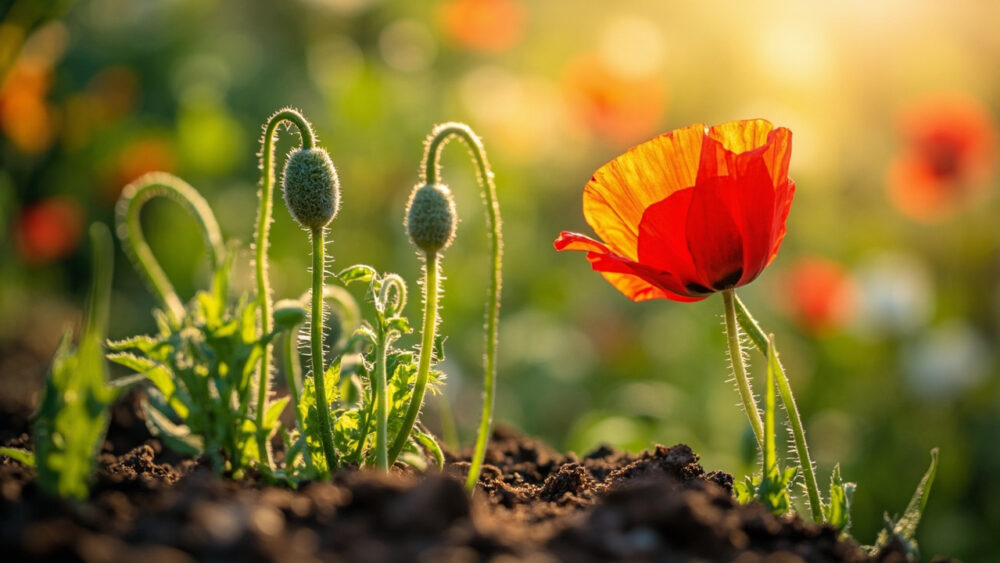
You’ll also see the classic nodding bud form here, hanging like a shepherd’s hook at the stem tip. That droop is not wilting or disease.
That drooping bud is actually the sign most gardeners misread, and it deserves its own explanation.
The nodding bud: the stage everyone worries about for nothing
If you assumed a bent-over bud means the plant is dying of thirst or shock, that guess costs a lot of gardeners a perfectly healthy poppy. The nodding habit is built into the plant’s structure on purpose.
Inside that hairy, fuzzy-coated bud, the petals are folded and crushed against each other like tissue paper in a too-small box. The stem straightens and the bud turns upright in the day or two right before it opens, and the sepals split and fall away almost the moment the petals start to expand.
From first crack to a fully open flower can take less than a day in warm weather. Watch a nodding bud that has just started to lift its head and you can usually catch the opening the following morning.
Once open, though, the flower itself runs on a much shorter clock than most people expect.
Bloom stage: 2 to 4 days per flower, weeks per plant
Each individual poppy flower lasts only 2 to 4 days before petals drop, sometimes just a single day in hot, windy weather. That feels fast, but a healthy plant is producing a steady sequence of buds, not one grand show.
A well-grown plant of most annual poppies (Shirley, California, corn poppy types) will bloom in flushes for 4 to 6 weeks total. Perennial Oriental poppies bloom for a shorter, more concentrated 2 to 3 week window in late spring to early summer, then go dormant and can vanish above ground entirely by midsummer.
Deadheading spent flowers won’t extend bloom the way it does with many annuals, since poppies are already genetically set to produce a certain number of flowers per plant. It does keep the bed tidy and stops every flower from converting straight to seed if you’d rather collect fewer, larger pods.
What happens after the petals fall matters just as much as the bloom itself.
Seed pod stage: the long, quiet finish
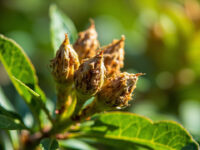
After petals drop, the pistil left behind swells into the familiar pepper-shaker seed pod over 3 to 6 weeks. Pods start green and pliable, then dry, harden, and turn tan or brown.
You’ll know pods are ready to harvest when they rattle faintly if you shake the stem and small pores or slits open near the top of the pod. Cut stems and hang them upside down over a paper bag if you want to catch seed cleanly rather than losing it to wind.
Annual poppies finish their life cycle here and can be pulled once pods are harvested. Perennial types die back to the rosette or disappear entirely, then return from the root the following spring.
Knowing what a normal finish looks like also makes it much easier to spot a stall that isn’t normal at all.
Healthy Progress Versus an Actual Stall
A rosette sitting still for a month is normal. A rosette that’s yellowing, flattening, or rotting at the crown is not, and usually points to soil that’s staying too wet.
Stems that pause mid-elongation during a cold snap will resume once temperatures climb back into the 60s. Stems that yellow and collapse instead are more often a root or crown rot issue than a temperature one.
No bloom at all after a full season of healthy rosette and stem growth, especially in perennial poppies, usually just means the plant is a first-year seedling that needs another winter before it flowers.
- Rosette not growing but green and firm: normal, root establishment in progress.
- Yellow, mushy crown: overwatering or poor drainage, cut back watering immediately.
- Tall, thin, floppy stems: too much nitrogen or too little sun, thin plants and reduce feeding.
- Bud stuck and never opening: often cool, wet weather, give it warm sunny days and patience.
Everything above compresses into one card worth keeping on hand all season.
Poppies at a Glance
- When to plant: direct sow 2 to 4 weeks before your last frost, or in fall in mild climates, since poppy roots resent transplanting.
- Depth and spacing: scatter seed on the surface with barely any covering, then thin seedlings to 6 to 12 inches apart once true leaves show.
- Germination time: 7 to 21 days in soil around 50 to 65°F, faster in warmer soil.
- Full timeline: roughly 90 to 120 days from seed to first bloom for annual types.
- Bloom window: individual flowers last 2 to 4 days, but a healthy plant blooms in flushes for 4 to 6 weeks.
- Biggest early risk: overwatering or harsh watering during germination, when seedlings are thread-thin and easily washed out or rotted.
- Normal but alarming sign: the nodding, drooping bud right before it opens, which is a structural stage, not a sign of stress.
Get seedlings through that first fragile watering window and give the rosette its slow weeks underground. Everything after that, the stretch, the nod, the bloom, tends to take care of itself.