A lily moves through five distinct stages from bulb to bloom to dormancy, and each one takes 2 to 6 weeks depending on your climate and the type of lily you planted. Right now you’re probably standing over a pot or a bed trying to figure out if what you’re looking at is normal. Understanding lilies growing stages is really just learning to read a handful of visual cues, and once you know them you’ll never panic over a lily again.
Here’s what most people get wrong first: they assume slow shoot emergence in spring means a dead bulb, when it’s usually just cold soil doing its job. There’s also a stage almost nobody watches closely enough, the one right after bloom, and skipping it is the single biggest reason lilies get weaker every year instead of stronger. And if you’ve ever wondered whether a lily that skipped flowering this year is gone for good, the honest answer surprises most people.
Stick with me through each stage and I’ll flag exactly what healthy growth looks like versus a real problem. At the bottom you’ll find a save-able “Lilies at a Glance” card with the numbers you’ll want on hand all season.
Stage One: Dormant Bulb (Late Fall Through Early Spring)
A lily bulb spends anywhere from 3 to 5 months underground doing nothing visible at all. This is normal and it’s not optional, lilies need a cold period to bloom well later. The bulb itself should feel firm and slightly moist, like a stored onion, with fleshy overlapping scales rather than dry papery ones.
Your only job at this stage is to leave it alone and make sure the ground drains. Soggy, waterlogged soil in winter rots bulbs faster than cold ever will. If you planted new bulbs in fall, aim for 6 to 8 inches deep and let winter do the rest.
The waiting is the hardest part, but the real test comes the moment green appears.
Stage Two: Shoot Emergence (Early to Mid Spring)
Once soil temperatures climb past roughly 50°F a few inches down, a single reddish-green shoot pushes up through the soil. This usually happens 4 to 8 weeks before your last frost date, sometimes earlier for established, warm-bed plantings.
If you assumed a late shoot means a failed bulb, that guess kills more perfectly good lilies than any pest does. Lilies are simply slow starters in cool soil, and a shoot that seems a week “late” compared to your neighbor’s is almost always fine. What actually signals trouble is a shoot that emerges, then turns black or mushy at the base, which points to bulb rot from wet, poorly draining soil rather than timing at all.
What it needs from you: patience, and protection from a hard late freeze if a shoot is already up. A light frost blanket overnight is enough; you don’t need anything elaborate.
Once that shoot commits, growth speeds up fast.
Stage Three: Vegetative Growth (Mid Spring Into Early Summer)
This is the stretch where a lily earns its height. The stem thickens and climbs, often 1 to 3 inches a week in good conditions, with narrow leaves spiraling or whorling up its length depending on the type.
Feed and water matter most here. Lilies want consistently moist soil, about an inch of water a week if rain doesn’t provide it, and a balanced fertilizer worked in once growth is 4 to 6 inches tall. Skip heavy nitrogen, it pushes leafy growth at the expense of the flower buds forming inside the stem where you can’t see them yet.
Stake tall varieties like Orientals and trumpet types now, while the stem is still flexible, not after a storm bends it.
The buds that decide your whole season are quietly forming right now, out of sight.
Stage Four: Budding and Bloom (Early to Late Summer)
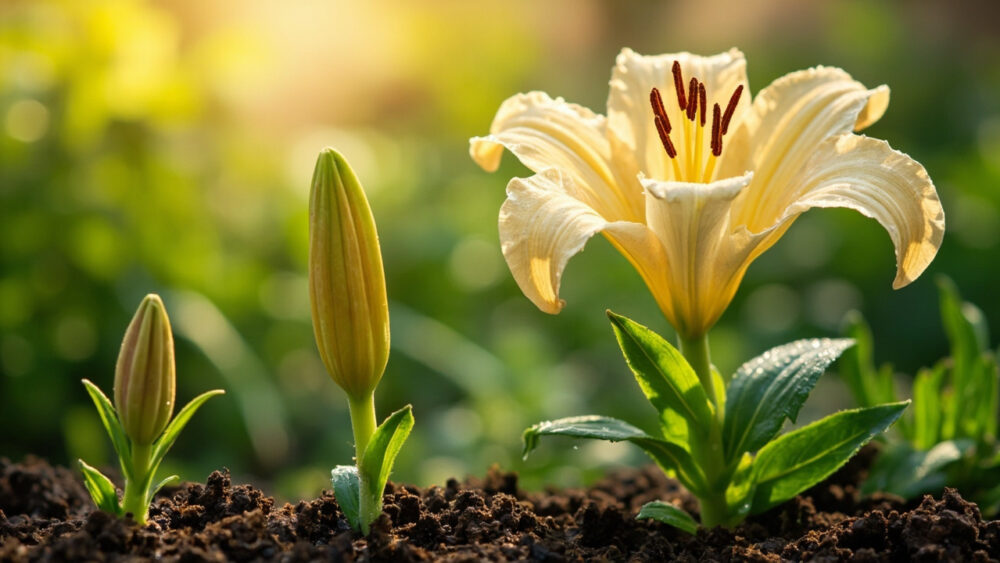
Buds appear as small green pods clustered near the top of the stem, usually 6 to 10 weeks after shoot emergence. They swell and lengthen over 2 to 3 weeks before the first one cracks open.
Bloom timing varies a lot by type: Asiatics tend to open first in early summer, trumpets and Orientals follow, and some rebloom-style hybrids stretch flowering into early fall. A single lily plant typically stays in bloom 1 to 2 weeks, though a well-budded stem with staggered opening can put on a show for 3 to 4 weeks.
The one mistake that ruins the display almost every time is cutting the stem down for a bouquet and taking too much foliage with it. Cut flowers for the vase, but leave at least two-thirds of the leafy stem standing, because that foliage is still feeding the bulb for next year.
Once the last petal drops, most gardeners stop paying attention, and that’s exactly the wrong move.
Stage Five: The Post-Bloom Stage Everyone Skips
This is where lilies actually get built or ruined for next year, and it’s the stage almost nobody watches. After flowering, the stem and leaves stay green and keep photosynthesizing for 6 to 8 weeks, quietly recharging the bulb underground.
Deadhead spent blooms so the plant doesn’t waste energy making seed, but do not cut the stem itself until it yellows and goes limp on its own, usually by late summer or early fall. Cutting green foliage early is the number one reason lilies bloom smaller, or not at all, the following year.
Keep watering through this stretch, lightly, since a bulb building next year’s flower still needs moisture even though nothing is blooming above ground.
So what about a lily that skipped blooming entirely this year, the question you were probably about to ask?
The Honest Answer: A No-Bloom Year Isn’t the End
A lily that produces only leaves with no flower stalk usually means the bulb is too young, too small, or was stressed the previous fall, not that it’s dying. This is common with bulbs planted the same spring rather than the fall before, since they haven’t built enough stored energy yet.
Give it one full season of good sun, steady moisture, and undisturbed post-bloom foliage, and most lilies bounce back and flower normally the next year. Only worry if the bulb itself feels soft, hollow, or smells rotten when you check it, that’s a genuine loss, not a skip year.
Knowing the difference between a resting bulb and a dying one comes down to a few checks anyone can do.
Healthy Progress Versus a Real Stall
A lily that’s simply slow still shows small, steady change: a shoot that’s an inch taller each week, leaves that stay firm and green, buds that swell even gradually. That’s normal progress, even if it’s behind schedule compared to a warmer garden nearby.
A true stall looks different. Watch for these signs:
- No change for 3 or more weeks during active growing season with warm soil and adequate water.
- Yellowing that starts from the bottom up during active growth, rather than the normal end-of-season yellowing.
- A stem that snaps softly or feels mushy near the soil line, a sign of rot rather than dormancy.
- Leaves that are stippled, webbed, or chewed, which points to pests like aphids or lily leaf beetle rather than a growth-stage issue.
Red lily leaf beetle and aphids are the most common pests, and both respond to picking off by hand for small infestations or an insecticidal soap or labeled pesticide for larger ones, always following the product label exactly.
If your lily matches the stall list rather than the slow-but-steady list, the fix depends on which sign you’re seeing, but most cases trace back to drainage.
Lilies at a Glance
- When to plant: fall for the strongest first-year bloom, or early spring as soon as soil can be worked, at 6 to 8 inches deep and 8 to 12 inches apart.
- Dormancy length: roughly 3 to 5 months over winter, no visible growth needed or expected.
- Shoot emergence: once soil hits about 50°F, typically 4 to 8 weeks before your last frost.
- Time from shoot to bloom: about 10 to 14 weeks total in a normal season.
- Bloom window: 1 to 2 weeks per stem, staggered types can flower 3 to 4 weeks total.
- Water needs: about 1 inch per week through growth and bloom, light watering continues 6 to 8 weeks after bloom.
- Biggest mistake to avoid: cutting green foliage or stems down right after bloom instead of waiting for natural yellowing.
If you remember one thing, remember that the foliage after bloom is building next year’s flower, not just standing around dying.
Leave it green as long as it wants to stay green, and your lily will thank you with a bigger show next season.