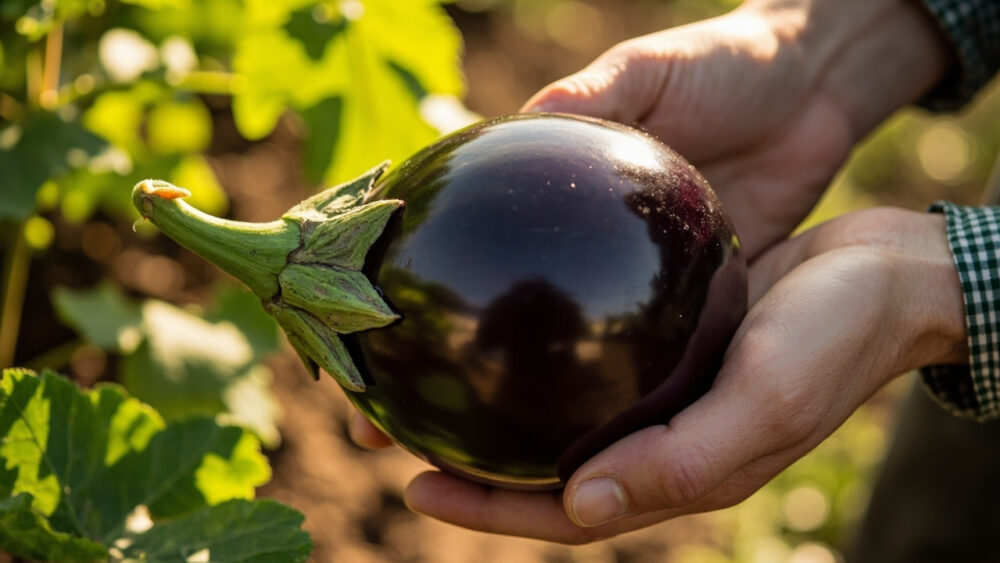
The short answer to how to store eggplant: keep it whole, unwashed, and dry in a cool spot around 50 to 55 degrees Fahrenheit, and eat it within 5 to 7 days. Your refrigerator’s main compartment works if you have nothing better, but eggplant is one of the few vegetables that actually resents standard fridge temperatures. Cold below about 41 degrees causes chill damage that shows up as sunken brown pits before you even get it to the cutting board.
Here is the mistake that ruins most eggplant before it ruins the dish: people wash it right after buying or harvesting, then bag it up wet. That trapped moisture is what causes the slimy, moldy spots you find three days later, not the vegetable’s natural lifespan.
There is also a sign almost everyone misreads. A few brown seeds inside is not spoilage, it is just a slightly older fruit. The real rot signal is different, and I will show you exactly what it looks like. Stick around for the section on freezing too, since eggplant needs one extra step before the freezer that most people skip, and skipping it is why “freezer eggplant” has a bad reputation. Everything you need is saved in the Eggplant at a Glance card at the very bottom, but the details in between are what make that card actually work for you.
The Best Way to Store Fresh Eggplant
Keep it whole and out of the crisper drawer’s coldest zone. Eggplant is a warm-climate fruit at heart, and it holds up best somewhere between 50 and 55 degrees Fahrenheit with moderate humidity, which is exactly why a cool pantry, a mild basement, or an unheated porch in early fall often outperforms the fridge.
If a cool room isn’t available, your fridge’s main shelf area, not the back where it’s coldest, is the next best option. Place it in a loose paper bag or leave it uncovered so air can move around it. Plastic traps humidity against the skin and speeds up soft spots.
Do not wash it first. Wipe off garden dirt with a dry cloth if needed, and save the rinse for right before you cook.
Where you set it down matters just as much as how you store it.
How Long Eggplant Actually Keeps, Method by Method
On the counter in a cool room, expect 3 to 4 days before quality starts sliding. In the fridge, whole and unwashed, you get 5 to 7 days, sometimes closer to 10 in a very consistent fridge, though flavor and texture are best in that first week.
Cut eggplant is a different clock entirely. Once sliced, it oxidizes and softens fast, so plan to use it within 24 hours, wrapped tightly in the fridge.
Cooked eggplant, whether roasted, grilled, or in a finished dish, keeps 3 to 5 days refrigerated in a sealed container.
Frozen and properly prepped, eggplant holds 8 to 12 months, though 6 months is where texture is still genuinely good rather than just edible.
Those numbers only hold if the prep beforehand was right, and that’s where most kitchens lose ground.
The Prep That Makes or Breaks Storage
Skip the wash, but don’t skip the inspection. Before you store anything, run your hands over the skin feeling for soft give, and check the stem end, which is usually the first place to wrinkle or darken.
If you’re freezing eggplant, raw slices freeze into a spongy, waterlogged mess. The fix is blanching: cut into slices or cubes, drop into boiling water for 3 to 4 minutes, then plunge into ice water immediately to stop the cooking.
Pat the pieces completely dry, spread them on a tray so they freeze separately, then bag them once solid. That single blanching step is the one most people skip, and it’s the entire reason home-frozen eggplant so often turns to mush.
Salting is a separate move worth knowing. If a recipe calls for cooking eggplant right away, salting cut pieces for 20 to 30 minutes draws out excess moisture and bitterness before cooking, but it is not a storage method and won’t extend shelf life on its own.
Get the prep right and the next question is simply how to tell when time has run out.
The Signs Eggplant Has Actually Turned
Brown seeds inside are not the warning sign people think they are. That’s just maturity, and the flesh around them is usually still fine to cook.
The real signs of spoilage are visual and textural, not internal. Look for:
- Skin that has gone dull and wrinkled instead of glossy and taut
- Soft, sunken patches that give under light pressure, especially near the stem
- Brown or black spots on the surface that feel mushy rather than firm
- A sour or ammonia-like smell, which means bacterial breakdown has started
- Slimy residue on the skin after a few days in a sealed bag
A little surface wrinkling with everything else still firm is early aging, not spoilage, and that eggplant is fine cooked soon. Sunken soft spots and smell mean it’s done.
Once you know what failure looks like, it’s worth knowing exactly how people cause it.
The Mistakes That Ruin a Batch
Cold is the biggest one. Storing eggplant in the coldest part of the fridge, or right against the back wall near the cooling vent, causes chill injury that looks like pitting and brown scald within a couple of days.
Washing before storage is the second biggest. Wet skin in a sealed bag is a guaranteed environment for mold, usually visible as fuzzy gray or white patches within 48 hours.
Sealing eggplant in airtight plastic without any airflow traps humidity against the skin, which softens it faster than leaving it uncovered ever would.
Skipping the blanch before freezing is the mistake that makes people give up on freezing eggplant altogether, when the technique itself works fine.
And cutting it too far ahead of cooking wastes the eggplant twice over, once through browning and once through the moisture loss that leaves it rubbery.
Avoid those five and eggplant is actually a low-maintenance vegetable to keep around, which brings us to the part you’ll want saved.
Eggplant at a Glance
- Best storage spot: a cool room around 50 to 55 degrees Fahrenheit, or the main fridge shelf if that’s not available, never the coldest back corner.
- Fridge life whole: 5 to 7 days unwashed and unwrapped or in a loose paper bag.
- Fridge life cut: use within 24 hours, wrapped tightly.
- Counter life: 3 to 4 days in a cool room, less in a warm kitchen.
- Freezer life: 8 to 12 months if blanched 3 to 4 minutes and dried before freezing, best quality within 6 months.
- Never do this: wash before storing, or seal it airtight while wet.
- Real spoilage signs: sunken soft spots, dull wrinkled skin, sour smell, slimy patches. Brown seeds inside are just age, not rot.
Keep it dry, keep it out of the fridge’s coldest zone, and use it within the week.
That’s the whole trick, everything else is just details that make it stick.