Celery is ready to harvest when the stalks reach 7 to 9 inches tall and about the thickness of your finger, usually 85 to 120 days after transplanting, depending on the variety and how warm the season has been. You can start pulling outer stalks even earlier for a light harvest, or wait for a full head. The plant does not drop hints the way a tomato blushes red, so knowing when to harvest celery comes down to reading the stalks themselves, not the calendar.
Here is the mistake that wrecks most home celery patches: waiting for it to “look done” the way other vegetables do. Celery does not swell up or change color dramatically. It just sits there looking like celery, and gardeners keep waiting for a sign that never arrives while the stalks turn stringy and bitter underneath.
There is also a timing question nobody asks until it is too late, which is what a light frost actually does to a celery bed still in the ground. And a lot of gardeners assume you either harvest the whole plant or none of it, which is not true and costs them weeks of production. Stick around for the Celery at a Glance card at the bottom, it is the save-to-your-phone version of everything below.
The Real Ready Signs
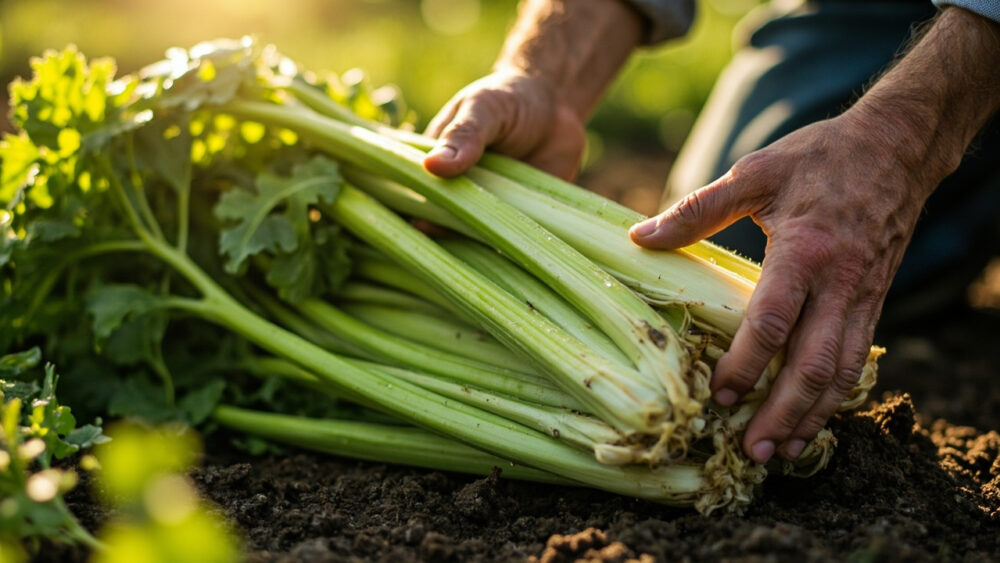
Forget waiting for a dramatic change. Check stalk height and thickness first: outer stalks at 7 to 9 inches with some real diameter to them, not thin like a pencil, means the plant has enough size to harvest from.
Color and Snap
A ready stalk is solid green (or pale gold to white on self-blanching types), firm, and snaps rather than bends when you flex it. Limp stalks that fold without a crack are underfed or under-watered, not ready.
The Squeeze Test
Grab the outer stalks near the base and give the bunch a gentle squeeze. A dense, solid feel means good stalk development. A hollow, airy feel means it needs more time, more water, or both.
Once a handful of outer stalks pass these checks, the whole plant is in play.
The Timing Window, and What Guessing Wrong Costs You
Celery is a cool-season crop with a long runway: 85 to 120 days from transplant to full harvest, depending on variety and heat. It grows best in the 60 to 70°F range and sulks or turns bitter above 80°F for extended stretches.
Harvest too early and you get thin, flavorless stalks with barely any usable bite, since celery bulks up significantly in its last few weeks.
Harvest too late and the stalks go fibrous, stringy, and can turn hollow or pithy in the center, especially in a hot, dry stretch. Bolting is the other late-season risk: once celery sends up a central flower stalk, usually triggered by a heat spell or a cold snap followed by warmth, the plant channels energy into seed production and the stalks turn bitter and woody fast.
Here is the honest answer about frost: celery actually tolerates a light frost better than most vegetables, and a touch of cold can sweeten the flavor. But a hard freeze will damage the stalks, so treat the first hard frost date for your zone as your real deadline, not the first light frost.
Miss that window and the stalks you left behind are usually not worth eating, not just less impressive.
How to Harvest Without Wrecking the Rest of the Plant
You have two real options, and most guides only tell you about one of them.
- Whole-plant harvest: cut the entire head at the base, right at soil level, using a sharp knife. This ends that plant’s production for the season.
- Outer-stalk harvest: snap or cut just the outer 2 to 4 stalks per plant, leaving the inner core and young stalks to keep growing. This is the move most people never try.
For outer-stalk harvesting, grab the stalk near its base and pull down and out with a slight twist, or cut it cleanly with a knife an inch above the soil line. Do not yank straight up, that tears at the crown and invites rot into the whole plant.
Leave the inner stalks and growing point untouched if you want more harvests later. That inner core is where all the new growth comes from.
Which method you choose changes everything about how long this bed keeps feeding you.
Right After You Cut: What Actually Matters
Get harvested celery out of the sun and into water or the refrigerator within an hour if you can. Stalks left sitting in a warm garden go limp fast, since celery is mostly water and loses crispness quickly once cut.
Rinse off soil and trim the root end and any damaged leaf tips. Stand whole heads upright in a jar with an inch or two of water in the fridge, or wrap loosely in a damp paper towel inside a perforated bag.
Stored this way, celery holds well for 1 to 2 weeks, sometimes longer for firm, healthy stalks. It does not can or freeze well raw, texture turns mushy, but it freezes fine once chopped and used later in cooked dishes like soups and stocks.
That storage step is easy, the harder question is whether this plant has more to give.
Keeping the Harvest Going
If you used the outer-stalk method, the plant is not finished. Water consistently, about 1 to 1.5 inches per week, since inconsistent moisture is the top cause of stringy, hollow, or bitter stalks.
Side-dress with a balanced or nitrogen-leaning fertilizer every 3 to 4 weeks during the growing stretch. Celery is a heavy feeder and thin, pale stalks are usually a feeding problem, not a variety problem.
Keep harvesting outer stalks every couple of weeks as they reach size, always leaving the core intact. You can realistically pull stalks over a 6 to 8 week window this way instead of one single cutting.
Once nights consistently dip toward hard-freeze territory for your zone, or the center starts sending up a flower stalk, it is time to take the rest of the plant rather than keep gambling on more growth.
Celery at a Glance
- When to harvest: 85 to 120 days after transplanting, when outer stalks reach 7 to 9 inches tall and finger-thick.
- Ready signs to check: firm stalks that snap instead of bend, solid green or pale color depending on variety, a dense feel when you squeeze the bunch.
- Two harvest methods: cut the whole head at soil level for one big harvest, or snap outer stalks only and leave the core for repeat harvests over several weeks.
- How to cut: use a sharp knife at soil level, or twist and pull outer stalks near the base without tearing the crown.
- Timing risk if early: thin, underdeveloped, flavorless stalks.
- Timing risk if late: stringy, hollow, or bitter stalks, and risk of bolting in heat.
- Storage: refrigerate upright in a little water or wrap damp, lasts 1 to 2 weeks, freezes fine chopped for cooked dishes only.
Read the stalk, not the calendar, and celery tells you exactly what it needs.
Leave the core alone when you can, and one planting can feed you for weeks instead of one afternoon.