The short answer: prune geraniums back by about a third to a half in early spring once new growth starts showing at the base, and deadhead spent blooms all season long to keep more coming. If you are working with hardy garden geraniums (the perennial ones, often called cranesbill), you cut them hard right after the first flush of bloom fades in early summer to force a fresh round. Learning how to prune geraniums correctly comes down to timing the cut to the plant’s stage, not the calendar on your wall.
Most people who try this make the same mistake, and it is not cutting too much. It is cutting at the wrong moment, usually in fall when the plant looks tired and they want to tidy it up before winter.
There is also a sign almost everyone misreads on their geraniums right now: leggy, sparse growth with flowers only at the tips. Most people think that means the plant needs more fertilizer. Stick around, because the real fix and the full save-able rundown, including exact cut heights and the deadheading habit that actually works, is waiting at the bottom.
When to Prune Geraniums (and When to Leave Them Alone)
Timing depends entirely on which geranium you are growing. Zonal and pelargonium types (the ones in pots and hanging baskets with big round flower clusters) get their major cutback in early spring, before new growth takes off, or right after you bring them in from overwintering indoors.
Hardy perennial geraniums get cut back hard immediately after their first bloom cycle finishes, usually early summer, to trigger a second flush.
Do not prune either type in fall. Cutting back in autumn removes the foliage that protects the crown through winter and pushes out tender new growth that frost kills immediately. Fall is for deadheading spent flowers and light shaping only, nothing more.
Get the season right and the rest of this is just technique.
Tools and the One Prep Step That Actually Matters
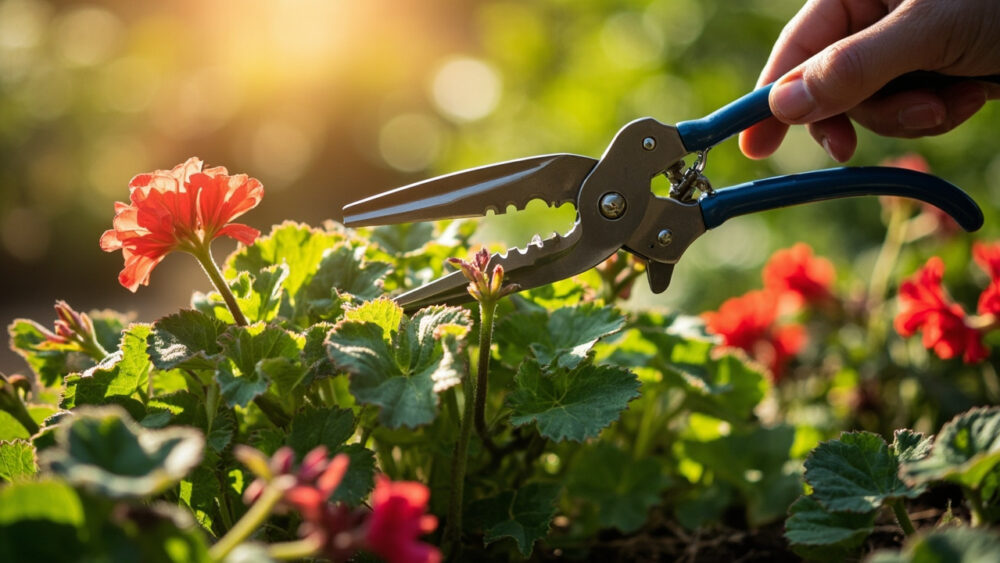
You need clean, sharp bypass pruners or snips, nothing fancier. Anvil-style pruners crush stems instead of slicing them, and crushed stems heal slower and invite rot.
The prep step everyone skips is wiping the blades with rubbing alcohol before you start, and again if you move between plants that show any sign of disease. Geraniums are prone to bacterial and fungal issues that spread easily on dirty blade edges, and a thirty-second wipe costs you nothing.
Water the plant the day before a big pruning session, not the same day. A well-hydrated but not soggy plant handles the stress of cutting far better than one that is wilting or waterlogged when you take the shears to it.
With clean tools and a hydrated plant, you are ready for the actual cuts.
How to Prune Geraniums Step by Step
Step 1: Find the Leaf Nodes
Look for the small swollen bumps or joints along each stem where a leaf or leaf scar attaches. Every cut you make should land just above one of these nodes, about a quarter inch, because that is where new growth will emerge.
Step 2: Cut Back Zonal and Pelargonium Types
In early spring, cut stems back to about 4 to 6 inches from the soil or pot rim, removing roughly a third to half of the plant’s total growth. Leggy stems that grew long and bare over winter can be cut harder, down to 2 to 3 inches, since they will rebound.
Step 3: Cut Back Hardy Perennial Geraniums
Once the first bloom flush fades and the foliage starts looking ragged, shear the whole plant down to 2 to 4 inches above the ground. This feels drastic and it is supposed to.
Step 4: Deadhead All Season
Snip spent flower stalks down to where they meet the main stem, not just the flower head itself. Leaving the stalk behind wastes the plant’s energy on a stem that will never bloom again.
That hard early-summer cut on hardy geraniums looks brutal in the moment, and that is exactly where the next question comes in.
What to Expect After You Cut
If you assumed a freshly pruned geranium should look better right away, that guess is backwards. For the first week to ten days after a hard cutback, the plant often looks worse: sparse, stubby, maybe a little sad sitting there.
That is normal. New growth typically shows at the cut nodes within 7 to 14 days under decent light and moderate warmth, faster in summer heat, slower in cool spring conditions.
Hardy geraniums sheared after their first bloom usually rebloom within 3 to 5 weeks with fresh foliage and a second, often fuller, flower show. Zonal types resume blooming on the new growth within about 4 to 6 weeks of a spring cutback.
Skip the fertilizer for the first week. A freshly cut plant needs to recover and root in before it can use extra nitrogen, and pushing it too soon just stresses it further.
Now for that leggy, flowers-only-at-the-tips look from the intro, because the cause is not what most people think.
The Mistakes That Cost You Flowers
Leggy growth with blooms only at the stem tips is not a fertilizer problem. It is almost always a pruning problem: the plant has not been pinched or cut back in a long time, so all the energy is going to the oldest, tallest growth instead of branching out lower down. More fertilizer on a leggy geranium usually just makes taller, weaker stems, not more flowers.
Here are the mistakes that actually cost people a season of blooms:
- Deadheading the flower only: snipping just the bloom and leaving the long bare stalk behind wastes energy and looks messy within days.
- Pruning in fall: removing protective foliage right before cold weather invites frost damage and winter dieback.
- Using dull or dirty blades: crushed, torn cuts heal slowly and are an open door for stem rot and fungal disease.
- Cutting too little out of hesitation: a light trim on an overgrown geranium does not fix legginess, it just delays the real cutback by another month.
- Fertilizing immediately after a hard prune: this pushes weak, leggy growth before the root system has caught up.
Fix the pruning habit and most of what looks like a feeding problem disappears on its own.
Geraniums at a Glance
- When to prune zonal or pelargonium types: early spring, once new basal growth appears, cutting back by a third to a half.
- When to prune hardy perennial geraniums: right after the first bloom flush fades, usually early summer, sheared to 2 to 4 inches.
- Where to cut: about a quarter inch above a leaf node, using clean bypass pruners.
- How much to remove: a third to half of total growth on a spring cutback, harder on leggy overgrown stems.
- Deadheading habit: snip the whole flower stalk down to the main stem, all season, every week or two.
- Recovery time: new growth in 7 to 14 days, rebloom in 3 to 6 weeks depending on type and warmth.
- Never do this: hard-prune in fall, or fertilize within a week of a major cutback.
Cut at the right stage, always above a node, and let the plant look a little rough for a week before you judge it. That patience is what turns a leggy geranium back into a full one.