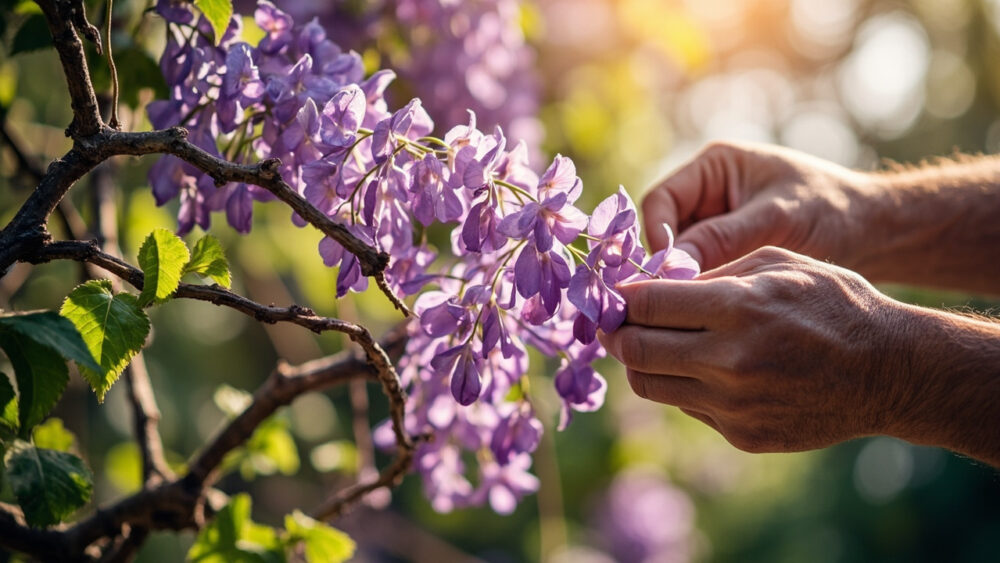
If your wisteria is putting out plenty of leaves but no flowers, the most likely cause is too much nitrogen combined with too much shade, and the fix is to stop feeding it lawn fertilizer, get it at least six hours of direct sun, and start pruning it hard twice a year instead of once. That combination solves the problem for the majority of wisteria that refuse to bloom. But it is not the only cause, and guessing wrong wastes another full year waiting on a vine that was never going to flower anyway.
Everyone blames the weather first, a late frost that “nipped the buds,” and sometimes that is real. Far more often the plant is simply too young, too shaded, too fertilized, or pruned at the wrong time of year, and those are all fixable starting today. There is also one detail on the vine itself, the thickness and color of its bark, that tells you almost immediately whether you are dealing with an impatient young plant or a mature one with a management problem.
Stick with this. Below you will find every real cause ranked by likelihood, how to tell them apart on your actual plant, an honest recovery timeline, and a two-minute diagnosis checklist you can run right now standing next to the vine.
Why Wisteria Won’t Bloom, Most to Least Likely Cause
1. Too much nitrogen
Confirm it: the vine is vigorous, dark green, throwing long whippy new growth several feet a season, and sits near a lawn that gets fed regularly or got a dose of general-purpose fertilizer this spring. Nitrogen tells a wisteria to make leaves and shoots, not flowers.
Fix it by stopping all nitrogen fertilizer entirely. If you feed at all, use a low-nitrogen, higher-phosphorus formula in early spring, but most established wisteria bloom better with no fertilizer whatsoever.
Next up is the cause almost as common and often paired with this one.
2. Not enough sun
Confirm it: count the hours of direct, unobstructed sun the main flowering wood actually receives. Wisteria needs a genuine six hours minimum, and it blooms best with more. A vine climbing a shaded fence, growing under a tree canopy, or backed against a north-facing wall is working with a light deficit no amount of pruning fixes.
Fix it by cutting back overhead competition where you can, or accept that a shaded planting site may never flower well and consider retraining a leader toward the sunniest available structure.
Sun and pruning work together, and pruning is where most people make their real mistake.
3. Wrong pruning, or no pruning at all
Confirm it: look at the plant’s structure. A wisteria left to run wild for years, covering a fence or pergola in a tangle with no defined framework, is putting all its energy into extending vegetative growth rather than setting flower buds along short spurs.
Wisteria flowers on spurs that form on wood that has been cut back hard, not on the long whips it throws naturally. Fix it with two prunings a year: cut new summer growth back to five or six leaves in mid to late summer, then in late winter cut those same shoots back further to two or three buds. This spur system is what actually forces bloom.
If your vine is doing all of this correctly and still refuses, age is probably the real answer.
4. The plant is simply too young
Confirm it: check how it was started. Wisteria grown from seed can take seven to fifteen years to bloom, sometimes longer, and there is no pruning trick that speeds that up much. Grafted or cutting-grown nursery plants of known cultivars usually bloom within two to five years given decent sun and correct pruning.
Look at the bark too. Young wisteria has smooth, thin, greenish-brown bark. Mature flowering wood is thick, gray, and fissured like a small tree trunk.
Fix it with patience, correct pruning from year one, and no nitrogen, so the plant is ready to flower the moment it’s mature enough to.
Assuming age and pruning are both fine, look lower, at the roots.
5. Root disturbance or transplant stress
Confirm it: did you move it, hit the roots digging nearby, or plant it within the last one to two years? Recently transplanted wisteria commonly skips blooming for a season or two while it reestablishes roots.
Fix it with time and consistent moisture, not extra feeding. Avoid disturbing the root zone further, and resist the urge to compensate with fertilizer, which only compounds the nitrogen problem.
One more cause worth ruling out if your winters run cold or erratic.
6. Cold damage to flower buds
Confirm it: wisteria sets flower buds the previous summer, and a hard late-spring freeze after buds have started to swell can kill them outright even though the rest of the plant looks completely healthy. This shows up as a vine with normal leafing but zero flowers in an otherwise good year, often after a mild winter followed by a sharp cold snap.
There is no fix for damage already done. Going forward, avoid planting wisteria in a frost pocket or against a wall that traps cold air, and don’t panic-prune after a freeze since the plant itself is usually fine.
Once you have a suspect, here is how to confirm you picked the right one.
How to Tell the Causes Apart
Nitrogen overload shows dark, oversized, glossy leaves and long new shoots on an otherwise mature-looking vine.
Shade problems show a plant that grows fine but stays thin-caned and stretchy, reaching toward light.
Pruning-related no-bloom shows a thick tangle of old growth with no visible short spurs, just long whips everywhere.
A too-young plant shows smooth young bark and vigorous growth with no flowering history at all, ever, on that vine.
Transplant stress shows a recently disturbed root zone and a bloom gap that started right after the move.
Cold damage shows healthy foliage but a total, sudden bloom failure in one specific year after a freeze.
With the cause narrowed down, the next question is whether it’s fixable this year or next.
Will It Recover?
Nitrogen and pruning problems resolve fastest, often within one to two growing seasons once you stop feeding and start the twice-a-year cut-back routine.
Shade problems only improve if you can genuinely increase light; if the site stays shaded, expect sparse bloom indefinitely regardless of pruning effort.
Youth resolves itself with time and correct care, though seed-grown vines can test anyone’s patience for a decade or more.
Transplant stress typically clears in one to two seasons with stable moisture and no further disturbance.
Cold-damaged buds cost you exactly one season’s flowers and nothing more; the vine itself is rarely at risk.
The honest cutting-losses point is a wisteria over fifteen years old, in good sun, correctly pruned, that has never once bloomed, since that usually points to a seed-grown or unreliable individual that may simply be a poor bloomer for good.
Whatever your prognosis, prevention from here forward is straightforward.
How to Keep It From Happening Again
Skip fertilizer on established wisteria entirely unless soil testing shows a real deficiency.
Commit to the twice-yearly prune, summer shoot shortening and late-winter spur cutback, every single year without skipping.
Site new plantings in full sun from the start rather than hoping a shaded spot will do.
Buy named, grafted cultivars when planting new, since they bloom years sooner and more reliably than seed-grown stock.
Leave root zones undisturbed once established, and mulch lightly instead of digging nearby.
Get the routine right once and a mature wisteria will reward you with flowers reliably every single spring after that.
Diagnosis Checklist
- Check the leaf color and shoot length: if leaves are dark, oversized, and shoots ran several feet this season, suspect nitrogen and stop all feeding.
- Count direct sun hours on the flowering wood: if it’s under six hours, suspect shade and improve exposure where possible.
- Look at the vine’s structure: if it’s a tangle of long whips with no short spurs, suspect pruning neglect and start the twice-yearly cutback.
- Check the bark: if it’s smooth and thin rather than thick and fissured, suspect youth, and if seed-grown, prepare for a long wait.
- Recall recent activity: if you transplanted or dug nearby within the last two years, suspect root stress and simply wait it out.
- Recall the past winter: if there was a late hard freeze after mild weather, suspect cold-killed buds and expect normal bloom next year.
- If none of these fit and the vine is mature, sunny, correctly pruned, and still bloomless for many years running, accept it may be an unreliable individual worth replacing with a named cultivar.
Most bloomless wisteria are fixable with sun, patience, and a sharper pair of pruners than most people are willing to use.
Get those three right and the flowers show up on their own schedule, not yours.