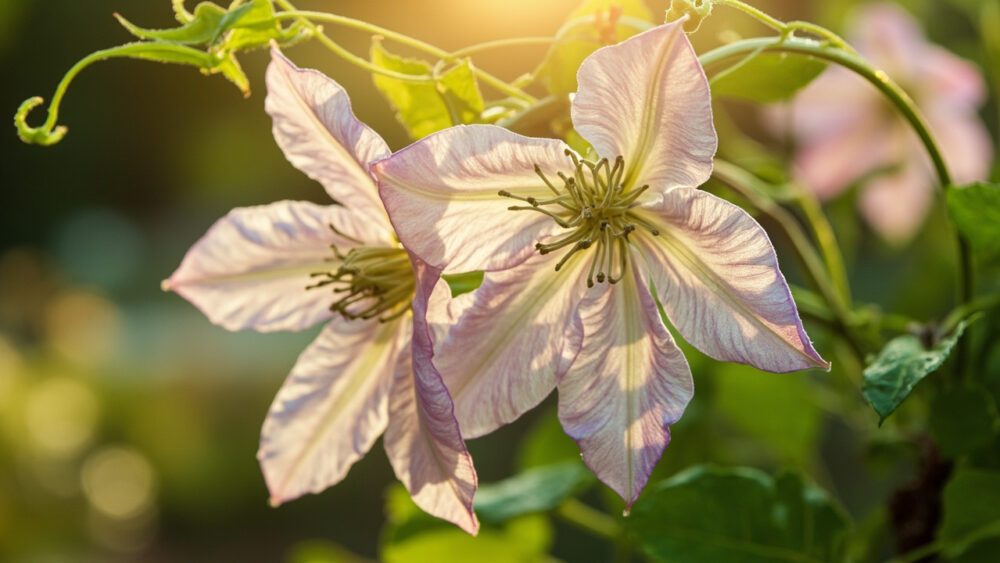
Yes, clematis is a perennial vine and comes back year after year in USDA zones 4 through 9, which covers most of the country. The roots survive winter underground even when every bit of top growth dies back or turns to brown straw.
But the honest answer has a catch that trips up a lot of first-year growers. What comes back next season, and how much of last year’s vine survives, depends on which of three pruning groups your clematis belongs to, and most tags and nursery labels do not make that obvious.
Get that wrong and you will either hack off next year’s flower buds by accident, or stare at a tangle of dead-looking vine wondering if you killed it. Stick around, because the quick-reference card at the bottom sorts out exactly what to expect and when to cut, so you can save it and stop guessing every March.
The Plain Answer: Perennial, With One Big Asterisk
Clematis is a true perennial vine in zones 4 through 9, and some varieties push into zone 3 or zone 10 with the right siting. The vine itself may look completely dead by midwinter, but the crown and root system underground are alive and building next year’s growth.
The asterisk is pruning group, not hardiness. Clematis is split into three groups, usually labeled 1, 2, and 3, based on whether they bloom on old wood, new wood, or both. Cut a group 1 vine back hard in spring and you can wipe out the entire bloom season without killing the plant.
If you do not know your variety’s group, that is fine, there is a workaround coming.
Next, what actually happens to the vine between now and spring.
What Happens Over Winter, and What You’ll See Next Spring
Above ground, expect the leaves to yellow and the stems to turn brown and papery once night temperatures drop into the 30s. That is normal dieback, not disease, and it happens every fall on established plants.
Below ground, nothing dramatic happens at all, which is the point. The root crown sits tight through winter, and as soil warms into the 50s in spring, new shoots push up from the base or from buds along the old woody stems, depending on the type.
Here is the part that surprises new growers: a clematis in its first year often looks weaker the second spring than it did going into fall, because it is establishing roots before it invests in top growth. Year three is usually when it takes off. If you assumed a slow second spring means it’s dying, that guess is wrong more often than it’s right, patience is the actual fix.
Knowing what’s normal is one thing, helping it come back stronger is another.
How to Help Your Clematis Return Strong
Mulch is the single biggest lever you have. Clematis famously wants its roots cool and shaded even while the vine climbs into full sun, so a 2 to 3 inch layer of mulch or a low shading plant at the base protects the crown through both summer heat and winter freeze-thaw cycles.
In colder pockets of zone 4, or in containers anywhere, winter protection matters more. Potted clematis roots freeze faster than in-ground roots, so move pots against a house wall, wrap them, or bury the pot in a trench for winter.
Prune according to your group:
- Group 1 (early bloomers, old wood): skip hard pruning, just tidy dead tips after flowering.
- Group 2 (large-flowered, blooms twice): light shaping in early spring only, before buds swell.
- Group 3 (late bloomers, new wood, includes most Jackmanii types): cut back hard to 12 to 18 inches in late winter, this group rewards aggressive pruning.
Don’t know the group? Cut nothing until you see where new growth emerges, then prune just above it.
Feed lightly in early spring with a balanced fertilizer and again after the first bloom flush. Skip heavy nitrogen, which pushes leaves at the expense of flowers.
Even with good care, there are yards where clematis genuinely struggles, and it is worth knowing when to stop fighting it.
When Treating It Like an Annual Is Honestly the Smarter Call
In zones colder than 3, or in a spot with poor drainage that stays soggy all winter, clematis roots frequently rot or freeze out no matter how well you mulch. If you have lost the same planting two winters running, that is not bad luck, that is the site telling you something.
Heavy clay that holds water, full shade with no more than an hour or two of direct sun, or a container left outside uninsulated in a zone 5 or colder winter are the three most common conditions that turn a perennial vine into a one-season plant by default.
In those cases, buying a fresh vine each spring and enjoying one strong season of bloom is a completely reasonable choice, not a failure. Some gardeners do this on purpose in hanging baskets and small pots where overwintering space just does not exist.
If your site checks out fine, though, the payoff for waiting is real: established clematis vines get fuller and more floriferous for years, often not hitting their full size and bloom count until year three or four.
Here is the card to save so you never have to relearn this each spring.
Clematis: Quick Reference
- Perennial or annual: perennial vine in zones 4 through 9, hardy to zone 3 for some varieties, treat as annual in colder zones or waterlogged sites.
- Winter appearance: stems brown and dry out, this is normal dieback, not death.
- Spring return: new growth from the base or old stems as soil warms into the 50s, often slower and shorter in year two.
- Pruning group matters most: group 1 needs little pruning, group 2 light shaping, group 3 hard cutback to 12 to 18 inches in late winter.
- Root protection: 2 to 3 inches of mulch or shade at the base year round, extra insulation for containers.
- Time to full size: often 3 years for a vine to reach its mature bloom count and fullness.
- Red flag for annual treatment: repeated winter dieback of the whole plant in poorly drained soil or zone 3 and colder.
Plant it right once, mulch the roots, and prune by group, and a clematis will outlast most of the other things in your garden.
Get through year three and you’ll wonder why you ever doubted it was coming back.