Learning how to grow Russian sage comes down to three things: full sun, lean soil, and leaving it alone once it’s established. Plant it in spring after the soil has warmed and dried out, give it room to breathe, and resist the urge to baby it with rich soil or frequent watering. Get those three right and you’ll have a four-foot cloud of silvery stems and violet-blue flowers from midsummer into fall, without spraying a thing or fussing over it weekly.
Here’s what trips people up. Most Russian sage failures aren’t from neglect, they’re from kindness: too much water, too much fertilizer, soil that’s too good to it. There’s also a pruning mistake that either kills the plant’s shape for a whole season or, if you skip it entirely, turns your sage into a floppy, splayed-out mess by August.
And there’s a question every new grower eventually asks that nobody answers honestly: is this thing actually a sage, and is it going to take over the bed the way mint does? Stick around for that one. The full save-and-reference Russian Sage at a Glance card is waiting at the bottom once you’ve got the real story on each of these.
When to Plant Russian Sage
Plant Russian sage in springtwo to three weeks after your last frost date, once the soil has dried out and warmed to at least 55 to 60°F. In most of USDA zones 4 through 9, that lands somewhere between mid-spring and early summer depending on your region. Fall planting works too, but only if you can get it in the ground at least six weeks before your first hard freeze so roots have time to establish.
Don’t rush cold, wet spring soil. Russian sage roots rot fast in soggy ground, and a plant set out too early just sits there sulking instead of growing.
If you’re starting from a nursery pot, you have more flexibility than gardeners direct-sowing seed, since seed germination is slow and erratic and most people skip it entirely in favor of transplants or cuttings.
Timing is only half the battle, though. Where you put it decides whether it thrives or just survives.
Choosing the Spot and Prepping the Soil
Russian sage wants at least six hours of direct sunand it genuinely performs better with eight or more. Shade doesn’t kill it, but it turns a sturdy, upright plant into a leggy, floppy one that flops open at the middle and never quite blooms right.
Here’s the part that surprises people: this plant actually prefers poor, lean, well-drained soil over rich garden loam. If your soil is heavy clay, work in coarse sand or fine gravel to loosen it, not compost. If it’s already sandy or rocky, leave it alone entirely.
Good drainage matters more than fertility. Check by digging a hole six inches deep and filling it with water; if it hasn’t drained within an hour or two, pick a different spot or build a raised mound.
Once you’ve found ground that drains fast and bakes in full sun, the actual planting is the easy part.
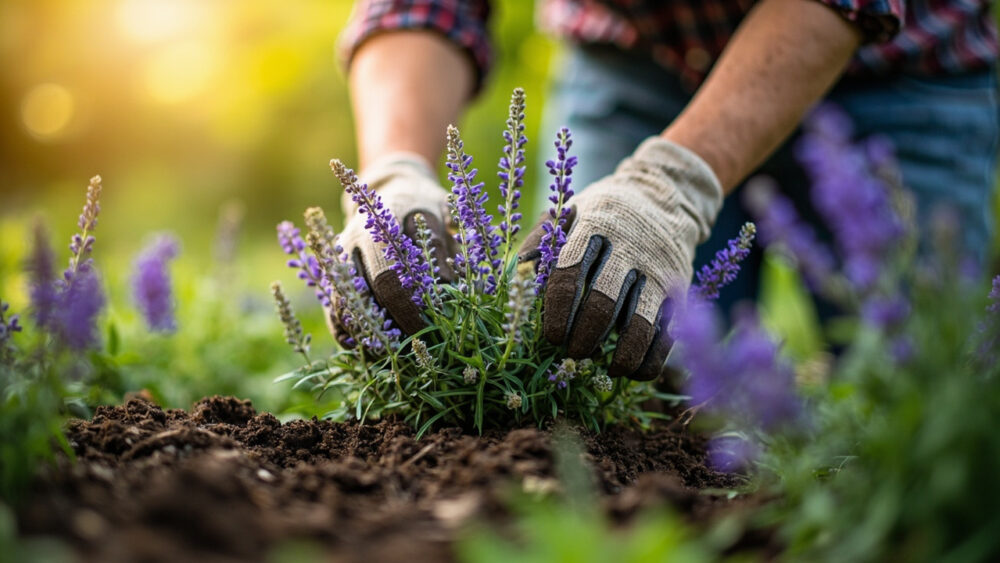
Planting Russian Sage Step by Step
- Dig the hole as deep as the root ball and about twice as wide, so roots can spread into loosened soil.
- Set the crown level with the surrounding soil surface, not buried deeper, since a buried crown invites rot.
- Space plants 2 to 3 feet apartsince mature Russian sage spreads 3 to 4 feet wide and needs airflow to avoid mildew.
- Backfill with the native soil you dug out, skipping rich amendments entirely.
- Water once, deeplyto settle the soil around the roots, then step back.
That’s genuinely all it takes to get one in the ground correctly.
What you do over the next few months is where most people quietly overcorrect.
Watering and Feeding Through the Season
Water new plants once or twice a week for the first four to six weeks, enough to keep the top few inches of soil from drying to dust. After that, established Russian sage wants very little supplemental water at all. It’s genuinely drought-tolerant once rooted in, built for lean, dry conditions the way lavender and thyme are.
If you assumed a bigger, healthier-looking plant needs more water and fertilizer to match, that guess is exactly what causes the floppy, weak-stemmed growth people complain about. Skip fertilizer altogether in average soil. In very poor soil, a light dose of balanced fertilizer once in spring is plenty; anything more produces soft, overgrown stems that flop over under their own weight and under wind.
Deep, infrequent watering during a genuine drought (soil dry three or more inches down, leaves visibly wilting in the evening) is the only exception worth making.
Treat it rough and it rewards you. Treat it gently and it gets floppy and weak, which brings us to the pests and problems it does still run into.
Problems That Actually Show Up
Root rot from wet soil is the number one killer, and it shows up as blackened stems at the base and a plant that wilts despite moist soil. There’s no fixing rot once it’s set in. The honest move is to pull the plant, improve drainage, and start over in a drier spot.
Powdery mildew, a white-gray dusting on leaves, shows up in humid climates or when plants are crowded with poor airflow. Space plants properly and it rarely becomes serious. If it does, a light fungicide labeled for powdery mildew on ornamentals works, applied exactly per the product label.
Deer and rabbits mostly leave it alone thanks to the strong, sage-like scent, which makes it a genuinely reliable border plant in areas where deer wreck everything else.
The pruning mistake is the one that actually shapes your season, and it happens in early spring, not summer.
The Pruning Timing Everyone Gets Wrong
Cut Russian sage back hard in early springonce you see new growth emerging at the base, not in fall. Cutting it back in fall removes the woody stems that protect the crown through winter, and in colder zones that can kill the plant outright.
Cut stems back to about 6 to 8 inches from the ground. This is the step that determines whether you get a tidy, upright plant or a sprawling, top-heavy one by midsummer.
Skip this prune and the plant still grows, but it grows leggy, woody at the base, and prone to splitting open in wind or heavy rain.
Get the timing right on this one cut and the rest of the season mostly takes care of itself, right up through bloom.
When Russian Sage Blooms and How to “Harvest” It
Russian sage blooms from midsummer into falltypically starting in July in most zones and continuing until frost, with tall spikes of small, tubular, violet-blue flowers held above silvery, aromatic foliage. There’s no harvest in the food-crop sense here. The payoff is the flower and foliage display itself, plus its usefulness as a cut or dried flower.
For fresh arrangements, cut stems when about half the flowers on a spike have opened, in the cool of morning, and strip the lower leaves before placing them in water. For drying, cut whole stems just as flowers open fully and hang them upside down in a dark, dry space for two to three weeks.
As for whether it spreads like mint: it doesn’t run underground the way true mints do, but it does self-seed modestly and forms a slowly widening woody clump over the years. It’s manageable, not invasive, though older clumps can eventually crowd out smaller neighbors if left unchecked for many seasons.
Deadheading spent spikes through the season keeps new blooms coming and keeps self-seeding in check.
Russian Sage at a Glance
- When to plant: spring, two to three weeks after last frost once soil hits 55 to 60°F, or fall at least six weeks before hard freeze.
- Sun and soil: full sun, six to eight hours minimum, in lean, fast-draining soil with no rich amendments.
- Spacing and depth: 2 to 3 feet apart, crown planted level with the soil surface, never buried.
- Watering: regular water for the first four to six weeks, then minimal water once established, since it’s drought-tolerant by nature.
- Feeding: skip fertilizer in average soil, use a light dose once in spring only in very poor soil.
- Pruning: cut back hard to 6 to 8 inches in early spring when new growth appears, never in fall.
- Bloom time: midsummer through fall, violet-blue spikes above silvery foliage, hardy in USDA zones 4 through 9.
Get the soil lean, the pruning timed to spring, and the water hand light once it’s rooted.
Russian sage forgives almost everything except kindness in the wrong form.