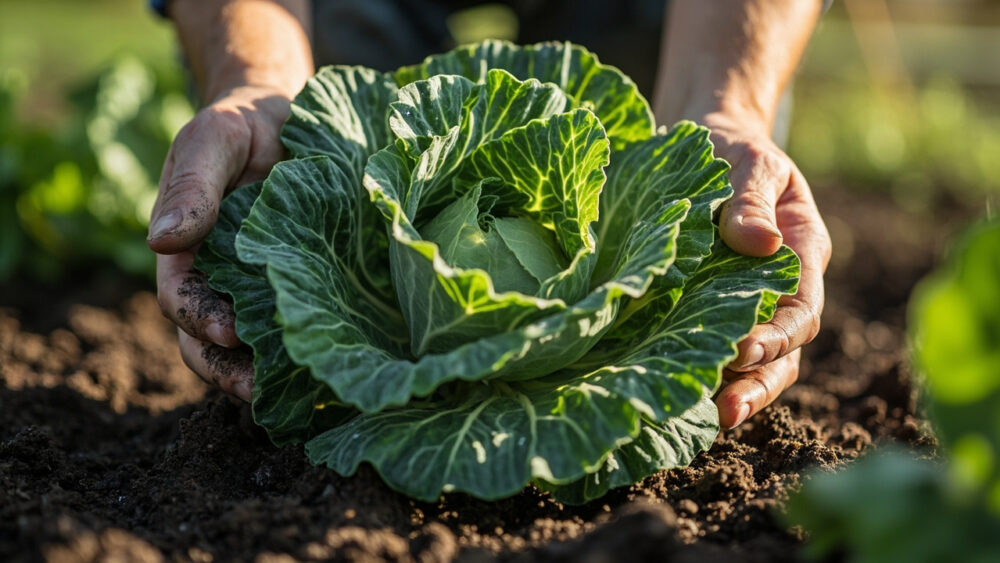
Growing cabbage means starting it in cool weather, giving each plant 12 to 18 inches of space in rich, firm soil, and keeping it watered evenly for the 60 to 100 days it needs to bulk up into a solid head. That is the whole plant, but cabbage has a way of punishing shortcuts you did not know you were taking. Get the timing or the feeding wrong and you end up with a head that splits, bolts, or just sits there the size of a fist.
There is one mistake that wrecks more cabbage crops than pests ever do, and it happens before the plant is even in the ground. There is also a sign on the leaves that half of gardeners misread as a watering problem when it is actually the opposite. And there is an honest answer to the question you are probably already forming: why did my head crack open right when it finally got big.
All of that gets covered below, in order, and at the very bottom you will find a save-able Cabbage at a Glance card with the numbers you will want to check again while you are standing in the garden.
When to Plant Cabbage
Cabbage is a cool-weather crop, not a summer one, and that single fact drives almost every timing decision. For a spring crop, set out transplants 2 to 4 weeks before your last expected frost, once soil temperature is at least 45°F, ideally 50 to 65°F. Cabbage tolerates a light frost fine once established.
For a fall crop, which tends to produce better-tasting, less bitter heads in most climates, count backward from your first fall frost. Start seed or set transplants 85 to 100 days before that date, so the heads mature in cool weather instead of summer heat.
In zones 3 to 6, spring and fall crops both work if you time them right. In zones 7 and warmer, cabbage often does best as a fall-into-winter crop, since spring heat arrives too fast for it to finish.
The mistake almost everyone makes happens right here, before a single seed goes in the ground.
The Mistake That Ruins Most Cabbage Crops
It is not pests, not watering, not soil. It is planting too late in spring or starting seed indoors too late for a fall crop. Cabbage wants to size up in cool weather, and once daytime temperatures push past 75 to 80°F consistently, growth slows, heads stay small, and plants get stressed enough to bolt (send up a flower stalk) instead of forming a solid head.
The fix is boring but it works: count backward from your target harvest window using the days-to-maturity on your variety, whether that is a 60-day early type or a 100-day storage cabbage, and add two weeks of buffer.
Miss that window and there is no real recovery. A bolting cabbage will not un-bolt.
Get the timing right and the next thing that decides your yield is what is under the plant, not around it.
Choosing the Spot and Prepping the Soil
Cabbage wants full sun, 6 or more hours a day, and soil that is rich, well-drained, and firm rather than loose and fluffy. Work in 2 to 3 inches of compost or aged manure before planting, and aim for a soil pH around 6.0 to 7.5. Cabbage is a heavy feeder, especially for nitrogen, and thin soil shows up later as small, loose heads.
Avoid planting where you grew broccoli, kale, or other brassicas in the last two to three years. Shared pests and diseases build up in the soil and cabbage pays the price.
Firm soil actually matters here in a way that surprises new gardeners: cabbage roots want contact, not air pockets, so skip heavy tilling right before planting and let the bed settle.
Once the bed is ready, the planting details are where spacing decisions either pay off or come back to bite you at head-forming time.
Planting Cabbage Step by Step
- Starting seed indoors: sow 4 to 6 weeks before your target transplant date, 1/4 to 1/2 inch deep, kept at 60 to 70°F for germination.
- Hardening off: expose transplants to outdoor conditions gradually over about a week before planting them out, especially if frost is still possible.
- Depth: set transplants at the same depth they were growing in their container, burying the stem slightly is fine but do not bury the lowest leaves.
- Spacing: 12 to 18 inches between plants, 24 to 36 inches between rows. Tighter spacing gives smaller heads, which is fine if that is what you want.
- Direct seeding: possible for fall crops in cooler climates, sow 1/2 inch deep, then thin seedlings to final spacing once they have 2 to 3 true leaves.
- Water in immediately after transplanting to settle the soil around the roots and cut down on transplant shock.
Spacing decided, the next few months come down to a fairly simple rhythm of water and food.
Watering and Feeding Through the Season
Cabbage wants consistent moisture, about 1 to 1.5 inches of water per week, whether from rain or irrigation. Uneven watering is the real cause behind that head-splitting problem you may already be bracing for, and it is also behind the leaf symptom most people misread.
If outer leaves look pale, curled, or slightly wilted even though the soil feels damp, the instinct is to water more. That is usually backward. It is often a nitrogen shortage, since cabbage is a hungry feeder and can show hunger symptoms that look a lot like thirst.
Side-dress with a nitrogen-rich fertilizer or compost about 3 and 6 weeks after transplanting. Keep the soil evenly moist rather than letting it swing between bone-dry and soaked, since that swing is exactly what causes heads to crack open once they are near full size.
A well-fed, evenly watered cabbage plant is also a plant with much better odds against the pests that come next.
Cabbage Problems and How to Head Them Off
Cabbage draws a predictable lineup of pests and diseases, and most of them have simple cultural fixes rather than dramatic ones.
- Cabbage worms and loopers: small holes chewed through leaves, green caterpillars hiding on the undersides. Floating row cover from planting onward keeps the adult moths from laying eggs in the first place.
- Aphids: clusters on the undersides of leaves or in the head itself. A strong water spray knocks most of them off; check plants weekly so it never gets out of hand.
- Cabbage root maggots: wilting plants with no clear leaf damage, roots chewed underground. Collars around the stem at planting time help block egg-laying flies.
- Clubroot and black rot: stunted, yellowing plants that do not respond to water or feeding. These live in the soil for years, which is exactly why crop rotation away from brassicas matters so much.
- Split heads: caused by uneven watering, usually a dry spell followed by heavy rain or a big drink. Harvest promptly once heads feel firm rather than leaving them to size up further.
For any pest or disease pressure that goes beyond what cultural fixes handle, an appropriately labeled product used exactly per its label is the safer next step rather than guessing at a stronger home remedy.
Handle the season’s threats and you get to the part that actually makes this whole thing worth it, the harvest itself.
When and How to Harvest Cabbage
Harvest when the head feels solid and firm when you squeeze it, not soft or springy. Size varies a lot by variety, so go by firmness and the days-to-maturity on your seed packet rather than by size alone.
Cut the head off at the base with a sharp knife, leaving the outer wrapper leaves and root in the ground. Many varieties will send up smaller secondary heads from the remaining stem if you leave it in place, which is a nice bit of bonus harvest most gardeners never expect.
If a head is ready but you are not, cabbage can hold in the garden for a couple of weeks past maturity in cool fall weather, longer than most vegetables tolerate. In warm weather, though, delay invites splitting, so cut it and store it in the fridge or a cold cellar instead of waiting.
That firmness test is the one piece of information worth carrying out to the garden with you, along with everything else below.
Cabbage at a Glance
- When to plant: transplants out 2 to 4 weeks before last frost for spring, or timed so a fall crop matures in cool weather, 85 to 100 days before first fall frost.
- Soil temperature: at least 45°F, ideally 50 to 65°F for best growth.
- Spacing: 12 to 18 inches between plants, 24 to 36 inches between rows.
- Depth: transplants at container depth, direct seed 1/2 inch deep.
- Water: 1 to 1.5 inches per week, kept even to avoid split heads.
- Feeding: nitrogen-rich side-dress at 3 and 6 weeks after transplanting.
- Harvest cue: head feels solid and firm when squeezed, cut at the base with a knife.
Cabbage rewards timing and even water more than any fancy technique. Get those two right and the rest of the season mostly takes care of itself.