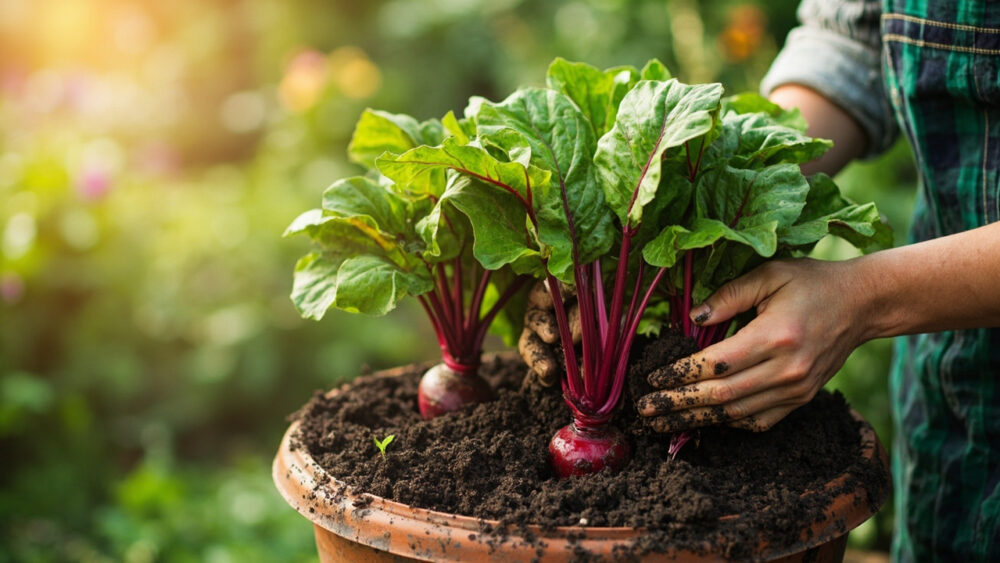
Beets grow fine in containers as long as the pot is at least 10 to 12 inches deep and you thin the seedlings ruthlessly. That second part is where most people fail. You can grow beets in containers on a patio, deck, or balcony with no garden bed at all, from seed to root in about 50 to 65 days depending on variety.
Here is what nobody tells you up front. The mistake that ruins most container beet attempts is not soil or sun, it is crowding. Beets seeds actually come in little clusters, so a single “seed” you plant often sprouts three or four seedlings stacked on top of each other, and if you do not rip most of them out, you get a pot full of leafy greens and zero root.
There is also a sign everyone misreads: a beet root pushing halfway out of the soil looks like a problem, but that is completely normal and not a symptom of anything going wrong. Stick with me and I will walk you through timing, the exact planting depth and spacing, feeding, the real threats to watch for, and when to actually pull them. The save-able Beets at a Glance card is at the very bottom once you have the full picture.
When to Plant Beets in Containers
Beets are a cool-season root crop, and they want to germinate in soil that has warmed to at least 50°F, ideally 50 to 85°F. That usually means starting seeds outdoors two to three weeks before your last expected frost, since beets tolerate light frost once sprouted.
In hot-summer regions, get a second round in six to eight weeks before your first fall frost. Beets sulk and get woody in real summer heat above the mid-80s, so a spring crop and a fall crop beat trying to push one planting through July.
Container growing gives you an edge here. You can start seeds a bit earlier than in-ground because pots warm up faster in spring sun, and you can move the whole thing into shade if a heat wave hits.
Timing solves half the battle, but the pot itself decides the rest.
Choosing the Container and Prepping the Soil
Depth matters more than width. Go with a container at least 10 to 12 inches deep with drainage holes in the bottom, no exceptions, since shallow pots produce stunted, forked, or flattened roots.
Width just determines how many beets you get. A 12 to 14 inch diameter pot comfortably grows six to eight beets; a long window box or half-barrel scales up from there.
Fill with a loose, well-draining potting mix, not garden soil straight from the yard, which compacts in containers and strangles root growth. A mix of quality potting soil with some compost worked in gives beets the fluffy texture they need to swell without hitting resistance.
Sun matters too. Beets want six or more hours of direct sun for the best root size, though they will tolerate four to five hours with slightly smaller roots and still-decent greens.
Good soil and good light get you to the starting line, but planting technique is where the season is actually won or lost.
Planting Beets Step by Step
1. Sow the seed clusters
Plant seeds ½ to 1 inch deep, spacing them 2 inches apart in rows or a grid across the pot. Remember each “seed” is really a small cluster, so you will get multiple sprouts from each one.
2. Water in gently
Moisten the soil right after sowing and keep it consistently damp, not soggy, until germination, which takes 5 to 10 days depending on soil temperature.
3. Thin without mercy
Once seedlings have their first true leaves, thin to one seedling every 3 to 4 inches. This is the step everyone hesitates on, and it is the single biggest factor in whether you get real beets or a pot of crowded greens.
4. Snip, don’t yank
Use scissors to cut extra seedlings at the soil line instead of pulling them, so you do not disturb the roots of the ones you are keeping.
Get the spacing right at this stage and everything downstream gets easier.
Watering and Feeding Through the Season
Containers dry out faster than garden beds, full stop. Check soil moisture by pressing a finger 1 inch down; if it comes back dry, water until it runs from the drainage holes.
In warm weather that can mean watering every day or every other day for smaller pots. Inconsistent watering is the second big beet-killer, causing roots to crack, turn woody, or grow stringy and bitter instead of sweet and tender.
Feed lightly. Beets do not need heavy nitrogen, which pushes leafy tops at the expense of the root, so skip high-nitrogen fertilizer entirely.
A balanced, lower-nitrogen fertilizer or a side dressing of compost once when plants are about a month old is plenty.
Water and food are only half the job, since a few common problems can undo a good planting fast.
Problems That Actually Show Up in Container Beets
Leaf miners tunnel pale, squiggly trails through the leaves. They rarely hurt the root itself, so pick off and destroy affected leaves rather than panicking about the harvest.
Cracked or oddly shaped roots almost always trace back to uneven watering or crowding, not disease, so revisit those two things before assuming something worse is wrong.
Small, spongy, or bitter roots usually mean the beets sat in the pot too long past maturity, or the container never got enough sun.
Fungal leaf spots, small tan or brown circles on the leaves, can appear in humid, still air. Improve air circulation between pots and remove badly affected leaves. If it spreads seriously, a fungicide labeled for vegetable garden use, applied exactly per the product label, is the next step.
Aphids sometimes cluster on the undersides of leaves. A strong blast of water or insecticidal soap applied per label directions usually knocks them back.
Handle these early and they stay minor, which brings you to the part you have been waiting for.
When and How to Harvest Beets
Here is that root pushing out of the soil again: that is the beet doing exactly what it should, not a cry for help. Use it as your cue, not your alarm.
Check the shoulders, the top of the root visible at the soil surface, once they reach 1.5 to 2 inches across for standard slicing beets, or golf-ball size if you prefer them extra tender. That is usually 50 to 65 days from sowing, though baby beets can be pulled as early as 40 days.
Grip the greens near the base and pull straight up. Loosen stubborn soil with a fork first if the pot has firmed up.
Do not leave mature beets in the pot hoping they will get bigger. Past a certain size they turn woody and lose sweetness, so harvest on the smaller side if you are ever unsure.
The greens are edible too, and taste great sauteed, so do not toss them when you thin or harvest.
That is the full arc from seed to plate, and here is the whole thing condensed to save.
Beets at a Glance
- When to plant: two to three weeks before your last frost in spring, or six to eight weeks before first fall frost, once soil hits at least 50°F.
- Container size: at least 10 to 12 inches deep, 12 inches or wider in diameter for six to eight beets.
- Planting depth and spacing: sow ½ to 1 inch deep, thin to one seedling every 3 to 4 inches once true leaves appear.
- Sun needs: six or more hours of direct sun for full-size roots, four to five hours works with smaller yields.
- Watering: keep soil consistently moist, checking daily in warm weather since containers dry out fast.
- Feeding: light, low-nitrogen fertilizer or compost once around the one-month mark, never heavy nitrogen.
- Harvest window: 50 to 65 days from sowing, when shoulders hit 1.5 to 2 inches across. Pull earlier for baby beets.
Thin early, water evenly, and pull them while they are still a little on the small side. That is the whole game with container beets.