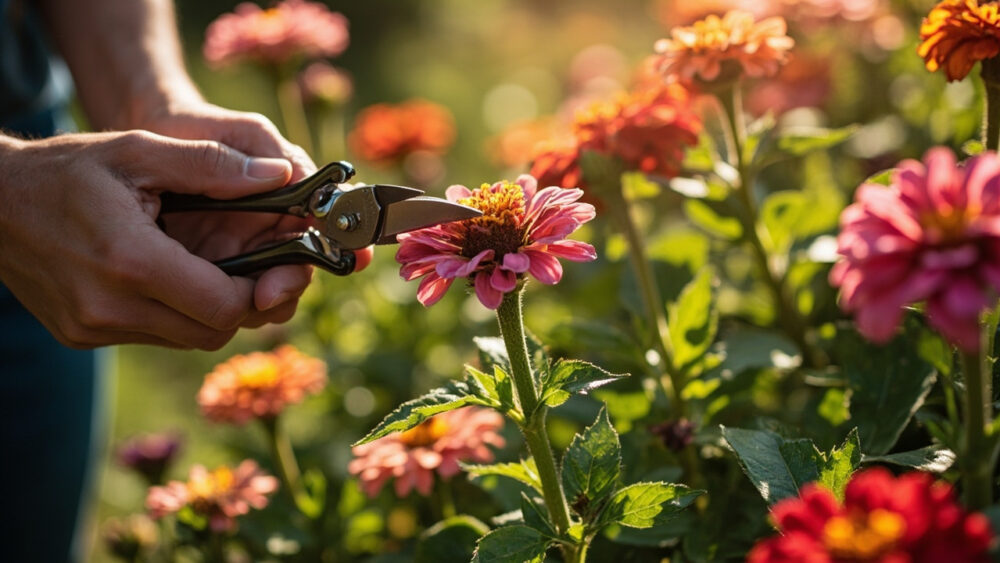
To deadhead zinnias, follow the stem down from the spent flower to the first set of full leaves or the next branching point, and cut there, not just below the flower head. Do this as soon as a bloom looks tired, faded, or is dropping petals, and do it all season, from the first flush of flowers until about six weeks before your first fall frost. Skip the shallow snip most people do right under the flower head. It looks tidy for about three days and then you are looking at the same bare stub with no new bud coming.
Most people who try this get one thing wrong almost immediately, and it is not the cutting motion. It is stopping too soon, either cutting too high on the stem or quitting deadheading in late summer when the plant looks “done.” Neither is fatal, but both cost you flowers you could have had.
Stick around and you will get the exact cut point with real inches, what a spent zinnia bloom actually looks like versus one that still has a few good days left, how much to remove in one pass without shocking the plant, and the honest timeline for when you will see the next round of buds. There is also a save-able Zinnias at a Glance card at the very bottom with every number in one place.
When to Deadhead, and When to Leave It Alone
Start deadheading the moment your zinnias produce their first fully open blooms, usually 7 to 10 weeks after sowing or 4 to 6 weeks after transplanting. Once flowering starts, check plants every 3 to 5 days. A zinnia that is left alone will still keep blooming some, but it slows down hard once it starts putting energy into seed instead of new buds.
Stop deadheading about 6 weeks before your average first fall frost. Any flower removed after that point is one the plant does not have time to replace, and you are better off letting the last blooms go to seed or simply enjoying them as is.
Do not deadhead a plant that is wilting from drought stress or transplant shock. Fix the water first. Cutting on top of stress just adds another wound to a plant that is already struggling.
Timing tells you when to move, but the tools in your hand decide how clean that cut heals.
The Tools and the One Prep Step That Actually Matters
A sharp pair of bypass pruners or garden scissors is all you need. Zinnia stems are fibrous, and dull blades crush rather than cut, which leaves a ragged wound that heals slower and invites stem rot in humid weather.
Wipe your blades with rubbing alcohol before you start, especially if you have handled any diseased plants that day. Zinnias are prone to powdery mildew and bacterial leaf spot, and dirty pruners are a real way to move both around the garden.
That is the whole prep step, and people skip it constantly because it feels unnecessary for something as simple as a flower stem.
Clean blades matter, but where you place the cut matters more, and that is where most people lose flowers without realizing it.
How to Deadhead a Zinnia, Step by Step
Step 1: Find the Spent Bloom
A flower ready for deadheading has lost its bright color, the petals are curling, browning, or falling, and the center may look swollen or fuzzy as it starts forming seed. If the bloom is still vivid and firm, even if a few outer petals have dropped, leave it a few more days.
Step 2: Trace the Stem Down
Follow that flower’s stem downward past the first leaf node and look for the next full set of leaves, a side branch, or a junction where two stems meet. This is usually 4 to 8 inches below the flower head, sometimes more on tall varieties.
Step 3: Cut There, Not Higher
Make your cut just above that leaf node or branch point, at a slight angle. This is the guessable part people get wrong: it feels wasteful to remove so much stem for one dead flower, so most gardeners snip an inch below the bloom instead.
That shallow cut leaves a bare stub with no leaves and no branching point, so the plant has nowhere to send new growth. Cutting down to the next node forces the plant to branch there, which means two new stems and two new buds instead of none.
On a full-size zinnia you can safely remove up to a third of the flowering stem in one cut without setting the plant back.
Get the depth of that cut right and the next flush shows up faster than you’d expect.
What Happens After You Cut
Expect new side shoots to appear at the cut node within 5 to 10 days, with fresh buds forming 2 to 3 weeks after that. This is the honest answer to the question most people are about to ask next: deadheading does not mean instant rebloom, it means the plant redirects energy that was going into seed production and spends the next couple weeks building new flowering stems instead.
The plant will look a little sparse right after a heavy deadheading pass, especially if you took several stems at once. That is normal and temporary.
Keep up regular watering during this recovery window, about 1 inch of water a week, since a plant pushing new growth needs consistent moisture more than a plant just holding steady.
A sparse-looking plant two weeks in is not a failure, but a few real mistakes can turn that into a permanent slowdown.
The Mistakes That Cost You Flowers
These are the ones that quietly wreck a zinnia’s bloom output over a season, even when the gardener is deadheading regularly.
- Cutting too shallow: snipping right under the flower head instead of down to a leaf node or branch, which leaves nowhere for new growth to start.
- Deadheading too late in the season: removing blooms inside that final 6-week window before frost, when the plant has no time left to produce a replacement.
- Ignoring foliage while you’re in there: zinnias get powdery mildew easily in humid weather or crowded beds, and a deadheading pass is the best time to spot it early and remove badly affected leaves.
- Ripping instead of cutting: pulling spent blooms off by hand can tear stem tissue and invite rot, especially after rain.
- Deadheading everything at once on a stressed plant: if the plant is wilting from heat or drought, deadhead lightly and wait, rather than removing a third of its stems in one pass.
Avoid those five and the only thing standing between you and a long bloom season is consistency.
Zinnias at a Glance
- When to start deadheading: as soon as the first blooms fade, usually 7 to 10 weeks after sowing.
- When to stop: about 6 weeks before your average first fall frost.
- Where to cut: down to the first full leaf node or branch point, 4 to 8 inches below the spent flower.
- How much to remove per pass: up to one third of the flowering stem, less if the plant is drought stressed.
- Tools: sharp bypass pruners or scissors, wiped with rubbing alcohol before use.
- Time to next bloom: new shoots in 5 to 10 days, new buds 2 to 3 weeks after that.
- Water during recovery: about 1 inch per week to support new growth.
Cut low, to a real node, not just under the flower, and stick with it right up until that six-week cutoff.
Do that consistently and a zinnia will out-produce almost anything else in the bed.