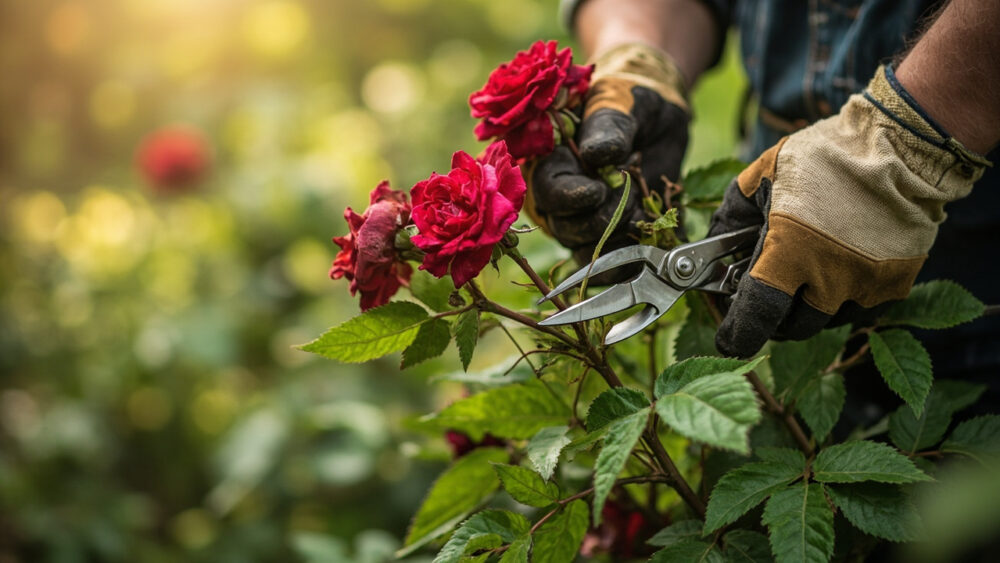
Deadheading Knockout roses means snipping the spent bloom cluster off just above the first full set of five leaves below it, cutting at a slight angle. Do it any time you see brown, papery, or shattering petals from late spring through late summer. You can skip it entirely and the bush will still rebloom, but cutting it right speeds up the next flush by a week or two and keeps the whole shrub looking cleaner.
That’s the short version, and honestly it’s most of what you need. But there are a few places people get this wrong in ways that cost them a whole round of blooms, plus one habit that actually works against the plant’s own rebloom cycle instead of helping it.
There’s also a hard stop date most people miss completely, a “more is better” instinct that backfires, and the honest truth about whether you even need to deadhead these roses at all. All of that’s coming up, and the Knockout Roses at a Glance card at the bottom is built to save to your phone for next time you’re standing in front of the bush with pruners in hand.
When to Deadhead, and When to Stop
Start once the first flush fades, usually four to six weeks after the bush leafs out for the season, whenever the earliest blooms go from vibrant to faded and papery. Knockouts rebloom in cycles roughly every five to six weeks all summer, so you’ll be back at this every few weeks through the season.
The part almost nobody tells you: stop deadheading about six to eight weeks before your first expected fall frost. Cutting late pushes out tender new growth that won’t harden off in time, and it also stops the plant from setting the small rose hips that signal it’s time to slow down and prepare for dormancy.
If you assumed you should keep deadheading right up until frost to squeeze out one more flush, that guess is exactly backward. Let the last blooms fade and stay on the bush late in the season.
Timing solved, but there’s a bigger question waiting: do you even need to do this at all.
Do Knockout Roses Actually Need Deadheading?
Here’s the honest answer to the question you’re probably about to ask. Knockout roses were bred to be self-cleaning, meaning they’ll drop spent petals and push new blooms with zero help from you.
You do not have to deadhead them to get repeat blooms. That’s the whole selling point of the variety.
So why bother? Two reasons. Spent blooms left on the bush look ragged and brown for a week or two before they drop, and removing them redirects a little energy into new buds instead of seed production, which speeds up the next flush noticeably.
Think of it as optional grooming with a real payoff, not a survival requirement. That changes how much pressure you should feel about doing it perfectly, which brings us to the tools and the one prep step that actually matters.
Tools and the One Prep Step That Matters
Use a pair of sharp bypass pruners, the scissor-action kind, not anvil-style pruners that crush stems. A clean, sharp cut heals faster and shrugs off disease better than a mashed one.
The prep step everyone skips: wipe your blade with rubbing alcohol before you start, especially if you’ve used those pruners on any other rose or on a plant with visible black spot or powdery mildew. Knockouts are disease-resistant, not disease-proof, and a dirty blade is a real way to spread fungal spores from a sick plant to a healthy one.
Grab thick gardening gloves too. Knockout canes carry plenty of thorns, and a full afternoon of deadheading without gloves will leave your hands looking like you lost a fight with the bush.
Gloves on, blade clean, now let’s talk about exactly where to cut.
How to Deadhead Knockout Roses, Step by Step
Step 1: Find the spent bloom
Look for flowers that have gone from bright pink, red, or coral to faded, curled, or dropping petals. If petals fall off when you brush the bloom lightly, it’s ready.
Step 2: Trace the stem down to the first five-leaf set
Follow the stem below the spent flower until you find a leaf cluster with five leaflets, not three. This is where the strongest new growth bud typically forms on a rose.
Step 3: Cut at a 45-degree angle
Cut about a quarter inch above that five-leaf set, angled so water sheds off the cut instead of sitting on it. A flat cut holds moisture and invites rot; an angled one doesn’t.
Step 4: Cut single blooms and whole clusters differently
Knockouts bloom in clusters. If the whole cluster is spent, cut the entire stem back to the five-leaf set below the cluster. If only one or two flowers in a cluster have faded while others are still fresh, snip just those individual spent flowers off at their base and leave the cluster stem alone.
Get the cut right and the bush does the rest, but what happens in the following days is where people start second-guessing themselves.
What to Expect After You Deadhead
Nothing dramatic happens right away, and that’s normal. Give it seven to fourteen days before you expect visible new buds, depending on temperature and how much sun the bush is getting.
Warmer weather speeds this up considerably. A bush deadheaded in June, when nights stay above 60°F, rebounds faster than one deadheaded in a cool, wet spring.
You’ll typically see small reddish new leaf growth first, low and near the cut, before any buds show. That new growth is the plant redirecting energy exactly where you told it to with the cut, which is the whole point of doing this.
If three weeks pass with no new growth at all, something else is going on, usually water or fertility, not the deadheading itself.
That leads straight into the mistakes that actually cost people a whole flush of flowers.
The Mistakes That Cost You a Flush of Blooms
Most deadheading mistakes on Knockouts aren’t about the cut itself, they’re about scale and timing.
- Cutting too high, above a three-leaf set: weaker regrowth buds live there, so you get thin, spindly new stems instead of vigorous ones.
- Taking too much cane at once: removing more than the top six to eight inches in a single pass stresses the plant and delays reblooming instead of speeding it up.
- Deadheading with dull or dirty pruners: crushed stems heal slower and are more likely to develop cane dieback or fungal entry points.
- Deadheading right through a drought: cutting encourages new growth, and new growth needs water; if the bush is already stressed and dry, hold off until you’ve watered it back to health.
- Ignoring the fall cutoff: late-season deadheading pushes tender growth that winter kills, weakening the bush going into next spring.
None of these ruin the plant permanently, Knockouts are famously forgiving, but each one costs you time you can’t get back mid-season.
All of that boils down to a handful of numbers worth keeping on hand, which is exactly what’s below.
Knockout Roses at a Glance
- When to deadhead: anytime blooms turn brown or papery, roughly every five to six weeks through the growing season.
- When to stop: six to eight weeks before your first expected fall frost.
- Where to cut: a quarter inch above the first five-leaflet leaf set below the spent bloom, at a 45-degree angle.
- How much to remove: no more than the top six to eight inches of stem in one pass.
- Tools needed: sharp bypass pruners wiped with rubbing alcohol, plus thick gloves.
- Time to new growth: seven to fourteen days, faster in warm weather above 60°F at night.
- Is it required: no, Knockouts are self-cleaning, but deadheading speeds up reblooming and keeps the bush tidy.
Get the cut angle and the five-leaf set right, and everything else about Knockout roses takes care of itself.
Skip deadheading entirely if you want, just don’t skip the fall cutoff.