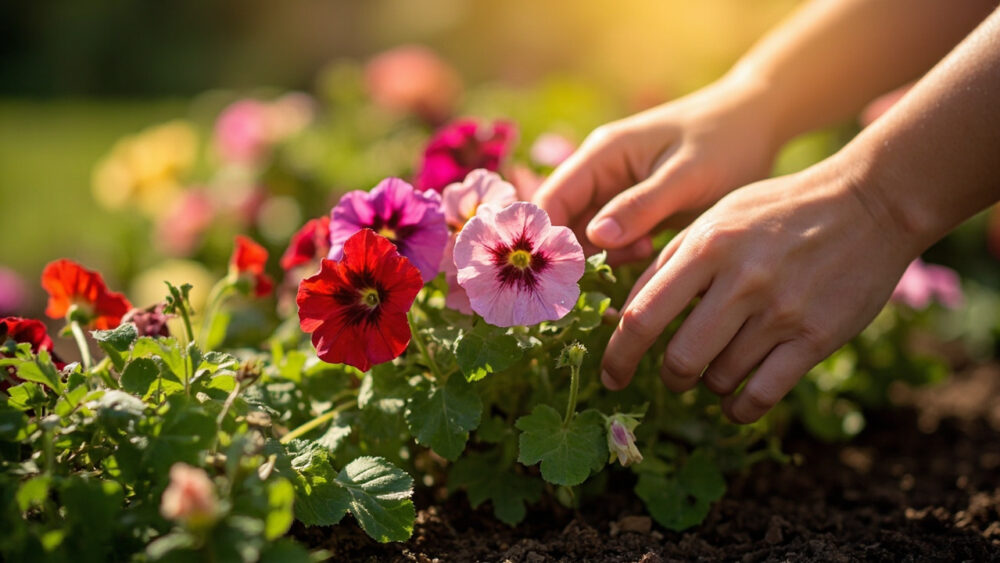
Petunias want at least six hours of direct sun, soil that dries slightly between waterings but never goes bone dry, and regular feeding since they bloom themselves nearly to exhaustion all season. Learning how to care for petunias really comes down to those three things plus one habit almost nobody keeps up with: deadheading or shearing. Skip that habit and you get a plant that blooms hard for six weeks, then quits.
Most of the “my petunias died” stories are actually the same three mistakes, and I’ll walk through each one. There’s also a sign of trouble everyone reads backward, treating it like a watering problem when it’s usually the opposite. And there’s a question every petunia owner eventually asks around midsummer that has an honest, slightly annoying answer.
Stick with me to the bottom and you’ll find a save-able Petunias at a Glance card with the numbers you actually need on hand, the kind of thing worth screenshotting before you walk back out to the garden center.
Light, Placement, and Temperature
Petunias are sun hogs. Give them six to eight hours of direct light and you get a mounded, floriferous plant. Give them four hours or less, dappled shade, or a north-facing spot, and you get a leggy plant with sparse, small flowers reaching sideways toward the light.
They like it warm but not scorching. Daytime temperatures in the 65 to 85 F range keep them happiest, and they stall out or drop buds once nights stay above 85 F for long stretches in the height of summer. They also do not tolerate frost. Wait until night temperatures are reliably above 40 to 45 F before planting out, whether that’s in the ground or in containers.
Containers matter more than people expect, because a black plastic pot on a hot patio can cook the roots even when the air temperature seems fine.
Watering: How Much, How Often, and How to Tell
Petunias in the ground usually need about an inch of water a week, less if you’re getting regular rain. Petunias in containers or hanging baskets are a different animal entirely, since they can need water daily once temperatures climb, sometimes twice a day for small hanging baskets in full sun.
Check by feel, not by schedule. Stick a finger an inch into the soil. If it’s dry, water. If it’s still damp, wait a day and check again. The top inch drying out is normal and fine; it’s the whole root zone drying out that stresses the plant.
Here’s the sign everyone reads backward: wilting in the afternoon heat. Most people see droopy petunias at 3 p.m. and dump water on them immediately. Often that plant is fine, it’s just doing what leaves do in intense heat to protect themselves, and it perks back up by evening. Water based on soil dryness, not on how the plant looks in the hottest part of the day.
Get the water timing right and the next thing that determines your bloom count is what’s actually in that soil.
Soil, Potting Mix, and Feeding
Petunias want soil that drains well but holds a little moisture, nothing soggy, nothing that turns to dust. In containers, use a quality potting mix, not garden soil, which compacts and drowns roots in a pot. In the ground, work in some compost if your soil is heavy clay or thin sand.
These plants are hungry. They’re blooming continuously all season, and that takes fuel. Feed every one to two weeks with a balanced liquid fertilizer, or mix a slow-release granular into the soil at planting and supplement with liquid feed through summer. Container petunias need feeding more often than in-ground ones, since watering washes nutrients out of pots fast.
Skip feeding for a month and you’ll see it: fewer new buds, pale foliage, a plant that looks tired even when it’s watered right.
Feeding solves the fuel problem, but there’s a maintenance habit that solves the shape and bloom-count problem, and it’s the one almost everyone skips.
Pruning, Deadheading, and the Midsummer Slump
This is the mistake that ruins most petunia seasons. People plant them, water them, maybe feed them once, and then never touch them again. By midsummer the plant is a tangle of leggy stems with a few flowers at the very tips and bare stretches everywhere else.
Deadhead spent blooms regularly, pinching off the flower right below the base. For older varieties especially, go further: every four to six weeks, shear the whole plant back by a third, cutting leggy stems down hard. It looks brutal and bare for about a week. Then it comes back thicker and covered in new buds.
Newer self-cleaning varieties, often sold as “wave” types or similar spreading petunias, drop their own spent flowers and need less deadheading, but they still benefit from an occasional haircut when they get scraggly or start blooming only at the stem tips.
This is the honest answer to the question everyone asks around July: no, your petunias slowing down doesn’t mean they’re dying, it means they need a haircut, not a burial.
Problems That Actually Show Up
A few issues account for almost every petunia complaint:
- Leggy, bare-stemmed growth: not enough light, or too long since the last shearing. Move to more sun and cut back hard.
- Yellowing lower leaves: usually overwatering or poor drainage, not a nutrient problem. Let the soil dry out more between waterings before you reach for fertilizer.
- Sudden wilting that doesn’t recover overnight: root rot from soggy soil, or in containers, roots that have simply outgrown the pot. Check drainage holes first.
- Sticky residue, stunted new growth, or visible tiny insects: aphids are common on petunias. A strong spray of water knocks most off, and insecticidal soap handles the rest if you follow the label.
- Fuzzy gray mold on flowers or stems in wet weather: botrytis blight, worse in humid, crowded plantings. Improve airflow by spacing plants out and remove affected parts.
Petunias are not toxic to humans, but they can cause mild stomach upset in dogs and cats if eaten in quantity. If a pet has eaten a significant amount, call your veterinarian rather than waiting to see what happens.
Once you’ve ruled out the common culprits, the better question is what a genuinely happy petunia actually looks like.
Signs Your Petunias Are Actually Thriving
New buds should be visible all the time, not just after a rain.
Color is a good tell, too. Foliage should be a healthy medium green, not pale yellow-green and not dark and leggy from stretching toward light. If you’re pinching spent blooms every few days because there are simply that many flowers to remove, that’s exactly what success looks like.
All of that, though, depends on getting the basic numbers right in the first place.
Petunias at a Glance
- When to plant: after night temperatures stay reliably above 40 to 45 F, with no frost forecast.
- Light needed: six to eight hours of direct sun for full, mounded growth.
- Spacing: 8 to 12 inches apart for most bedding types, checking the tag since spreading types need more room.
- Watering: about an inch a week in the ground, daily to twice daily for containers and hanging baskets in hot weather, always checked by feel an inch down.
- Feeding: a balanced liquid fertilizer every one to two weeks, more often for containers.
- Maintenance: deadhead regularly and shear leggy growth back by about a third every four to six weeks.
- Ideal temperature range: 65 to 85 F daytime, with blooming slowing once nights stay above 85 F.
Get the sun and the shears right and everything else is just fine-tuning.
Most petunia failures are really just a plant that never got its midsummer haircut.