Pansies go in the ground four to six weeks before your last spring frost, or in early fall six weeks before your first hard freeze, in soil that has been loosened and fed with compost. Space them 6 to 8 inches apart, set them no deeper than they sat in the pot, and water them in right away. Learning how to grow pansies really comes down to timing the cold and not overfeeding the bloom out of them, and both of those trip up more people than you’d think.
Here’s what nobody tells you at the garden center: the mistake that kills most pansy beds isn’t frost, it’s heat. These are cool-weather flowers pretending to be spring annuals, and planting them like petunias is how you lose them by June.
There’s also a sign almost everyone misreads when their pansies go leggy and stop blooming, and it isn’t what you’d assume. Stick with me through the sections below and I’ll get to that, plus the honest answer for how long a pansy bed actually lasts and what “harvest” even means for a flower you’re not eating.
Save your thumb some scrolling: there’s a full Pansies at a Glance card at the very bottom with every number in one place.
When to Plant Pansies
Pansies want cold, not warmth, to establish well. In spring, plant them four to six weeks before your average last frost date, as soon as soil can be worked and isn’t frozen or waterlogged. They shrug off light frost and even a dusting of snow once established.
In climates with mild winters, USDA zones 7 through 10 roughly, fall planting works better than spring. Set them out six weeks before your first hard freeze so roots establish before the ground goes cold, and they’ll often bloom on and off all winter and into spring.
In colder zones, spring planting is your main window, though a second fall planting for one last flush before winter is common where the season allows it.
Soil temperature matters more than the calendar, and that’s the part everyone skips.
Choosing the Spot and Prepping the Soil
Pansies want sun in cool weather and afternoon shade once temperatures climb. Full sun, 6 hours or more, gives the best bloom in spring and fall. In a spring planting that will run into early summer, a spot with some afternoon shade buys you extra weeks before the heat shuts them down.
Soil should be loose, well-drained, and rich in organic matter. Work 2 to 3 inches of compost into the top 6 to 8 inches of soil before planting. Pansies sitting in heavy, soggy clay rot at the roots fast, so if drainage is questionable, raise the bed or plant in containers instead.
Aim for a soil pH around 5.4 to 5.8, slightly acidic; most garden soils fall close enough that you won’t need to adjust, but a quick test is worth it if pansies have struggled in that spot before.
Get the bed right now and the rest of the season gets a lot easier.
Planting Pansies Step by Step
1. Loosen and level the bed
Break up the top 6 to 8 inches of soil and rake it level after mixing in your compost.
2. Space plants 6 to 8 inches apart
Tighter spacing gives a fuller look faster, wider spacing gives plants more room to spread without crowding. Either works, it’s a style choice, not a rule.
3. Plant at the same depth as the pot
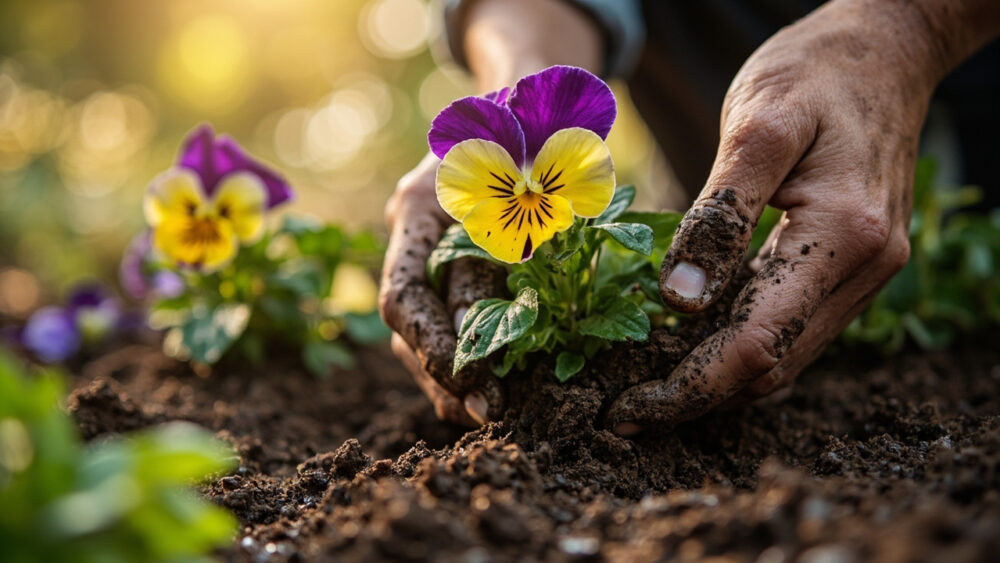
Dig a hole slightly wider than the root ball. Set the plant so the crown sits level with the surrounding soil, not buried and not sitting high and exposed.
4. Firm the soil and water immediately
Press soil gently around the base to remove air pockets, then water slowly until the ground around each plant is thoroughly damp.
That first watering is what settles roots into contact with soil, so don’t skip or rush it.
Watering and Feeding Through the Season
Pansies want consistently moist soil, never bone dry and never waterlogged. Check the top inch of soil with a finger; water when it starts to feel dry, which in cool spring weather might only be once or twice a week, more often once temperatures rise.
Feed every 3 to 4 weeks with a balanced liquid fertilizer, or work a slow-release granular into the soil at planting time. Here’s the counterintuitive part: too much nitrogen gives you lush green leaves and almost no flowers, which is the opposite of what most people are chasing.
If your plants are all foliage and no bloom, ease off the fertilizer rather than adding more.
Deadheading spent blooms by pinching them off at the stem keeps plants producing more flowers instead of going to seed.
Feeding light and deadheading often does more for bloom count than anything in a bottle.
Problems That Actually Show Up, and How to Head Them Off
Leggy, stretched growth with fewer flowers is the sign almost everyone misreads. Most people assume it means the plant needs more fertilizer or more water. It usually means the opposite: it’s a heat stress response, the plant is bolting toward survival mode as temperatures climb, and feeding it harder only accelerates the decline.
The fix is a hard trim, cutting stems back by a third to encourage compact new growth, plus more shade if you have it. In genuinely hot weather this buys weeks, not a full recovery.
Other issues to watch for:
- Slugs and snails: ragged holes in leaves, worse after rain. Handpick in the evening or use a slug bait labeled for edible-adjacent gardens, following the label exactly.
- Crown or root rot: wilting despite wet soil, usually from poor drainage. Improve drainage before replanting. Affected plants rarely recover.
- Aphids: clustered on new growth and stems. A strong water spray or insecticidal soap, applied per label directions, usually handles it.
- Powdery mildew: gray-white coating on leaves in humid, crowded conditions. Improve airflow by thinning nearby plants and avoid wetting foliage when watering.
None of these are usually fatal if you catch them early, and knowing which sign points to which cause saves you from treating the wrong problem.
When and How to “Harvest” Pansies
Pansies don’t harvest like a vegetable, but the honest answer to when they’re at their peak is this: they bloom continuously from planting through cool weather, typically 8 to 12 weeks after being set out, and individual flowers are ready to pick or deadhead the moment they’re fully open, which for most varieties is 60 to 70 days from seed if you’re starting your own.
Cut flowers for a vase in the cool morning hours when stems are fully hydrated. They’ll hold in water for 4 to 7 days.
The plant itself is a cool-season annual in most climates, meaning it lives one season and fades once sustained heat sets in, though in mild-winter zones it can act more like a short-lived perennial, cycling through blooms across fall, winter, and spring before finally giving out.
Knowing when a pansy is done, versus just resting, is what separates a gardener who replants at the right time from one who keeps babying a spent plant for nothing.
Pansies at a Glance
- When to plant: four to six weeks before last spring frost, or six weeks before first fall freeze in mild-winter zones.
- Spacing and depth: 6 to 8 inches apart, crown level with the soil surface.
- Light: full sun in cool weather, afternoon shade once temperatures climb.
- Soil: loose, well-drained, enriched with 2 to 3 inches of compost, pH around 5.4 to 5.8.
- Watering: keep soil consistently moist, water when the top inch dries out.
- Feeding: balanced fertilizer every 3 to 4 weeks, go light to avoid sacrificing blooms for foliage.
- Bloom window: continuous flowering for 8 to 12 weeks or more in cool conditions, individual annual life span ends with sustained heat.
Get the timing and the sun right, and pansies more or less take care of themselves.
The rest is just deadheading and staying honest about when the heat has won.