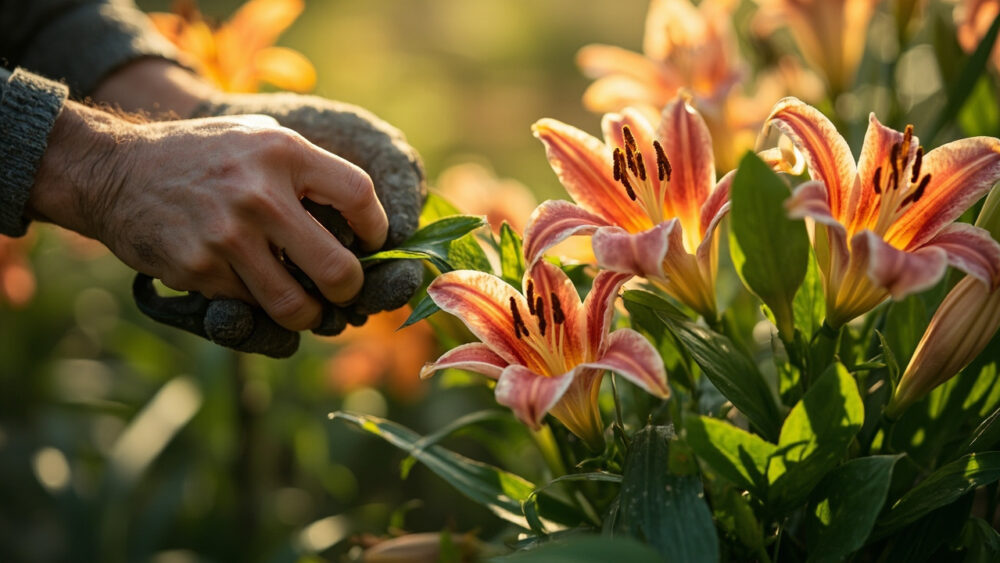
Lilies want six hours of sun, evenly moist but never soggy soil, and cool roots with warm tops. Get those three things right and the rest of how to care for lilies is just maintenance: feeding in spring, staking the tall ones, and cutting them back in fall. Get any one of them wrong and you get a plant that grows tall, skinny, and refuses to bloom.
Here is the mistake that wrecks most lilies before they ever flower: planting the bulb too shallow. It seems harmless. It is not.
There is also a sign nearly everyone misreads as disease when it is actually the plant telling you something completely different, and a question you have not asked yet but will the second your lily finishes blooming, which is whether you should cut it down now or leave it alone. Both get answered below, in plain terms, and at the very bottom you will find the Lilies at a Glance card, the short version worth saving to your phone before you walk away from this page.
Light, Placement, and Temperature
Lilies need at least six hours of direct sun to bloom well, though in hot climates (zone 8 and up) they appreciate light afternoon shade so the flowers do not scorch and fade fast. Morning sun with afternoon relief is close to ideal in warmer regions.
The part people miss is the roots. Lilies want cool, shaded soil even while the top of the plant bakes in full sun.
That is why a low groundcover or mulch layer around the base matters more than most gardeners assume. Bare, sun-baked soil around the stem stresses the bulb even when the foliage looks fine.
Lily bulbs are hardy across a wide range, roughly zones 3 through 9 depending on the type, with Asiatic and Oriental hybrids tolerating cold better than some of the trumpet types.
Get the roots shaded and the top in sun, and you have already solved the placement problem most people never think to check.
Watering: How Much, How Often, and How to Tell
Water when the top 1 to 2 inches of soil is dry, which in average weather is usually once or twice a week. Lilies want consistent moisture, not a swamp and not a drought in between.
Stick a finger into the soil next to the stem, not right against it. If it feels dry to that first knuckle, water deeply until it runs from the drainage holes or soaks well past the root zone in the ground.
If you assumed drooping leaves always mean the plant needs more water, that guess causes more rot than it solves. Lily bulbs sitting in wet, poorly drained soil rot from the base up, and the foliage droops for the exact same reason underwatered foliage droops: the roots cannot function.
Check the soil before you reach for the watering can. If it is already damp and the plant is drooping, the problem is too much water or poor drainage, not too little.
Knowing the difference between thirsty and drowning is the single biggest watering skill with lilies.
Soil, Potting Mix, and Feeding
Lilies need loose, well-drained soil with some organic matter. Heavy clay that holds water is the fastest way to lose a bulb to rot, so work in compost or coarse material before planting if your soil is dense.
In containers, use a standard potting mix with added perlite or coarse sand for drainage, and always use a pot with real drainage holes.
Feed with a balanced fertilizer as new growth emerges in spring, then again lightly after flowering to help the bulb rebuild its energy for next year. Skip heavy nitrogen feeds, they push leafy growth at the expense of blooms.
A slightly acidic to neutral soil pH, roughly 6.0 to 6.5, suits most lily types well.
Feed twice a year and you have covered the bulb’s entire nutritional need, which brings up the question of what else actually needs doing and when.
Pruning, Staking, and the Task Everyone Times Wrong
Here is the follow-up question almost every lily grower eventually asks: once the flowers fade, do you cut the plant down? No, not yet. Deadhead the spent flowers to stop seed formation, but leave the stem and leaves standing.
The green foliage keeps photosynthesizing after bloom and sends energy back down into the bulb for next year’s flowers. Cut it too early and you starve next season’s display before it even starts.
Wait until the foliage yellows and dies back naturally in fall, then cut the stem down to a couple of inches above the soil.
Tall varieties, especially Orientals and trumpet types that can reach 3 to 6 feet, benefit from a stake driven in early so wind and heavy blooms do not snap the stem later.
Divide crowded clumps every 3 to 4 years in fall, once they start blooming smaller or less densely, a sign the bulbs have multiplied past the room they have to grow.
Get the fall timing right and you have solved the one task that quietly determines next year’s whole show.
Problems That Actually Show Up, and What They Mean
Here is the sign nearly everyone misreads: orange-red beetles or their sticky, dark larvae on the leaves and buds are the lily leaf beetle, not just “some bug.” Left alone, they can strip a plant’s foliage in weeks. Hand-pick adults and larvae where practical, and if the infestation is heavy, an insecticide labeled for the pest is the answer, applied exactly per the product label.
Botrytis, a gray fungal blight, shows up as brown or spotted patches on leaves and flowers in cool, damp, humid weather. Improve air circulation between plants and remove affected foliage; a fungicide labeled for botrytis helps when caught early, again applied per the label.
Yellowing lower leaves with the plant otherwise upright and firm is often just normal aging, not disease. It becomes a problem worth investigating when it climbs the whole plant fast alongside soft, mushy stems at the base, which points to rot from overwatering.
Lilies are toxic to cats specifically, capable of causing serious kidney damage even from small amounts of pollen or leaf material. If a cat has chewed on or brushed against a lily, contact a veterinarian right away rather than waiting to see what happens.
Most lily problems trace back to one of two things, wet feet or hungry beetles, and both are manageable once you know what you are looking at.
How to Tell Your Lily Is Actually Thriving
A thriving lily pushes up strong, straight stems with dark green, glossy leaves spaced evenly up the stalk, no yellowing except at the very base. Buds form in clusters and open in succession rather than all at once, stretching the bloom over a couple of weeks.
The stem should feel firm, not soft or hollow-feeling when you gently press near the base. Firm means the bulb underneath is healthy and well fed.
Come back year after year with the clump slightly larger and the bloom count rising, and you know your soil, sun, and watering rhythm are all working together the way they should.
That steady yearly return is the real reward with lilies, and it is exactly why the quick reference below is worth keeping.
Lilies at a Glance
- When to plant: in fall or early spring once soil is workable and not waterlogged, bulbs settle in fastest in cool soil.
- Planting depth and spacing: set bulbs 6 to 8 inches deep and 8 to 12 inches apart, shallow planting is the top cause of weak, flopping stems.
- Light: at least 6 hours of direct sun, with afternoon shade in hot climates and cool, mulched soil at the base.
- Water: when the top 1 to 2 inches of soil dries out, usually once or twice weekly, never let soil stay soggy.
- Feeding: balanced fertilizer at spring growth and again lightly after bloom, skip heavy nitrogen.
- After bloom: deadhead flowers but leave foliage standing until it yellows and dies back in fall.
- Watch for: lily leaf beetles (orange-red, on leaves and buds) and botrytis blight in damp weather, and keep lilies away from cats entirely.
If you remember nothing else, remember this: plant deep, water by feel not by schedule, and let the foliage die back naturally before you cut it.
That single habit does more for next year’s blooms than any fertilizer you could buy.