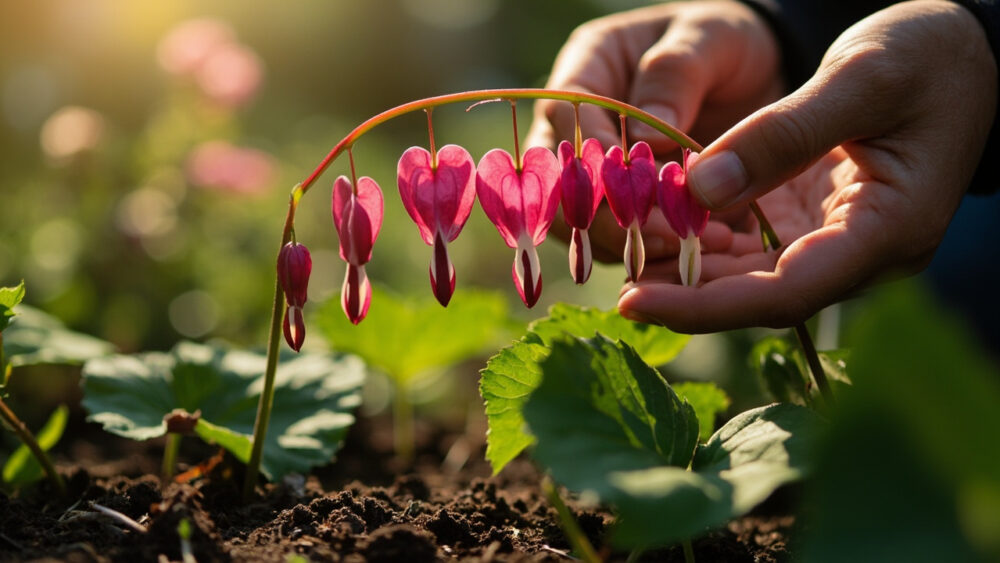
Caring for bleeding hearts comes down to three things: dappled shade, soil that stays evenly moist but never soggy, and letting the plant disappear on its own schedule in mid to late summer without panicking. Give it a spot with morning sun and afternoon shade, water it before the top inch of soil dries out, and leave the yellowing foliage alone when it starts to die back. That’s the whole job, but the details are where most people go wrong.
Here’s what trips people up: the plant going dormant looks exactly like the plant dying, and there is a very specific way to tell the difference before you dig it up and toss it. There’s also a placement mistake that seems harmless in April and kills the whole show by July. And if you’ve ever wondered why a bleeding heart bloomed beautifully for three weeks and then just vanished, that answer is coming too.
Stick with me through the sections below and I’ll give you the save-able Bleeding Hearts at a Glance card at the bottom, the kind of thing worth screenshotting before you walk back outside.
Light, Placement, and Temperature
Bleeding hearts want morning sun and afternoon shade, or dappled light all day under high tree canopy. Full sun in a hot climate is the mistake that ruins most attempts. It looks fine in cool spring weather, then the plant scorches and collapses early once temperatures climb into the 80s.
In cooler climates, zones 3 to 6, they’ll tolerate more direct sun without complaint. Further south, zones 7 and up, deep shade for most of the day is the safer bet. These plants genuinely prefer cool roots, so a north or east-facing bed near larger shrubs or deciduous trees is close to ideal.
They’re hardy down to zone 3 and don’t need winter protection in most regions once established.
Where you put the plant decides more than almost anything else you’ll do this season, and watering is where the second big decision lives.
Watering: How Much, How Often, How to Tell
Water when the top inch of soil feels dry to the touch, which in spring often means every 2 to 3 days, tapering to once or twice a week as temperatures cool in fall. Bleeding hearts have shallow, fleshy roots that don’t forgive drought well, especially while they’re actively blooming.
The honest answer to the question you’re probably about to ask, why did my plant vanish in July, is usually not disease and not underwatering. It’s dormancy. Old-fashioned bleeding hearts (Lamprocapnos spectabilis) naturally go dormant in the heat of summer, foliage yellows, flops, and disappears entirely, and that’s normal, not a symptom.
Fringed-leaf types (Dicentra eximia) stay green longer and are more drought-tolerant once established. Consistent moisture matters most during the active spring growth and bloom period.
Once you understand the watering rhythm, the soil underneath it needs its own kind of attention.
Soil, Potting Mix, and Feeding
Bleeding hearts want rich, well-draining soil with plenty of organic matter, think of a woodland floor: loose, humus-heavy, slightly acidic to neutral. Heavy clay that stays wet all winter will rot the roots; sandy soil that drains too fast will stress the plant in summer heat.
Work in a couple inches of compost or aged leaf mold at planting time, and again as a top dressing each spring. That’s usually enough; these aren’t heavy feeders.
If you do fertilize, a balanced, slow-release feed applied once in early spring as new growth emerges is plenty. Skip fertilizing after bloom, since pushing new growth right before dormancy does the plant no favors.
Good soil sets the stage, but the seasonal tasks are what keep the plant looking good year after year.
Pruning, Cleanup, and Repotting Timing
Here’s the sign everyone misreads: yellowing, collapsing leaves in mid to late summer feel like a problem to fix. They’re not. Let the foliage yellow and die back naturally rather than cutting it while it’s still green, since the plant is pulling energy back into the roots for next year.
Once foliage is fully brown and dry, usually by midsummer, cut it back to the ground. Mark the spot with a stake or label, because the bare patch that follows is easy to accidentally dig into come fall.
Divide plants every 3 to 4 years if you want more of them or the clump is thinning in the middle. Do this in early spring just as new shoots emerge, or in fall after dormancy, lifting the whole root clump and splitting it into sections with a sharp spade or knife.
Potted plants need repotting every 2 to 3 years, best done in early spring before growth resumes, moving up one pot size with fresh potting mix.
Timing the cutback right avoids the next problem on this list almost entirely.
Problems That Actually Show Up
Aphids are the most common visitor, clustering on new growth and flower stems. A strong water spray or insecticidal soap applied per the product label usually handles them within a week or two.
Root rot from soggy, poorly drained soil is the most serious issue, and it’s usually fatal to that plant once it’s advanced. Wilting despite moist soil is the tell, distinct from normal summer dormancy where the leaves yellow evenly before collapsing.
Powdery mildew and leaf spot can show up in humid, crowded conditions. Improve air circulation, avoid overhead watering late in the day, and treat with a fungicide labeled for ornamentals if it’s spreading fast.
Slugs will chew ragged holes in young spring foliage. Handpicking in the evening or using a slug bait per label directions keeps damage minor.
One honest note: bleeding hearts are toxic if ingested, to both people and pets, and can cause symptoms like drooling, vomiting, or lethargy in dogs and cats. If you suspect a pet or child has eaten any part of the plant, call a veterinarian or poison control right away rather than waiting to see what happens.
Once the pests and rot risks are managed, it’s worth knowing what a genuinely happy bleeding heart actually looks like.
Signs Your Bleeding Heart Is Actually Thriving
A thriving plant pushes up a full, symmetrical mound of arching stems in early spring, often within 2 to 3 weeks of soil warming past the mid-40s F. Heart-shaped flowers dangle in rows along the stem, typically for 4 to 6 weeks in spring before fading as heat arrives.
Healthy foliage is a soft blue-green, fern-like on fringed types and broader on old-fashioned types, with no yellowing until the natural summer dormancy sets in. New shoots each spring should be more numerous than the year before, a sign the root clump is expanding well.
If it reliably self-seeds a few volunteer seedlings nearby, or comes back bigger every spring, you’ve got the placement and care exactly right.
That’s the whole rhythm of the plant, spring growth, bloom, dormancy, rest, and it repeats reliably once you stop fighting the dormancy part.
Everything above compresses down into one quick card, and that’s what you came here for.
Bleeding Hearts at a Glance
- Light: morning sun and afternoon shade, or dappled shade all day in hot climates, zones 7 and up.
- Watering: keep soil evenly moist, water when the top inch feels dry, roughly every 2 to 3 days in spring.
- Soil: rich, well-draining, humus-heavy soil, slightly acidic to neutral, amended with compost at planting.
- Spacing and depth: space plants 18 to 24 inches apart, plant crowns about 1 to 2 inches below soil level.
- Dormancy: foliage yellows and dies back naturally by midsummer, this is normal, cut back only once fully brown.
- Feeding: one balanced, slow-release feed in early spring, skip fertilizing after bloom.
- Toxicity: toxic to pets and people if ingested, contact a veterinarian or poison control for suspected ingestion.
If you remember one thing, remember that the disappearing act in midsummer is the plant resting, not dying.
Leave it be, mark the spot, and it will be back bigger next spring.