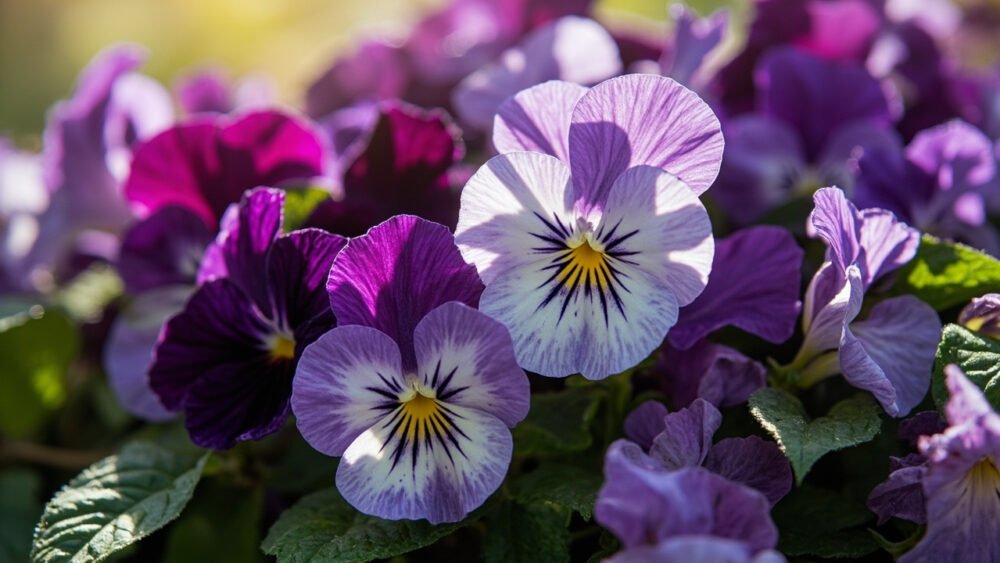
The fastest way to sort out the types of violets is to split them into three groups first: woodland natives that spread and go dormant in summer, African violets that live on windowsills year round, and bedding violas and pansies that most people call violets but are technically their bigger-flowered cousins. Once you know which group you are actually looking at, telling the individual varieties apart gets a lot easier.
Most people pick sweet violet because it smells nice, then get frustrated when it takes over a shady bed within two seasons. The one experienced gardeners quietly reach for instead is further down this list, and it is nowhere near as pushy. Stick around for number 13, because it is the violet most people misidentify in their own yard and never realize it.
The final entries and the actual method for choosing between all of these, based on your space, your climate, and how much fuss you want to deal with, are waiting at the bottom. Worth the scroll if you only plant one violet this year and want it to be the right one.
Woodland and Garden Violets (Viola Species)
These are the true violets, low perennials with heart-shaped leaves that mostly go dormant or semi-dormant in hot weather.
1. Sweet Violet (Viola odorata)
The one everyone plants for the fragrance and the one that spreads hardest by both seed and runners. It thrives in part shade in zones 4 through 9, blooms deep purple to white in early spring, and will colonize a bed within two or three years if you let it. Plant it where spreading is a feature, not a problem.
2. Common Blue Violet (Viola sororia)
The native lawn violet most homeowners fight and most pollinator gardeners protect. It self-seeds aggressively, tolerates full shade to full sun, and is the primary host plant for fritillary butterfly caterpillars in much of the eastern United States. If you mow a lawn full of small purple flowers in April, this is almost certainly it.
3. Confederate Violet (Viola sororia ‘Priceana’)
The white one with a blue-gray center that people assume is a different species entirely. It is simply a color form of the common blue violet, same toughness, same self-seeding habit, just a paler flower with faint purple veining near the throat.
4. Bird’s-Foot Violet (Viola pedata)
The one for dry, sandy, difficult sites where other violets rot. Its deeply lobed, finger-like leaves give it the name, and it wants full sun with sharp drainage rather than the moist shade most violets prefer. It is genuinely fussy about wet feet and will not thank you for rich garden soil.
5. Labrador Violet (Viola labradorica)
The quiet favorite of experienced gardeners who got tired of sweet violet’s takeover habit. It has purple-tinged foliage, small lavender flowers, spreads by rhizome at a manageable pace, and works as a well-behaved groundcover in zones 2 through 8 under trees where grass will not grow.
6. Wooly Blue Violet (Viola sororia var. missouriensis)
The regional variant with fuzzy, gray-green leaves and slightly larger, paler blue flowers than the standard common blue violet. It handles heavier clay soil better than most violets and is common in floodplain woods across the central United States.
The woodland types are the ones most likely already growing in your yard without an invitation, which is exactly why the houseplant category next feels like a completely different plant.
African Violets and Close Relatives (Streptocarpus Family)
These are not true violets botanically, but they are the “violet” most people actually own, grown as houseplants for year-round bloom.
7. Standard African Violet (Saintpaulia, now Streptocarpus section)
The classic windowsill variety with fuzzy, rounded leaves in a tidy rosette and flowers in purple, pink, or white. It wants bright, indirect light, even moisture from below rather than overhead watering, and temperatures that stay above 60°F. This is the one most people pick for the wrong reason, buying it in bloom at a grocery store without realizing it needs consistent humidity and will sulk hard in a dry, drafty room.
8. Trailing African Violet
The hanging-basket version with a spreading rather than rosette habit, better suited to a basket than a windowsill pot. It flowers a bit less heavily than standard types but fills out a hanging container in a way upright varieties cannot.
9. Miniature African Violet
The one built for tiny spaces, staying under 6 inches across at full maturity versus 8 to 16 inches for standard types. It suits terrariums and crowded plant shelves, but its small root system means it dries out faster and needs more frequent, lighter watering.
10. Chimera African Violet
The striped, patterned collector’s variety with a distinct pinwheel or striped pattern radiating from the center of each flower. True chimeras cannot be propagated from leaf cuttings the way standard African violets can, since the pattern comes from a genetic layering that leaf cuttings do not preserve. That makes them pricier and harder to find, and part of the appeal for collectors.
If houseplant violets need that much precision, the bedding types most garden centers sell under the same name are a relief by comparison.
Violas and Pansies Sold as “Violets”
Botanically these are Viola too, just bred for bigger flowers and bedding performance rather than woodland spreading.
11. Johnny-Jump-Up (Viola tricolor)
The small-flowered reseeder that shows up in cracks in pavement and forgotten corners of the garden year after year. Flowers are under an inch across in purple, yellow, and white combinations, and it tolerates cold down into the low 20s Fahrenheit, making it one of the earliest bloomers in a spring bed.
12. Garden Pansy (Viola x wittrockiana)
The big-faced bedding standard sold by the flat every fall and spring at garden centers. Flowers run 2 to 3 inches across in nearly every color, it handles light frost fine, and it fades hard once summer heat arrives above the mid 80s, which is the honest tradeoff for those huge blooms.
13. Horned Violet (Viola cornuta)
The one most people mistake for a small pansy and then wonder why it outperforms every pansy they have ever grown. It has smaller, more violet-shaped flowers than a garden pansy, but it blooms longer into heat, reseeds more reliably, and tends to survive a mild winter as a true short-lived perennial in zones 6 through 9 instead of dying out completely like most pansies do. If your pansies have always disappointed you by June, this is the swap.
14. Sorbet Series Viola
The compact, cold-hardy bedding line bred specifically for container performance, with smaller flowers than pansies but noticeably better heat tolerance and a mounding habit that does not sprawl or flop the way older viola varieties can.
15. Tufted Pansy
The clump-forming perennial type that behaves more like a true perennial violet than a one-season bedding plant, coming back reliably in zones 4 through 8 and forming a dense mounded clump rather than spreading by runner. It bridges the gap between the woodland violets at the top of this list and the bedding types, with better cold tolerance than a garden pansy and a longer lifespan in the ground.
How to Choose the Right One
- Start with space: a spreading groundcover under trees calls for a woodland violet like Labrador or common blue, while a container or windowsill calls for African violet types or a compact viola like the Sorbet series.
- Check your climate: woodland violets and horned violets handle real winters in zones 4 through 9, while garden pansies and Johnny-jump-ups are treated as cool-season annuals almost everywhere.
- Decide the purpose: pollinator habitat and butterfly hosting points toward native species like common blue or bird’s-foot violet, while a flower bed built for color points toward pansies, violas, or horned violets.
- Be honest about care appetite: African violets demand steady humidity, bright indirect light, and careful watering, while woodland violets mostly take care of themselves once planted, sometimes too well.
- Match soil to species: most violets want moist, humus-rich shade, but bird’s-foot violet is the exception and needs dry, sandy, full-sun conditions or it will rot.
- Plan for spread: if you cannot tolerate a plant that self-seeds and colonizes a bed, skip sweet violet and common blue violet entirely and choose a clumping type like tufted pansy or horned violet instead.
Fifteen violets, three completely different growing lives, and now you know exactly which one matches the spot you actually have.