The honest answer: two to three years before you cut a real harvest, and full production does not arrive until year three or four. Plant crowns this spring, and you will pick a light, restrained harvest the year after next. Grow it from seed instead of crowns, and add another full year to every stage of that timeline.
That range is not the whole story, though. How long does it take to grow asparagus in your specific yard depends on something most people never check before they plant, and it is the same thing that decides whether your patch lives for the 15 to 20 years asparagus is capable of or peters out after five.
Below is the stage-by-stage version, what actually speeds it up, the one shortcut that backfires almost every time, and a quick-reference card at the bottom you can save and check against your own bed.
The Realistic Timeline, Start to First Real Harvest
From crowns (one-year-old dormant roots, the way most home growers plant), expect this arc: year one is establishment only, no harvest at all. Year two allows a light harvest, two to three weeks of picking, spears pencil-thin to average. Year three and beyond is full harvest, six to eight weeks of cutting every spring.
From seed, push everything back a year. Seed-grown asparagus spends its first year just building a crown underground, so you are looking at three to four years before any harvest and four to five before full production.
Most garden centers sell crowns for exactly this reason. Buying dormant one-year crowns instead of starting seed is the single biggest legitimate way to shave a year off your timeline.
The variety you choose changes that timeline too, and not in the way most people expect.
What Actually Controls the Speed
Variety matters more than climate here. All-male hybrid varieties (Jersey Knight, Jersey Giant, Jersey Supreme) put their energy into spears instead of seed production and establish noticeably faster and heavier than older open-pollinated varieties like Mary Washington. If speed is the goal, plant an all-male hybrid.
Climate sets the calendar, not the total wait. Asparagus needs a real winter dormancy to perform well, so it thrives in USDA zones 3 through 8. In warmer zones it still needs some winter chill or it sulks. The years-to-harvest count stays the same everywhere; only the calendar date of “spring” shifts.
Soil is where most timelines actually go wrong. Asparagus roots run deep, want loose, well-drained soil with a pH near 6.5 to 7.0, and hate wet feet. Heavy clay or poor drainage does not just slow the plant down, it can stall the crown permanently and the plant never catches up.
Get the soil right at planting and the rest of the timeline mostly takes care of itself.
Stage by Stage: What You Should Actually See
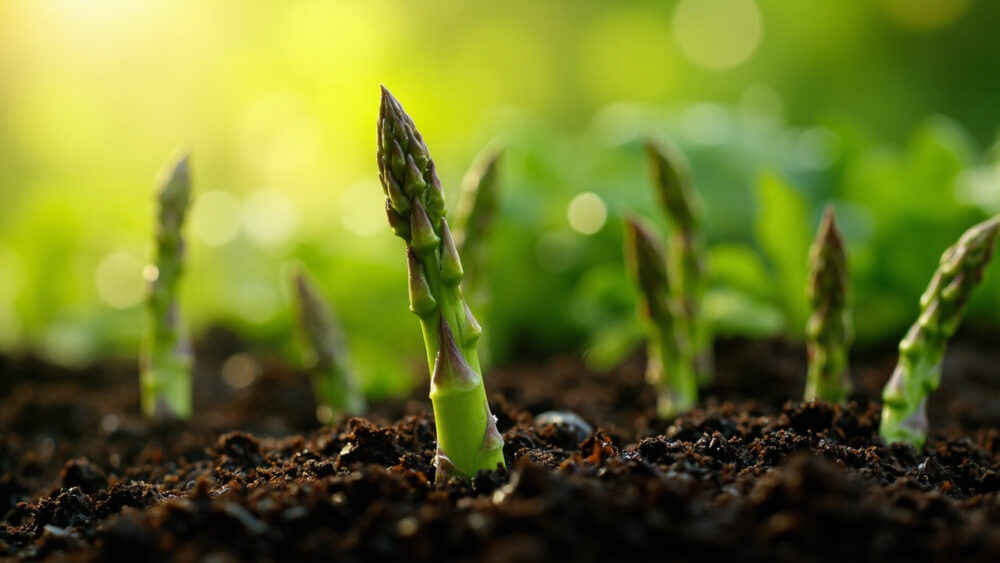
Weeks 1 to 4 after planting crowns: thin ferny spears push up, usually not much to look at. This is normal, not slow.
Year one, all season: the plant grows tall, feathery fern (up to 4 to 5 feet). Do not cut anything. Every spear left standing is feeding the crown for next year.
Year two, early spring: your first real spears, thicker than year one’s. Harvest lightly for 2 to 3 weeks, then stop and let the rest fern out.
- Year one: fern only, zero harvest, root system establishing.
- Year two: light harvest, 2 to 3 weeks, thin to medium spears.
- Year three: fuller harvest, 4 to 6 weeks.
- Year four and on: full harvest window, 6 to 8 weeks every spring.
If your bed matches that sequence, you are exactly on schedule.
How to Speed It Up, and What Doesn’t Work
The legitimate speedups are all front-loaded: buy one-year crowns instead of seed, choose an all-male hybrid, plant into deeply worked, well-drained soil amended with compost, and keep the bed weed-free the first two seasons so the crowns never compete for water or nutrients. Full sun, at least 6 hours, also matters more than people assume; shaded beds lag for years.
What does not work is harvesting early. Cutting spears in year one, or cutting hard in year two, is the single most common mistake, and it is also the one that permanently shrinks the bed’s output. Every spear you cut before the crown is ready is fern the plant does not get to grow, and fern is what recharges the root system for next year. There is no fertilizer, no additive, and no watering trick that overrides that biology.
Patience in years one and two is what buys you the 15 to 20 year bed everyone actually wants.
When Slow Is Normal, and When It’s a Real Problem
Normal slow: thin spears in year two, an uneven first flush, ferns that look a little sparse the first season. All of that resolves on its own by year three if the bed gets full sun and consistent moisture.
Not normal: a crown that produces no fern at all by midsummer of year one, spears that emerge and immediately wilt or rot, or a bed that still looks thin and weak going into year four. That usually points to poor drainage, planting too deep (crowns want 4 to 6 inches of soil over them at planting, not the deeper trenches old advice sometimes recommends), or a wet, heavy spot that never should have been asparagus ground.
If that describes your bed, the honest fix is often relocating a portion of the planting to better-drained soil rather than waiting out a problem that soil, not time, is causing.
Here is the whole thing distilled into one card you can save.
Asparagus: Quick Reference
- Core timeline: 2 to 3 years from crowns to a real harvest, full production by year 3 to 4.
- From seed: add a full year to every stage, harvest typically starts year 3 to 4, full production year 4 to 5.
- Fastest option: one-year dormant crowns of an all-male hybrid variety like Jersey Knight or Jersey Giant.
- Year one rule: zero harvest, let all fern grow to build the crown.
- Year two rule: light harvest only, 2 to 3 weeks, then stop.
- Site needs: full sun, well-drained soil, pH 6.5 to 7.0, USDA zones 3 through 8.
- Planting depth: crowns set with about 4 to 6 inches of soil covering them.
- Bed lifespan: 15 to 20 years once established, so the wait is a one-time cost.
Two patient seasons buy you two decades of spring harvests.
That trade is worth making.