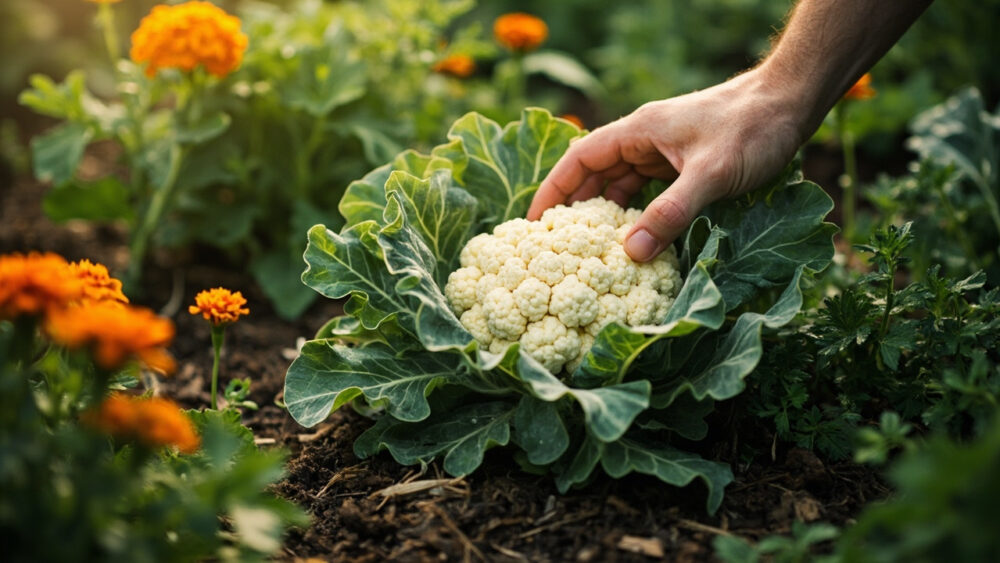
The best companion plants for cauliflower are aromatic herbs and alliums that confuse cabbage pests, plus low, fast growers like lettuce and spinach that shade its shallow roots without competing for the nitrogen cauliflower demands. Celery, beets, and chamomile round out a solid bed. Skip anything in the cabbage family nearby, and keep strawberries, tomatoes, and pole beans well away.
That much you can act on today. But there are a few things about cauliflower companion planting that trip up almost everyone, including gardeners who have grown a dozen other brassicas without trouble.
Cauliflower is fussier than broccoli and cabbage about consistency, and the wrong neighbor does not just attract a few cabbage moths, it can throw off the steady, uninterrupted growth cauliflower needs to head up cleanly instead of bolting or buttoning into a tiny, useless curd. There is also a popular pairing that sounds smart and actually backfires, and a mistake in bed layout that has nothing to do with which plants you pick at all. Stick around for the full breakdown, because the Cauliflower at a Glance card at the bottom has the spacing, timing, and soil numbers you will want saved to your phone before you touch a trowel this weekend.
Why Cauliflower Is Pickier Than Its Brassica Cousins
Cauliflower will forgive a lot of things broccoli forgives, but not an interrupted growth cycle. Any stress, a dry week, a root disturbance, a swing in temperature, and it responds by bolting early or forming a tiny, loose, bitter head instead of the tight white curd you planted it for.
That is why companion choices matter more here than with tougher brassicas. You are not just managing pests, you are protecting a plant that has almost no room for error once it starts to head up.
Here is who actually earns a spot in the bed, and why each one works.
The Companions Worth Planting
Dill, Chamomile, and Yarrow
These three draw in parasitic wasps and hoverflies, the insects that lay eggs inside cabbage worms and aphids and quietly wipe out a pest problem before you notice one. Dill also repels cabbage loopers when planted along the row edge rather than mixed through the bed.
Let one or two dill plants bolt to flower, that is when the beneficial insects actually show up.
Onions, Garlic, and Chives
Alliums mask the sulfur scent that cabbage moths and root maggot flies use to find brassicas in the first place. Plant them in the same bed, not just nearby, spaced every 6 to 8 inches between cauliflower plants for the strongest effect.
This is the single most effective pest-confusion pairing for any brassica, cauliflower included.
Lettuce, Spinach, and Celery
These fill the ground between cauliflower’s wide leaves without competing for the heavy nitrogen feed cauliflower needs. Lettuce and spinach mature fast, 30 to 45 days, so you harvest them out of the way before cauliflower’s canopy closes in.
Celery goes further: some gardeners find it improves cauliflower’s growth and flavor when grown in the same bed, likely by keeping soil consistently moist between plants.
Nasturtiums and marigolds belong here too, as sacrificial traps that pull aphids and beetles off the main crop.
None of that matters, though, if you plant the wrong thing sixteen inches away.
What to Never Plant Near Cauliflower
Never plant other brassicas nearby, meaning broccoli, cabbage, kale, Brussels sprouts, and turnips. This is the mistake that ruins most attempts, and it is not obvious why: it is not really about competition, it is about pest load. Grouping every cabbage-family plant together builds a single pest colony that hits all of them at once, and once cabbage worms or root maggots establish in a dense brassica block, rotating them out mid-season is nearly impossible.
Strawberries are a worse offender than most guides admit. They compete hard for the same shallow root zone and, more importantly, they attract slugs that then move straight onto your cauliflower’s tender lower leaves.
Tomatoes, peppers, and pole beans grow tall enough to shade cauliflower during the exact weeks it needs full sun to bulk up its curd. Shade at that stage does not kill the plant, it just gives you a small, disappointing head after a full season of work.
Mustard is a trap crop in theory, pulling flea beetles off your cauliflower, but plant it too close and it just gives the beetles a launching pad straight into your cauliflower rows instead.
Layout fixes half of this problem before a single pest shows up.
How to Actually Lay Out the Bed
Space cauliflower 18 to 24 inches apart in rows 24 to 30 inches apart. That is nonnegotiable: crowd it tighter and you get small, uneven heads no companion plant can fix.
Run a border of alliums or dill around the perimeter of the whole bed rather than scattering them randomly among the cauliflower. A perimeter planting confuses pests trying to find the bed in the first place, which works better than pest control after they are already inside it.
Tuck lettuce and spinach into the gaps between young cauliflower transplants, since cauliflower starts small and leaves that space open for 3 to 4 weeks before its leaves spread.
Even a well-planned bed gets undone by one popular myth, though.
The Pairing Myths That Do Not Hold Up
If you assumed marigolds alone will keep cabbage worms off cauliflower, that guess is half right and half wishful thinking. Marigolds repel some soil nematodes and attract pollinators, but they do very little against the cabbage moths and loopers that actually damage cauliflower leaves. Dill and dense planting do far more of that work.
Another common claim: that nasturtiums “protect” brassicas outright. They do not protect anything, they sacrifice themselves. Aphids swarm nasturtiums instead of your cauliflower, which is useful, but only if you are willing to let the nasturtiums look ragged and do not panic and spray them.
And plenty of gardeners still believe basil or mint helps cabbage-family crops the way it helps tomatoes. There is no real evidence for that with cauliflower, and mint’s aggressive spreading roots will fight your cauliflower for water regardless.
Knowing what does not work matters just as much as knowing what does, and now you have both.
Cauliflower at a Glance
- When to plant: set transplants out 2 to 3 weeks before your last spring frost, or in late summer for a fall crop when soil temperatures start dropping below 75°F.
- Spacing: 18 to 24 inches between plants, 24 to 30 inches between rows.
- Soil and water: rich, consistently moist soil, pH 6.0 to 7.0, never letting it dry out between waterings.
- Best companions: dill, chamomile, onions, garlic, chives, lettuce, spinach, celery, nasturtiums, marigolds.
- Never plant nearby: broccoli, cabbage, kale, Brussels sprouts, turnips, strawberries, tomatoes, pole beans, mustard.
- Signs of trouble: loose or ricey curds mean heat or water stress, and yellowing lower leaves usually mean a nitrogen shortfall, not overwatering.
- Days to maturity: 55 to 85 days from transplant, depending on variety.
Get the neighbors right and the spacing right, and cauliflower stops being the finicky brassica everyone warns you about.
Everything else, the watering, the feeding, the patience, is just follow-through.