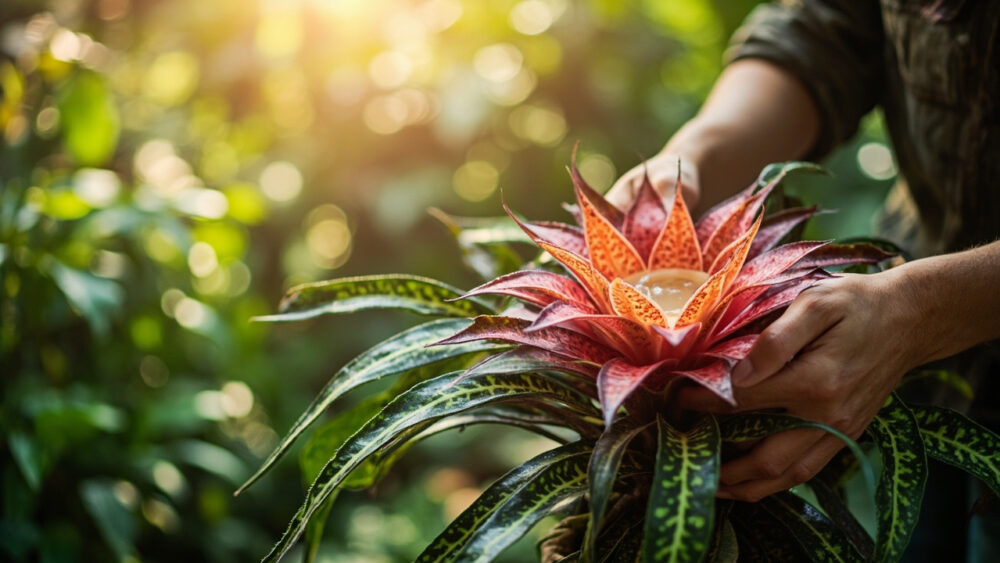
Bromeliad light requirements come down to one simple rule: bright, indirect light, the kind you’d get sitting a few feet back from an east or west window, not direct sun blasting through the glass and not a dim corner either. Most bromeliads want light bright enough to read by comfortably without a lamp, but no harsh direct rays for more than an hour or two a day. Get that part right and everything else about growing one gets easier.
Here’s where most people go wrong, though, and it is almost never in the direction they expect. Everyone assumes a plant this colorful and tropical-looking wants full sun like a hibiscus, and that guess kills the center rosette faster than neglect ever would. There’s also a sneaky seasonal shift nobody warns you about, and a placement trick that saves plants stuck in genuinely dark rooms without any greenhouse required.
Stick around for the Bromeliad at a Glance card at the bottom. It’s the save-to-your-phone version of everything below, the kind of thing you pull up standing in front of the plant trying to decide if it needs to move.
How Much Light Does a Bromeliad Actually Need
Bromeliads in the wild mostly grow as epiphytes tucked into tree branches under a broken, filtered canopy. That’s the light level you’re recreating indoors: bright but diffused, not the raw intensity of an unobstructed south window at noon.
Think of it in hours and intensity both. Aim for something like 12 hours of bright ambient light a day, with direct sun limited to early morning or late afternoon if it happens at all. Grow lights work fine too, run 10 to 12 hours on a timer, positioned 12 to 18 inches above the foliage.
Different types shift the range slightly. Thin, soft, silvery-leaved types like Tillandsia and many Vriesea tolerate lower light than the stiff, thick-leaved Guzmania and Aechmea types, which want more brightness to hold their color.
None of that matters yet if you don’t know what “bright indirect” looks like in your actual house.
What Good Bromeliad Light Actually Looks Like in a Room
An east-facing window is close to ideal. Gentle morning sun for an hour or so, then soft light the rest of the day, sitting the plant right on the sill or within a foot or two of the glass.
A west window works too, but pull the plant back 3 to 4 feet from the glass, because afternoon sun there runs hotter and more direct than morning sun ever does.
South-facing windows are the trickiest. Bright, yes, but often too intense right at the glass. Set the plant 4 to 6 feet back, or hang a sheer curtain between plant and window to soften it.
North windows are usually too dim on their own for the thicker-leaved types, fine for the softer Tillandsias, and a candidate for supplemental light for everything else.
A good gut check: if the light is bright enough to cast a soft, fuzzy-edged shadow but not a sharp black one, you’re in the zone.
Now, what happens when that light is off in either direction.
The Sign of Too Little Light Everyone Reads Wrong
You’d assume a bromeliad starving for light just gets pale and sad, the way a lot of houseplants do. That’s not usually the tell here.
The real sign is stretching and losing color. Leaves reach and elongate toward the light source, the rosette loses its tight, symmetrical shape, and any pink, red, or orange in the foliage fades toward plain green. Growth also slows to a crawl, and a plant that should eventually push a new pup off the base just sits there for a year doing nothing.
Flower bracts are the other giveaway. A bromeliad that bloomed once in bright light and then got moved somewhere dimmer often won’t produce another colorful bract from its pups at all, because the color show is directly tied to light intensity.
If your bromeliad looks like it’s leaning and going quietly green, it isn’t sick, it’s asking to move closer to a window.
The Sign of Too Much Light, and Why It’s Not Just Sunburn
Too much direct sun shows up as bleached, tan, or brown patches on the leaves, usually on whichever side faces the glass. That part’s predictable enough.
What surprises people is how fast it happens and how it doesn’t heal. Damaged leaf tissue on a bromeliad stays damaged. There’s no green-up, no recovery, just a permanent scar on that leaf until it’s eventually replaced by new growth from the base.
The cup at the center of the rosette matters here too. Many bromeliads hold water in that central cup, and intense midday sun heating that standing water can scald the tissue around it, which is a different and worse injury than a simple leaf burn from dry heat.
If you see crisp brown patches showing up within days of a move to a sunnier spot, that plant went from too little light straight past the sweet spot into too much, with no gentle warning in between.
Seasons change the amount of light coming through that same window without you doing anything at all.
The Follow-Up Question: Does Winter Change Everything
Yes, and this is the honest answer nobody gives you upfront. The same south window that scorched a bromeliad in July can be exactly right in January, because the sun angle drops and the intensity drops with it.
A spot that felt perfectly bright and safe all summer can also go noticeably dimmer in winter, especially in a north-facing room or a house with deep eaves blocking the low winter sun.
Rotate your expectations, not just the pot. Watch for stretching or color fade starting around late fall, and be ready to slide the plant a foot or two closer to the glass for winter, then back for summer.
If you run a grow light, this is also the season to lean on it more, since natural daylight hours are shorter across the board regardless of window direction.
None of this requires a greenhouse, and neither does fixing a bromeliad stuck in a genuinely dark room.
Placement Fixes for Rooms Without Great Light
Not every home has a bright east window free to give up. There are workable fixes short of moving house or building a sunroom.
- Add a small grow light: a basic LED grow light on a timer, 10 to 12 hours a day, 12 to 18 inches above the plant, replaces a weak window entirely.
- Use a bathroom or kitchen with a window: these rooms often get overlooked but frequently have decent light and the humidity bromeliads appreciate.
- Try a glass shelf near a window: stacking plants closer to the light source instead of on a distant floor or table often solves the problem without any new equipment.
- Rotate the pot weekly: a quarter turn each week keeps growth even instead of lopsided and leaning toward one side.
- Group with a sheer curtain, not blinds: sheers soften harsh direct sun without cutting brightness the way heavier blinds do.
Get the placement close to right, and a bromeliad forgives almost everything else you might get wrong with it.
Bromeliad at a Glance
- Light needed: bright, indirect light for 10 to 12 hours a day, direct sun limited to an hour or two of gentle morning light at most.
- Best window: east-facing, plant right at the sill, or west and south windows with the plant pulled back 3 to 6 feet or filtered by a sheer curtain.
- Too little light looks like: stretching, a loosening rosette shape, fading color, and stalled growth rather than obvious paling.
- Too much light looks like: tan or brown scorch patches, often on the side facing the glass, that never heal on that leaf.
- Grow light setup: basic LED, 12 to 18 inches above the foliage, run 10 to 12 hours daily on a timer.
- Seasonal adjustment: move a few feet closer to the window in winter, back again in summer, as sun angle and day length shift.
- Quick placement fix: a sheer curtain over a bright window, or a spot on a shelf closer to the glass instead of a dim floor location.
Bright, filtered, and consistent beats intense and direct every time with this plant. When in doubt, give it slightly less direct sun and slightly more patience.