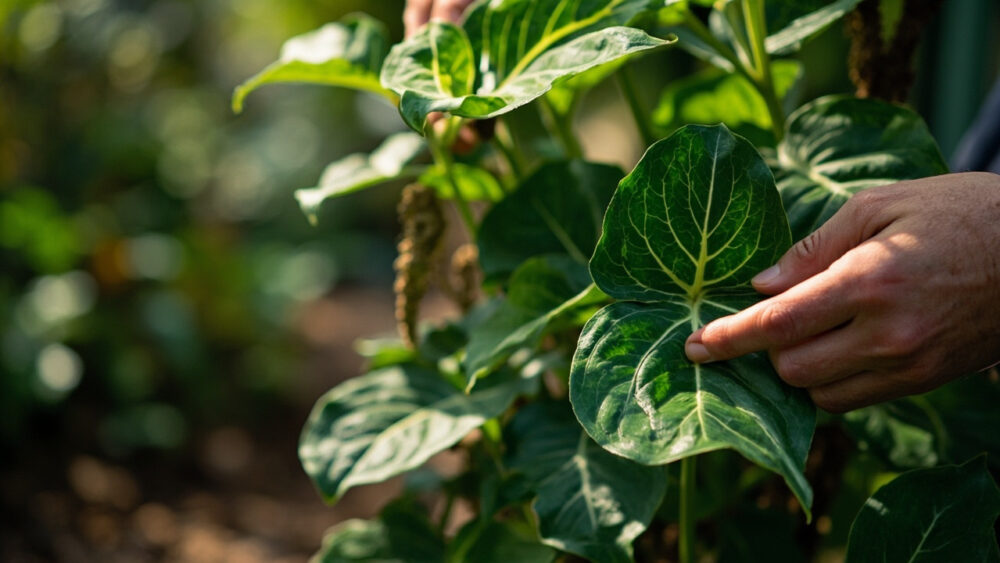
Alocasia frydek care comes down to four things this plant will not compromise on: bright indirect light, evenly moist but never soggy soil, humidity above 50 percent, and warmth that never dips below 60°F. Get those four right and the velvety, white-veined leaves keep coming all growing season. Get any one of them wrong and Frydek tells you fast, usually by dropping a leaf you thought was healthy.
Most people who kill this plant are not neglecting it. They are overwatering it out of love, second-guessing a normal dormancy drop, or missing the one sign that separates “adjusting” from “dying.” There is also a mistake with fertilizer timing that costs people an entire growing season without them ever realizing that was the cause.
Stick with me through the sections below and I will walk through light, water, soil, routine care, the problems that actually show up on this plant, and how to read the difference between thriving and merely surviving. Save the Alocasia Frydek at a Glance card at the bottom for the phone-in-hand version of all of this.
Light, Placement, and Temperature
Frydek wants bright, indirect light, the kind you get a few feet back from an east or west window, or filtered through a sheer curtain on a south window. Direct midday sun scorches those dark leaves into crispy patches within a day or two. Too little light and the plant stretches, leaves get smaller, and the white veining fades.
Temperature matters more with this plant than with most houseplants. Keep it between 65°F and 80°F. Below 60°F for any length of time and it sulks, drops leaves, or goes dormant on you. Keep it away from drafty windows, AC vents, and exterior doors in winter.
Humidity is the piece people skip. Frydek wants 50 to 60 percent humidity minimum. Dry indoor air in winter shows up as brown, crispy leaf edges before anything else goes wrong.
Get the environment right and watering becomes the next thing this plant will test you on.
Watering: How Much, How Often, and How to Tell
Water when the top 1 to 2 inches of soil have dried out, not on a fixed schedule. In a warm, bright spot that might mean every 6 to 8 days. In a cooler or dimmer spot, it could stretch to 10 or 12.
If you assumed drooping leaves mean the plant is thirsty, that guess is what kills most Frydeks. Overwatered roots droop and yellow just like underwatered ones. The real tell is the soil, not the leaf. Push a finger in to the second knuckle. Dry, water thoroughly until it runs from the drainage holes. Still damp, wait.
This plant’s rhizome rots fast in waterlogged soil, faster than the leaves show it. By the time you see yellowing at the base, the damage below soil may already be done. Always let the pot drain completely and never let it sit in a saucer of standing water.
Once you’ve got the water routine dialed in, the soil it’s sitting in matters just as much.
Soil, Potting Mix, and Feeding
Use a chunky, fast-draining aroid mix: standard potting soil cut with perlite, orchid bark, and a handful of coarse sand or pumice, roughly equal parts. Straight potting soil alone holds too much water for this plant’s rhizome to tolerate long term.
Feed every 4 to 6 weeks during spring and summer with a balanced liquid houseplant fertilizer diluted to half strength. Skip fertilizing entirely from late fall through winter.
Here’s the mistake that quietly wrecks a whole season: feeding a dormant or struggling plant to try to “help it along.” Fertilizer on a plant that isn’t actively growing just burns roots that are already stressed, and it will not push new leaves out of a plant that’s resting.
Feeding on the right schedule only pays off if the routine tasks around it are timed correctly too.
Pruning, Repotting, and Cleaning: When and How
Prune only the leaves that are fully yellow, brown, or collapsed. Cut at the base of the stem with clean scissors. Do not remove a leaf that’s still mostly green just because it looks a little tired; it’s still feeding the rhizome.
Repot every 12 to 18 months, or sooner if roots are circling the pot’s edge or pushing up through the soil surface. Go up one pot size only, 1 to 2 inches wider, since an oversized pot holds excess moisture the roots can’t use fast enough.
Wipe the broad leaves with a damp cloth every couple of weeks. This isn’t cosmetic. Dust blocks light absorption on a plant that’s already working with the light you give it, and clean leaves also make early pest scouting a lot easier.
Speaking of pests, here’s where Frydek actually runs into trouble.
The Problems That Actually Show Up on This Plant
Yellow lower leaves, one at a time: normal aging, especially if new growth is still coming. Only worry if several yellow at once.
Brown, crispy edges: low humidity or a buildup of mineral salts from tap water. Try distilled or rain water and raise humidity.
Drooping with wet soil: root or rhizome rot from overwatering. Unpot, check for soft, dark, mushy roots, trim them out, and repot in fresh dry mix.
Sudden total collapse in cool weather: often dormancy, not death. Cut back watering, keep it warm, and wait; new growth often returns from the rhizome in spring.
Spider mites and mealybugs: fine webbing or small white cottony clusters, usually under leaves. Isolate the plant and treat with insecticidal soap or neem oil, following the label exactly.
This plant is mildly toxic to people and pets if chewed or eaten, thanks to calcium oxalate crystals that cause mouth and throat irritation. If a pet or child ingests it, call a vet or poison control rather than waiting to see what happens.
Once you’ve ruled out these common issues, the next question is simpler: is the plant actually happy?
How to Tell It’s Genuinely Thriving
A thriving Frydek pushes a new leaf every 3 to 6 weeks during the growing season. Each new leaf should be as large or larger than the one before it, a real sign of a strong, established rhizome.
The give-away most people miss is the velvet texture and vein contrast. On a genuinely healthy plant the white veining looks almost carved into the deep green, and the leaf surface has a slight matte sheen, almost like felt. Dull, flat, or pale leaves mean the light or humidity still isn’t quite right, even if the plant looks otherwise fine.
New leaves unfurling tightly and standing upright before relaxing outward are another strong sign, and so is a rhizome that stays firm to the touch if you ever check it during repotting.
Everything above adds up to one quick-reference card, and that’s what’s worth saving.
Alocasia Frydek at a Glance
- Light: bright, indirect light, a few feet from an east or west window, never direct midday sun.
- Temperature: 65°F to 80°F, never below 60°F for extended periods.
- Humidity: 50 to 60 percent or higher, use a humidifier or pebble tray in dry indoor air.
- Watering: when the top 1 to 2 inches of soil are dry, water thoroughly and let it drain completely.
- Soil: chunky, fast-draining aroid mix of potting soil, perlite, orchid bark, and coarse sand or pumice.
- Feeding: balanced liquid fertilizer at half strength every 4 to 6 weeks in spring and summer, none in fall or winter.
- Toxicity: mildly toxic to pets and people if ingested, contact a vet or poison control for suspected ingestion.
If you remember one thing, remember this: check the soil, not the leaf, before you water.
Everything else about this plant follows from getting that single habit right.