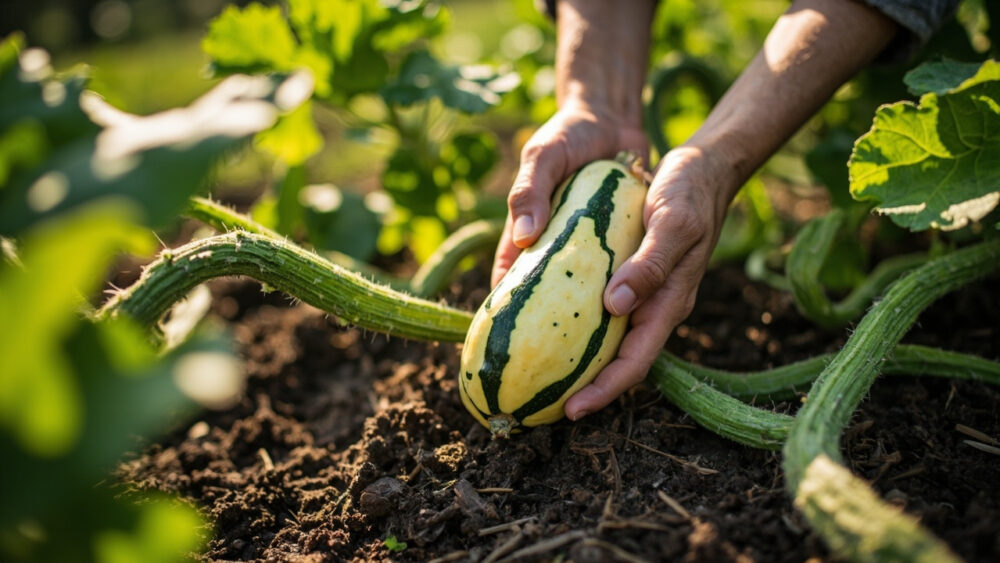
Delicata squash grows the same way any winter squash grows: direct-seeded (or transplanted) into warm soil after your last frost, given 4 to 6 feet of room to sprawl, and left alone for 80 to 100 days until the rind hardens and the cream-colored skin gets its orange-green stripes. It is one of the easier winter squash to grow, and one of the trickiest to harvest at the right moment, which is where most people actually lose the crop.
Here is what nobody tells you upfront. The mistake that ruins most delicata harvests happens weeks after the vine looks done growing, not while it is growing. There is also a sign on the fruit itself that almost everyone reads backward, and an honest answer about how long delicata actually stores compared to butternut or acorn, which is the question you are about to ask once you have a full harvest basket sitting on the counter.
Stick around for all of that, and save the Delicata Squash at a Glance card at the very bottom for your phone, it has the numbers you will want again in July and again in October.
When to Plant Delicata Squash
Wait until the soil is genuinely warmnot just until frost risk has passed. Delicata seeds germinate poorly below 60°F and sit rotting in cold, wet soil instead of sprouting. Aim for soil that has held steady at 65 to 70°F for a few days, which usually lands 1 to 2 weeks after your last spring frost date.
If you garden in a short-season climate (zone 5 or colder), start seeds indoors 3 to 4 weeks before your last frost instead of waiting on the soil. Squash transplants hate root disturbance, so start them in 3 to 4 inch pots, not cell trays, and harden them off before they go in the ground.
In zones 6 and warmer, direct-seeding is simpler and the plants often outrun transplants within a few weeks anyway.
Get the timing right and the rest of the season is mostly patience.
Choosing the Spot and Prepping the Soil
Delicata needs full sun, 6 hours minimum, 8 or more if you can give it. Give the vines room: even though delicata plants stay more compact than a sprawling pumpkin, they still want 4 to 6 feet of space in every direction, or a trellis if you’re tight on room.
Work in 2 to 3 inches of compost or aged manure before planting. Squash are heavy feeders and heavy drinkers, and thin, sandy, or exhausted soil shows up later as pale leaves and small fruit no matter what you do after planting.
Good drainage matters as much as fertility. Squash roots sitting in standing water rot fast, so if your bed holds puddles a day after rain, raise it 6 to 8 inches before you plant.
Once the bed is ready, the actual planting takes ten minutes.
Planting Delicata Squash Step by Step
1. Form mounds or rows
Build low mounds about 12 inches across, spaced 3 to 4 feet apart, or plant in rows with plants 18 to 24 inches apart and rows 5 to 6 feet apart. Mounds help in wetter climates because they shed extra water off the root zone.
2. Sow at the right depth
Plant seeds 1 inch deep in warm soil, slightly shallower (about ¾ inch) if your soil runs heavy clay. Drop 2 to 3 seeds per mound and thin to the strongest single seedling once they have their first true leaves.
3. Water in immediately
Give the bed a deep, gentle soak right after planting and keep the top inch of soil consistently moist until germination, which takes 7 to 10 days in warm soil.
4. Set transplants carefully, if using them
Slide the whole root ball out without disturbing it, plant at the same depth it was growing in the pot, and water in well. Squash transplants that get root-bound or disturbed often stall for a week or two.
From here on, it is watering, feeding, and watching, not more planting.
Watering and Feeding Through the Season
Delicata wants about 1 to 1.5 inches of water a week, more during hot stretches or once fruit is sizing up. Water at the soil linenot overhead, since wet leaves late in the day invite powdery mildew.
Check moisture by feel: push a finger 2 inches down, and if it’s dry, water. Mulch with straw or shredded leaves once plants are established to hold that moisture and keep weeds down.
Feed lightly but consistently. A balanced fertilizer or side-dressing of compost at planting, again when vines start running, and again when the first flowers open covers most of what the plant needs. Too much nitrogen late in the season gives you huge leaves and few, weak fruit, so ease off nitrogen-heavy feeding once fruit sets and let the plant focus on ripening.
Feeding right keeps the plant productive, but it won’t save you from the problems that show up regardless.
Problems Most Likely to Strike
Squash vine borers and squash bugs are the two that end seasons early. Vine borers tunnel into the stem near the base, and the first sign is usually a vine that wilts suddenly despite moist soil, sawdust-like frass near the stem base is the tell. Squash bugs cluster on stems and leaf undersides and cause yellow speckling that turns brown; check the undersides of leaves weekly and crush egg clusters (they’re copper-colored, laid in neat rows) before they hatch.
Powdery mildew shows up as white, dusty patches on leaves in humid weather or when leaves stay wet overnight. Improve air circulation, water at the base, and remove badly affected leaves; if it’s spreading fast, a fungicide labeled for powdery mildew on vegetables can slow it, applied exactly per the label.
Poor fruit set with lots of flowers is the other common frustration, and here’s the guessable mistake: most people assume it’s a fertilizer problem. It is almost always a pollination problem instead, squash have separate male and female flowers, and if bees are scarce you may need to hand-pollinate with a small brush in the morning when flowers are open.
Head off the bugs early and the pollination issue rarely turns into a real crisis.
When and How to Harvest Delicata Squash
Delicata is ready 80 to 100 days from seed, when the rind has gone from pale and slightly glossy to a hard, matte cream color with dark green or orange stripes. Press a fingernail into the skin: if it dents easily, it needs more time. If it resists, it’s ready.
Here’s the sign people read backward: a fully orange, deeply colored rind isn’t necessarily riper, it can just mean the fruit sat in strong sun longer. Hardness and dullness of the skin, not color intensity, is the real signal.
Cut, don’t pullleaving a 1 to 2 inch stem attached to each squash. A squash torn free with no stem rots at that wound within a couple of weeks in storage, no matter how ripe it was otherwise.
Harvest before a hard frost hits the vines, since frost-damaged fruit won’t store. Here’s the honest follow-up answer: delicata does not store like butternut or acorn. It holds well for 1 to 3 months in a cool, dry spot (around 50 to 55°F), noticeably shorter than the 4 to 6 months you get from butternut, so plan to eat or cook down your delicata harvest earlier rather than tucking it away and forgetting it.
Curing the fruit for 7 to 10 days in a warm, dry spot (around 80°F if you can manage it, or just a warm porch) after harvest toughens the skin further and extends that storage window.
Delicata Squash at a Glance
- When to plant: direct-seed or transplant once soil holds at 65 to 70°F, about 1 to 2 weeks after last frost, or start indoors 3 to 4 weeks early in short-season zones.
- Spacing: 3 to 4 feet between mounds or 18 to 24 inches between plants in rows, with 5 to 6 feet between rows.
- Planting depth: 1 inch deep in warm soil, ¾ inch in heavy clay.
- Sun and soil: full sun, 6 to 8 hours minimum, rich well-drained soil with 2 to 3 inches of compost worked in before planting.
- Water: 1 to 1.5 inches per week, at the soil line, kept consistent through fruit sizing.
- Days to harvest: 80 to 100 days from seed, when rind is hard and matte, not dented by a fingernail.
- Storage: 1 to 3 months in a cool, dry spot around 50 to 55°F, shorter than most winter squash, so use it sooner rather than later.
Get the soil temperature and the spacing right and delicata mostly grows itself.
The part that decides whether you actually get to eat it is cutting the stem clean and pulling it in before frost.