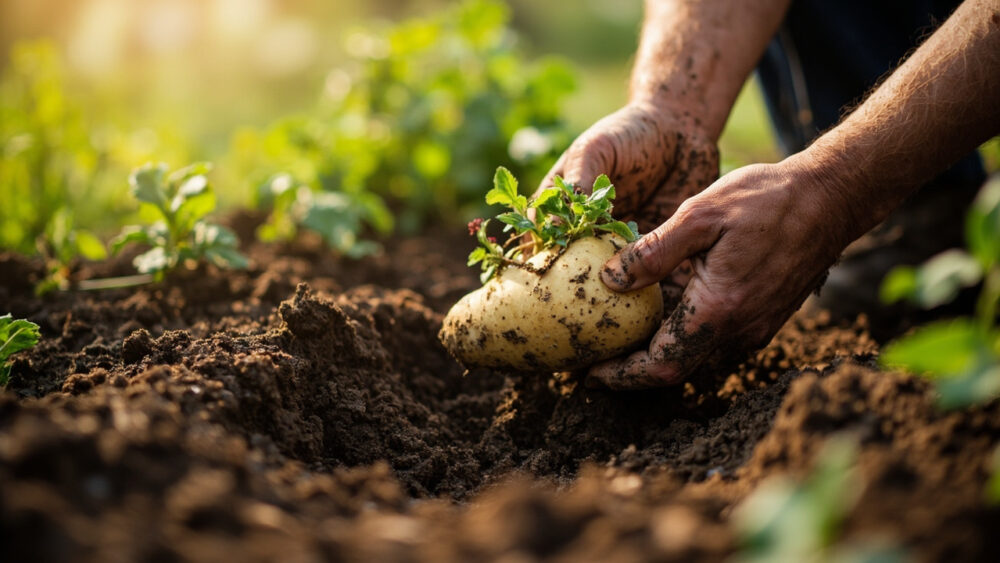
Plant seed potatoes 4 to 6 inches deep in the ground, spaced 10 to 14 inches apart in rows 30 to 36 inches apart. That is the number that matters most when you’re figuring out how deep to plant potatoes, and it holds whether you’re working a raised bed, a trench in open ground, or a grow bag on a patio. Get the depth right and you set up everything else, from how many tubers you get to how green and bitter the ones near the surface turn out.
But depth on planting day is only half the story. The other half is what you do after the plant is up, and that’s where most home gardeners lose a chunk of their harvest without ever knowing why.
Before we get to spacing mistakes, hilling timing, and the container math that trips people up, there’s a save-it-to-your-phone Potatoes at a Glance card waiting at the bottom of this piece with every number in one place.
The Exact Depth, and Why 4 to 6 Inches Is the Sweet Spot
Seed potato pieces go 4 to 6 inches deep, eyes facing up. Any shallower and the developing tubers push up toward daylight, turning green and building up solanine, a compound that makes them bitter and mildly toxic. Any deeper and the sprout burns energy just fighting to reach the surface, delaying emergence by a week or more.
Soil temperature matters as much as the ruler. Potatoes want soil at 45°F or warmer to sprout reliably, and most gardeners plant 2 to 4 weeks before their last spring frost date. Cold, waterlogged soil at planting depth rots seed pieces before they ever sprout.
That 4 to 6 inch window isn’t arbitrary, it’s the buffer zone that keeps new tubers covered as they form.
Why Tubers Need Room Above Them, Not Just Below
Here’s the part almost nobody expects on their first try: potatoes don’t grow downward from where you planted the seed piece. They form on stolons that branch off the stem, above the seed potato and below the soil surface.
If you assumed depth was just about protecting the seed piece from frost or drying out, that guess misses the real reason. The seed potato is just the launching pad. The actual crop forms in the loose soil above it, which is why hilling, mounding extra soil around the stems as they grow, matters just as much as the initial planting depth.
Skip the hilling and you get a plant that looks fine above ground while half its tubers sunburn green just under a thin crust of soil.
That single misunderstanding is also why spacing gets blamed for problems that are really about hilling.
Row and Bed Spacing That Actually Gives Tubers Room
In traditional rows, space seed pieces 10 to 14 inches apart within the row, and space rows 30 to 36 inches apart. That row width isn’t about airflow, it’s about leaving enough shoulder room to hill soil up from both sides without robbing the neighboring row.
In raised beds or wide blocks, you can tighten this to a 12 by 12 inch grid, but only if you’re committed to hilling with mulch instead of native soil, since you won’t have a furrow to pull from.
Trench Method vs. Hill Method
- Trench method: dig a trench 4 to 6 inches deep, set seed pieces at spacing above, cover with 2 to 3 inches of soil, then fill in the rest as shoots emerge.
- Hill method: plant at full depth immediately, then mound soil around stems every 2 to 3 weeks as the plant grows taller.
Either method gets you to the same place, a deep, loose column of soil the tubers can expand into.
What Goes Wrong When Plants Are Too Close
Crowd seed pieces closer than 8 to 10 inches and you’ll still get a green, leafy row that looks like it’s doing fine. The honest answer is the harvest doesn’t match the foliage.
Tight spacing means small tubers, not fewer tubers. The plants compete hard for water, nutrients, and root space, so instead of a handful of good-sized potatoes per plant you get a larger number of small, often misshapen ones. Airflow also drops between crowded plants, which raises the risk of early blight and other fungal issues on the foliage in humid weather.
It’s a trade nobody wants: same amount of work, same bed space, a noticeably smaller and lower-quality harvest.
Go too far the other way, though, and you pay a different price.
What Goes Wrong When Plants Are Too Far Apart
Spacing wider than 16 to 18 inches doesn’t hurt individual plants, each one actually gets bigger and produces more tubers per plant. The problem is total yield per square foot of bed.
You’ve traded plant density for plant size, and in most home gardens that’s a net loss since garden space is the limiting factor, not seed potatoes. Wide spacing makes more sense if you’re specifically chasing a few oversized baking potatoes rather than a big total harvest.
Knowing which trade-off you’re making on purpose beats discovering it by accident in October.
Container and Grow Bag Depth: The Same Rule, Scaled Up
Containers follow the same logic as the ground, just compressed. Start with 4 to 6 inches of soil in the bottom of a bag or container, set your seed pieces on top spaced 8 to 10 inches apart if you’re using a large multi-plant container, then cover with another 4 to 6 inches of soil.
As the plant grows, keep adding soil or straw around the stem, the same hilling logic as in-ground planting, filling the container gradually rather than all at once. A 10-gallon grow bag comfortably fits 2 to 3 plants; a 25-gallon bag can handle 4 to 5.
Containers dry out faster than garden soil, so check moisture every couple of days once the weather warms.
Get the container depth wrong and the fix looks a little different than it does in open ground.
How to Fix an Overcrowded Planting After the Fact
If your potatoes are already up and you can see you planted too tight, you have two honest options, and neither one is free.
- Thin now: pull every other plant while they’re still small, ideally under 6 inches tall, and treat the pulled ones as tiny new potatoes to eat fresh. This gives the remaining plants real breathing room.
- Let it ride and manage hilling aggressively: keep mounding soil generously and water consistently, accepting that your yield will run toward more, smaller potatoes rather than fewer, larger ones.
There’s no trick that turns a crowded planting into a spacious one without either removing plants or accepting the smaller-tuber trade-off. Once tubers have started forming, thinning stops helping and you’re better off just managing what you’ve got.
That’s the honest prognosis, no miracle fix waiting in a later section, which is exactly why getting the spacing right at planting time is worth the extra five minutes with a tape measure.
Potatoes at a Glance
- Planting depth: 4 to 6 inches deep, eyes facing up, in soil at least 45°F.
- In-row spacing: 10 to 14 inches between seed pieces for balanced yield and tuber size.
- Row spacing: 30 to 36 inches apart to leave room for hilling from both sides.
- When to plant: 2 to 4 weeks before your last spring frost date, once soil has warmed and dried out enough to work.
- Hilling schedule: mound soil around stems every 2 to 3 weeks starting when shoots reach 6 to 8 inches tall.
- Container spacing: 8 to 10 inches apart, 4 to 6 inches of soil below and above the seed piece, topped off as the plant grows.
- Overcrowding fix: thin while plants are under 6 inches tall, or accept smaller tubers if you let it ride.
Depth gets a potato started, but hilling is what actually grows your harvest.
Measure once at planting, then keep the soil piled up all season, and the rest takes care of itself.