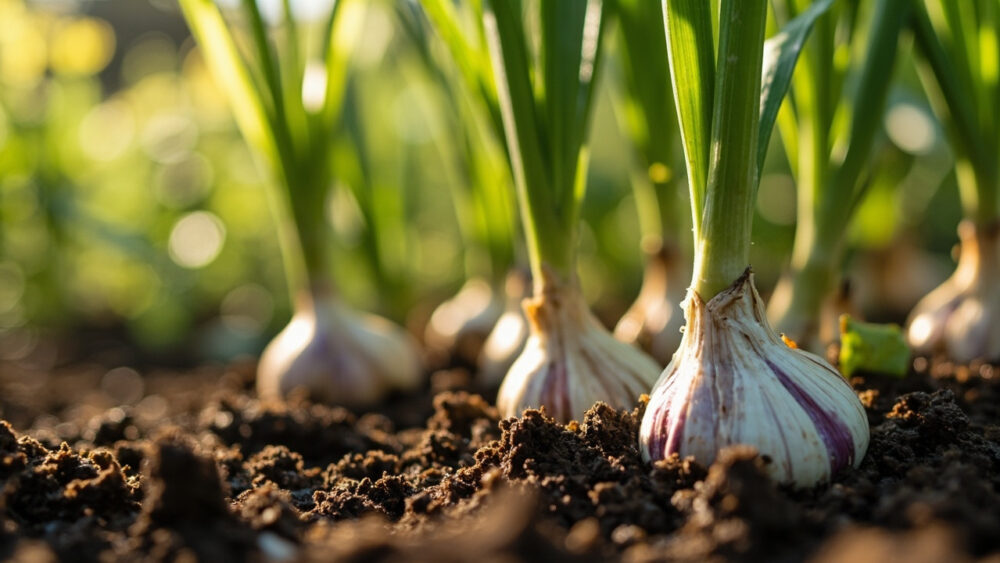
Garlic takes about eight to nine months from planting to harvest, and that surprises most people who click looking for a quicker answer. You plant in fall, the cloves sit through winter doing almost nothing visible, then everything happens fast in late spring. There is no shortcut version where you plant in spring and harvest by summer, not if you want real bulbs.
That eight to nine month range is the honest one, but your actual timeline depends on which type you planted, how cold your winter got, and whether you’re judging by the calendar or by what the plant is actually telling you. Most people misread one specific stage as “nothing is happening” when it is actually right on schedule, and that mistake causes more premature digging than any other single mistake with this crop.
Stick around for the stage-by-stage breakdown and the save-able quick-reference card at the bottom, it has the full timeline plus the qualifiers that change it for your yard specifically.
The Realistic Timeline, Start to Finish
Plant in fall, roughly two to six weeks before your ground freezes hard, so the cloves can grow roots before winter locks things down. In most of the U.S. that lands somewhere in October or November, though warm-winter zones (8 and up) can plant into December or even wait for a short window in early spring instead.
From that fall planting, expect green shoots within two to four weeks, then a long winter pause, then a growth sprint once soil warms in spring. Harvest lands in early to mid summer, so the full span from clove in ground to bulb in hand runs 240 to 270 days.
That is the number to write down, but it is not the whole story.
What Actually Controls the Speed
Variety matters more than most gardeners expect. Hardneck garlic (the type that throws a flower stalk, or scape) generally needs a real cold winter and tends to mature slightly earlier in summer. Softneck garlic, the kind you see braided, skips the cold requirement in warmer climates and often takes a touch longer to bulb up.
Climate is the second lever. A longer, colder winter followed by a fast warm-up in spring pushes bulbing along efficiently. A winter that stays mild and wishy-washy, or a spring that yo-yos between warm and cold, stretches the timeline and can shrink the bulbs too.
Soil and daylight are the third factor, and this is the one people underestimate. Garlic bulbs up in response to increasing day length combined with rising temperature, not just time passed on the calendar.
Get the day-length trigger wrong and no amount of fertilizer fixes it.
Stage by Stage: What You Should Actually See
Weeks 1 to 4 after fall planting: green shoots poke up an inch or two. This is normal and does not mean the plant is rushing toward harvest, it is just establishing roots before cold hits.
Winter: growth appears to stop entirely, sometimes the visible shoot even looks a little rough or yellowed under snow or hard frost. This is the stage everyone misreads as trouble.
It is dormancy, not decline, and digging up a clove to check on it during winter does more harm than leaving it alone.
Early to mid spring: rapid leaf growth resumes once soil hits roughly 40 to 50°F. This is when garlic looks like it is finally “doing something,” and it is, this is the fastest visible growth of the entire cycle.
Late spring: hardneck varieties send up a scape, a curling flower stalk. Many growers snap these off, which redirects energy into the bulb rather than seed production.
Early to mid summer: the lower leaves start browning while the top four to six stay green. That specific ratio, not just “some brown leaves,” is your harvest signal.
Get that ratio right and you’re done for the year.
How to Speed It Up, and What Doesn’t Work
You cannot meaningfully rush garlic, and any product or trick claiming to cut the timeline in half is not telling you the truth. What you can do is remove the things that slow it down unnecessarily.
Plant at the right depth, about 2 inches deep with the pointed end up, in loose, well-drained soil. Compacted or waterlogged soil slows root establishment before winter even starts, and that lost time never fully gets recovered.
Keep weeds down all spring. Garlic has a shallow root system and loses the competition for water and nutrients fast, which shows up as smaller, slower bulbs rather than a faster or slower calendar.
A balanced fertilizer in early spring, right as growth resumes, helps the plant use the lengthening days efficiently, but feeding heavily late in the season just grows leaves at the bulb’s expense.
None of this shortens the eight or nine months, it just makes sure you get a full-size bulb at the end of them.
When Slow Growth Is Normal, and When It’s a Real Problem
If your garlic looks stalled in winter, that is normal. If it looks stalled in the middle of spring, when day length and temperature are both rising and neighboring plants are clearly growing, that is worth investigating.
Common real causes of a spring stall: soil that stayed too wet and rotted the clove (pull one and check, it should smell like garlic, not sulfur or mush), cloves planted too shallow and heaved out by frost, or a planting date so late the roots never established before the ground froze.
A stalled plant with a firm, intact clove usually just needs more warmth and patience. A soft, foul-smelling clove is not coming back, and that bed is better replanted next fall than nursed along.
Here is the part most people get wrong on purpose or by accident, they pull garlic too early because the timeline “feels long,” and an underdeveloped bulb never catches up once it’s out of the ground.
Patience is most of this crop, and the reference card below is what to check instead of the calendar.
Garlic: Quick Reference
- Total time: about 240 to 270 days, roughly 8 to 9 months, from fall planting to summer harvest.
- Planting window: 2 to 6 weeks before your ground freezes hard, typically October to November in most zones, later in warm-winter zones 8 and up.
- Harvest window: early to mid summer, judged by leaf color, not by the calendar.
- Harvest signal: lower leaves browning while the top 4 to 6 leaves stay green.
- Hardneck vs softneck: hardneck needs real winter cold and matures slightly earlier, softneck tolerates milder winters and often takes a bit longer.
- Fastest growth stage: early to mid spring, once soil hits roughly 40 to 50°F.
- Cannot be rushed: bulbing is triggered by day length and temperature together, not by fertilizer or time alone.
Plant it, mostly ignore it over winter, and let the calendar do what it was always going to do.
Come summer, the leaves will tell you exactly when it’s time.