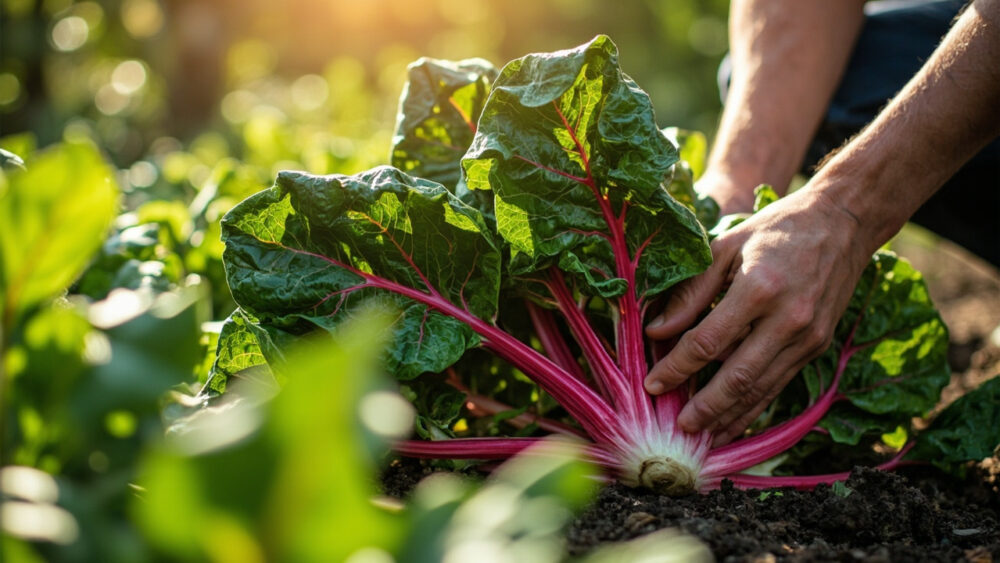
You can start harvesting swiss chard once the outer leaves hit 6 to 8 inches tall, usually 45 to 55 days after plantingand you can keep cutting from the same plants for months if you take outer leaves instead of the whole plant. There is no single “ready” date the way there is with a melon or an onion. Chard rewards you for showing up early and often, and it punishes you in a very specific way if you wait too long, which we will get into.
Most people make one of two mistakes: they either yank whole plants too early because it feels wasteful to cut just a few leaves, or they let the plant get away from them for a month and come back to leaves the texture of a wet paper bag. Both are fixable, and both are covered below.
There is also a sign almost everyone misreads as “the plant is done,” when it usually means the opposite. Stick around for that one, plus the save-able Swiss Chard at a Glance card at the very bottom with every number in one place.
The Real Ready Signs
Chard does not ripen the way a tomato or a squash does. There is no single moment of doneness, just a leaf that is big enough to be worth cutting.
Leaf size
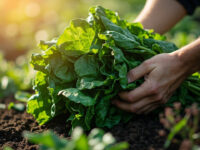
Outer leaves at 6 to 8 inches from the base of the stalk to the leaf tip are ready for a first light harvest. Baby-leaf pickers go even smaller, around 3 to 4 inches, for salad-stage leaves with a milder flavor.
Leaf feel and color
A ready leaf feels firm and a little glossy, not floppy. Color should be deep green (or deep red or purple-red on the ribs, depending on variety), not pale or yellowing at the edges, which usually signals the plant is stressed or hungry rather than ready to bolt.
Stalk thickness
The stalk of a harvest-ready outer leaf is usually about as thick as a pencil to a finger’s width. Thinner than that and it will wilt fast after cutting; give it another week.
Size and feel tell you it is ready, but timing tells you how long that window actually lasts.
The Timing Window, and What Early or Late Costs You
Chard is a cut-and-come-again crop, which means the “harvest window” is really the entire growing season, not a single week. From a spring planting, expect your first cut around 6 to 8 weeks in, then repeat cuttings every 2 to 3 weeks after that for months, sometimes straight through a mild fall and into winter in warmer zones.
Harvest too early and you are not ruining anything, just leaving yield on the table. Tiny leaves are tender but there is not much to them. It costs you volume, not the plant.
Wait too long and the real cost shows up: leaves get tough, ribs turn stringy, and flavor turns bitter, especially once the plant starts pushing up a flower stalk in response to long days and heat. Once chard bolts, leaf quality drops fast and does not come back on that plant.
Here is the sign almost everyone misreads: a tall, thick central stalk shooting up from the crown looks like healthy new growth, but it is actually the plant announcing it is done producing leaves and switching to seed. That is not a leaf to harvest, that is a signal to cut the whole plant back hard or start over.
Catching that stalk early, before it flowers, is the difference between a rescued plant and a lost one.
How to Harvest Without Wrecking the Plant
The technique matters more with chard than with most greens, because a sloppy cut damages the crown the plant regrows from.
- Work from the outside in. Always take the largest, outermost leaves first and leave the small inner leaves and the central growing point untouched.
- Cut, do not pull. Use a clean knife or scissors at the base of the stalk, right where it meets the crown. Pulling can tear the crown and open it up to rot.
- Take no more than a third at a time. Stripping a plant bare stalls it out. Leave at least 4 to 6 healthy inner leaves standing so it can keep photosynthesizing and regrowing.
- Cut in the morning. Leaves are at their crispest and most hydrated before the day heats up, and they will hold longer after cutting.
If a leaf snaps off cleanly with light pressure, it was ready. If you have to saw or tear it, give it more time.
Cutting right is half the job, what you do in the next hour decides how long that harvest actually lasts.
Right After the Cut: Don’t Let It Wilt on the Counter
Chard leaves are mostly water and they know it. Left out in sun or a warm kitchen, they go limp within an hour.
Get leaves into water or a cool spot immediately. A quick dunk in cold water, then a shake dry, firms them right back up if they have gone a little soft on the walk from garden to kitchen.
Do not wash what you are not using right away. Wet leaves stored wet rot faster than dry ones. Wash only what you are about to cook or eat now.
For storage, wrap unwashed leaves loosely in a damp paper towel or cloth, bag them, and refrigerate. They hold well for 5 to 7 days that way. After that, texture starts to go even if the leaves still look fine.
Chard does not can or dry well as a fresh vegetable, but it freezes easily. Blanch for about 2 minutes, cool in ice water, drain, and freeze; frozen chard keeps a good 8 to 10 months and is genuinely one of the easier greens to put up.
Getting that first harvest home safely is one thing, keeping the plant productive for the next three months is the part that actually saves you money.
Keeping the Harvest Coming All Season
A single chard planting, cut correctly, can feed you from early summer through fall, sometimes longer in mild climates. The key is treating it like a perennial cutting garden rather than a one-shot crop.
Feed lightly after every 2 to 3 cuttings. A balanced fertilizer or a side-dress of compost keeps new leaves coming. Chard that is never fed slows down and toughens up fast.
Water consistently, about 1 to 1.5 inches per week. Chard tolerates dry spells better than lettuce does, but drought stress is what pushes it toward bitter flavor and early bolting.
In hot climates, chard often stalls or turns bitter in peak summer heat and picks back up as days cool in fall. That is normal. It is not dying, it is waiting.
If a plant does bolt and send up a flower stalk, cut that stalk out at the base as soon as you see it. Some plants will throw a second flush of edible leaves afterward, though the flavor is usually a step down from the first round.
One more honest note: chard is biennial by nature, meaning a plant that survives a mild winter (zones 6 and warmer with protection, more reliably in zones 7 to 9) will often bolt hard the following spring no matter what you do. At that point it is done and it is time to replant.
Everything above works better once you can see it all in one place, so here is the card.
Swiss Chard at a Glance
- When to plant: 2 to 3 weeks before your last frost for a spring crop, or 6 to 8 weeks before first fall frost for a fall crop, soil at least 50°F.
- Spacing and depth: sow seeds 1/2 inch deep, thin to 6 to 12 inches apart in rows 18 to 24 inches apart.
- First harvest: 45 to 55 days after planting, once outer leaves reach 6 to 8 inches.
- How to cut: take outer leaves only, cutting at the base with a knife or scissors, leaving 4 to 6 inner leaves standing.
- How often: every 2 to 3 weeks through the season, feeding lightly after every 2 to 3 cuttings.
- Storage: unwashed and wrapped damp in the fridge for 5 to 7 days, or blanched and frozen for 8 to 10 months.
- Warning sign: a thick central stalk shooting up means the plant is bolting, cut it out immediately or start over.
Chard forgives almost every mistake except one: waiting too long after that center stalk appears. Cut early, cut often, and one planting will feed you for months.