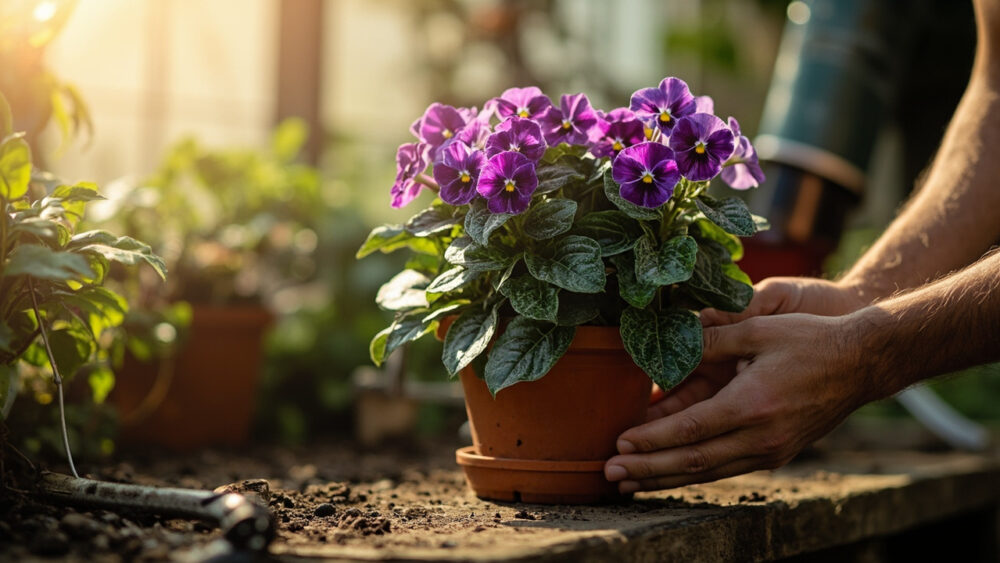
African violets need bright, indirect light for 8 to 12 hours a day, and most homes deliver that with an east or north-facing window, or a spot about 3 feet back from a south or west window. Direct sun through glass will scorch the fuzzy leaves fast, but too little light is the more common killer since a violet just quietly stops blooming and slowly starves. That’s the trap in this whole african violet light requirements question: it isn’t about finding “sun” or “shade,” it’s about finding that narrow bright-but-diffused band in between.
Here’s what most people get wrong before they even start troubleshooting: they assume no blooms means the plant needs fertilizer, when it’s almost always a light problem in disguise. There’s also a sneaky middle-ground failure that looks like too much light but is actually too much heat from a window, and the two get fixed completely differently.
Stick with me and I’ll walk through what “enough light” actually looks like in a real room, how to read the leaves so the plant tells you what it needs, and what changes room to room as the seasons turn. Save-and-forget the at-a-glance card is waiting at the bottom.
How Much Light Does an African Violet Actually Need
African violets are native to shaded, humid forest floors in parts of Tanzania and Kenya, growing under a canopy that filters harsh sun into something soft and constant. That’s the light you’re recreating indoors. They want bright, indirect light, roughly the brightness of a well-lit office, for 8 to 12 hours daily, with darkness at night to trigger blooming.
Direct, unfiltered sun, especially midday summer sun through south or west glass, is too intense and will bleach or burn the leaves within days. But deep shade, the kind found in a windowless hallway or 6 feet back from a small north window, isn’t enough to push blooms even if the plant survives.
The plant genuinely wants that middle zone, and it’s narrower than people expect.
What The Right Spot Actually Looks Like In Your House
Forget lumens and foot-candles for a second. Use your hand.
Hold your hand about a foot above the leaves at midday. If it casts a soft, blurry-edged shadow, that’s the light level you want. A sharp, crisp-edged shadow means the light is too direct and too strong for that exact spot.
In real terms: an east-facing window is close to ideal, especially in the first few hours after sunrise. A north-facing window works if it’s unobstructed and the room stays bright all day. South and west windows deliver plenty of light but need distance, buffer the plant 2 to 4 feet back, or put a sheer curtain between the glass and the leaves.
If you’re using a grow light instead, keep it 8 to 12 inches above the foliage and run it 12 to 14 hours a day on a timer, since artificial light is weaker than people assume and violets under lights tend to need longer exposure than window-grown plants.
Distance and direction matter more than which window you technically have.
The Sign Everyone Misreads: Not Enough Light
If you assumed a light-starved violet just looks sad and droopy, that’s not usually the tell. A violet running low on light often looks perfectly healthy, lush even, and that’s exactly why the problem gets missed for months.
The real signs are quieter. Long, stretched leaf stems reaching toward one direction is the first one, sometimes called legginess. Leaves that are dark green but thin and floppy instead of firm is another.
The biggest tell of all: no flowers, or flowers that are small, sparse, and short-lived even though the leaves look fine. A violet can hold onto healthy-looking foliage for a long time on low light while it simply refuses to bloom.
People blame fertilizer or the pot or the water for this constantly. Move it somewhere brighter first, and watch what happens over the next month before you touch anything else.
The Other Mistake: Too Much Light (And The Heat Trap)
Too much direct light shows up fast and looks different: leaves that are pale, yellowish, or bleached, especially on the side facing the window. Brown, crispy patches or a scorched look on the leaf edges is direct sun damage, usually within days of a plant getting moved somewhere brighter without easing it in.
Here’s the part that trips people up. Sometimes what looks like light damage is actually heat damage from sitting too close to glass that’s radiating warmth, even on a day that isn’t sunny. Leaves can go limp or crispy from heat stress alone, light aside, particularly right against a south or west window in summer.
The fix for true light scorch is more distance or a sheer curtain. The fix for heat stress is simply pulling the plant an inch or two off the glass, since window surface temperature swings more than people expect.
Telling these two apart saves you from making the wrong adjustment and losing another few weeks.
Seasonal Light Changes You Need To Track
The sun’s angle shifts a lot between summer and winter, and a spot that was perfect in July can become too dim by December, or too intense in the opposite way depending on your window direction.
Winter light is weaker and lower in the sky, so a plant that sat comfortably 3 feet back from a south window in summer may need to move closer, sometimes to within a foot or two of the glass, to get the same brightness in winter.
Summer sun coming through the same south or west window is stronger and more direct, so that’s when you pull the plant back or add a sheer curtain buffer.
An east window tends to need the least seasonal adjustment since morning sun stays relatively gentle year-round.
If your violet blooms reliably from spring through fall and stalls every winter, that’s not a mystery, that’s just the seasonal light drop, and it’s fixable.
Placement Fixes That Don’t Require A Greenhouse
You don’t need a sunroom to get this right. A few cheap adjustments cover almost every situation.
Rotate the pot a quarter turn every week so the plant doesn’t grow lopsided and lean permanently toward the window.
Use a sheer curtain as your dimmer switch for a too-bright south or west window rather than moving the plant somewhere dimmer entirely. It cuts intensity without cutting duration.
If natural light is genuinely too weak in your space, a small LED grow light on a timer is a reliable fix and doesn’t need to be fancy or expensive to work.
And if you’re not sure your eyes are judging brightness accurately, a basic light meter app on your phone gives you a rough number to compare spots in your own house, which is more useful than guessing.
Once the light is dialed in, the rest of african violet care gets a lot more forgiving.
African Violet at a Glance
- Light needed: bright, indirect light for 8 to 12 hours a day, never direct midday sun through glass.
- Best windows: east or north-facing directly, south or west-facing from 2 to 4 feet back or behind a sheer curtain.
- Grow light setup: positioned 8 to 12 inches above the leaves, running 12 to 14 hours daily on a timer.
- Sign of too little light: stretched, leaning leaf stems and few or no blooms despite healthy-looking foliage.
- Sign of too much light: pale, bleached, or crispy brown leaf edges, usually on the side nearest the window.
- Seasonal adjustment: move closer to the window in winter, pull back or add a sheer buffer in summer.
- Maintenance habit: rotate the pot a quarter turn weekly to keep growth even on all sides.
If you remember one thing, remember this: a violet with plenty of leaves but no flowers is telling you it wants more light, not more fertilizer.
Fix the light first, and most other African violet problems solve themselves.